

AI Sports Betting: A Practical Guide for Bettors
AI sports betting uses probabilistic models to produce market-grade win probabilities, player prop predictions, and live win rates that bettors can use to identify value against bookmaker lines. The core output is a calibrated probability, not a guaranteed pick. When that probability diverges meaningfully from the implied odds in the market, a positive expected value (EV) opportunity exists. Whether you act on it depends on your staking discipline, your ability to line shop, and your understanding of what the model is actually telling you.
Here is what AI betting outputs typically look like in practice:
- Win probability with confidence band: a percentage estimate (e.g., 58% home win) with an uncertainty range showing how much the model trusts its own estimate
- EV flag: a signal that the model’s probability implies a better price than the posted line (e.g., EV > 1.05)
- Suggested stake: a fractional-Kelly recommendation, usually 0.1–0.3 of full Kelly, to limit variance
- Short rationale or feature attribution: which inputs drove the prediction (recent form, injury status, pace matchup)
- Confidence score: a composite signal indicating how much historical data supports the current setup
AI output is most actionable when EV exceeds 1.05, the model’s calibration metrics are disclosed, and you can shop the line across at least two sportsbooks before placing the bet.
Table of Contents
- What does “AI sports betting” actually mean for bettors?
- How AI models for sports betting are built
- What types of AI betting tools are available?
- What practical benefits can AI provide bettors?
- What are the real limits and risks of AI in sports betting?
- How to use AI outputs responsibly
- How to vet an AI sports betting service before subscribing
- Mannysvariety: how the AI approach works and what the track record shows
- Key Takeaways
- The part most bettors get wrong about AI picks
- Mannysvariety gives you a verifiable starting point
- Useful sources and further reading
What does “AI sports betting” actually mean for bettors?
The term covers a broad product category. At its core, AI sports betting refers to services that use machine learning models to produce structured predictions bettors can act on, rather than relying on human handicappers alone. The practical outputs vary by product type, but the underlying logic is consistent: ingest data, build a probability estimate, compare it to market odds, and flag value.
Sports analytics frameworks recommend combining structured data (team and player statistics), market data (line movement, public betting percentages), and situational factors (weather, injuries, rest days) to form evidence-based decisions. In a commercial AI service, that process runs automatically across hundreds of games per day.
What bettors actually receive depends on the platform:
- Prediction engines: raw probability outputs for spreads, moneylines, and totals, often with calibration metrics attached
- Pick feeds: curated daily selections with suggested stakes, delivered via email, mobile alert, or web dashboard
- Prop analyzers: micro-models focused on player statistics (receiving yards, strikeouts, assists) where market inefficiencies tend to be larger
- Live win probability streams: real-time updates that recalculate as game events unfold, useful for in-play betting
- Line-shopping integrations: tools that compare the model’s implied price against live odds across multiple sportsbooks
Pro Tip: When evaluating any AI picks service, ask whether the probability output is calibrated or just a raw model score. A raw score tells you the model’s ranking; a calibrated probability tells you the actual likelihood, which is what staking systems like Kelly require.
Industry-grade platforms run large-scale simulations to deliver pregame and live win probabilities that update continuously as the game state changes. That simulation depth is what separates a serious prediction engine from a basic statistical model.
How AI models for sports betting are built
Understanding model architecture helps bettors evaluate provider claims and spot red flags. A well-built AI betting model has three distinct layers: data ingestion, feature engineering, and a decision layer that converts probabilities into wagers.
Data ingestion pulls from historical game logs, player tracking data, injury reports, weather feeds, and market odds. The market odds layer is particularly important. Fused models that combine market-derived features with non-market data often outperform either component alone, with one study achieving an AUC of 0.951 and a substantially better Brier score than market-only or non-market-only variants. The market encodes sharp-money information; ignoring it leaves signal on the table.

Feature engineering transforms raw inputs into predictive variables: rolling form windows (last 3, 5, and 8 games), opponent-specific defensive ratings, spatial embeddings from shot-chart data, and situational flags like back-to-back games or travel distance. Model families used in practice include gradient-boosted trees (XGBoost, LightGBM) for tabular data, recurrent networks (LSTM, GRU) for sequential form, and convolutional architectures for spatial shot data.
Uncertainty quantification is where serious models separate from basic ones. Techniques like Monte Carlo dropout, Bayesian ensembles, and ensemble variance allow a model to express not just a probability but how confident it is in that probability. Research on uncertainty-aware NBA forecasting shows that pairing these techniques with fractional-Kelly staking and EV thresholds produces a positive equity curve on moneylines in less-efficient market segments.
The decision layer converts probabilities into bet recommendations:
- EV threshold: only flag bets where the model’s implied price exceeds the posted odds by a minimum margin (e.g., EV > 1.1)
- Fractional-Kelly sizing: cap bet size at 0.1–0.3 of full Kelly to limit variance without sacrificing long-run edge
- Odds cap: exclude bets where the line has moved past a threshold, indicating the market has already priced in the edge
- Bet filters: remove low-sample-size matchups or games with missing injury data
Pro Tip: Calibration matters more than raw accuracy. Selecting models by calibration produced average returns of +34.69% versus -35.17% when models were selected by accuracy alone. A model that is poorly calibrated will break Kelly-based staking systems even if it achieves the platform-reported 63.5% win rate.
Calibration vs. accuracy: A model that predicts 70% win probability should win roughly 70% of the time in that scenario. If it wins only 55%, the model is overconfident and your Kelly stakes will be too large, accelerating drawdowns even when the model has genuine edge.
What types of AI betting tools are available?
The market for AI-driven betting tools has expanded significantly as investment in AI infrastructure reshapes what commercial services can deliver. Bettors now have access to several distinct product categories, each suited to a different use case.
| Tool Type | Best For | Typical Packaging |
|---|---|---|
| Prediction engine | Modelers who want raw probabilities | API feed, CSV export |
| Pick service | Casual bettors who want curated selections | Daily email, web dashboard |
| Prop analyzer | Value seekers targeting player markets | Web app, mobile alerts |
| Live probability stream | In-play bettors | Real-time web or API |
| Line-shopping aggregator | Bettors with multiple sportsbook accounts | Browser extension, web app |
| Slip automation tool | High-volume bettors | API or mobile integration |
- Prediction engines give modelers direct access to probability outputs. They require the user to apply their own staking logic and line-shopping process. Best for bettors comfortable reading calibration metrics.
- Pick services package the model’s output into a curated daily list with suggested stakes. The provider handles model selection and EV filtering; the bettor executes. Best for bettors who want data-driven guidance without building their own model.
- Prop analyzers focus on player-level micro-markets where bookmaker lines are often set using simpler methods. These markets tend to be less efficient than game-level spreads, making them a productive target for AI models with rich player-tracking data.
- Live probability streams update win probability as game events occur, flagging in-play EV opportunities. Execution speed matters here; latency between the model update and bet placement can eliminate the edge entirely.
- Line-shopping aggregators compare the model’s implied price against live odds at multiple sportsbooks. Even a half-point improvement on a spread or a few cents on a moneyline compounds meaningfully over a full season.
What practical benefits can AI provide bettors?
AI tools offer four concrete advantages over manual handicapping, each tied to a specific limitation of human analysis.
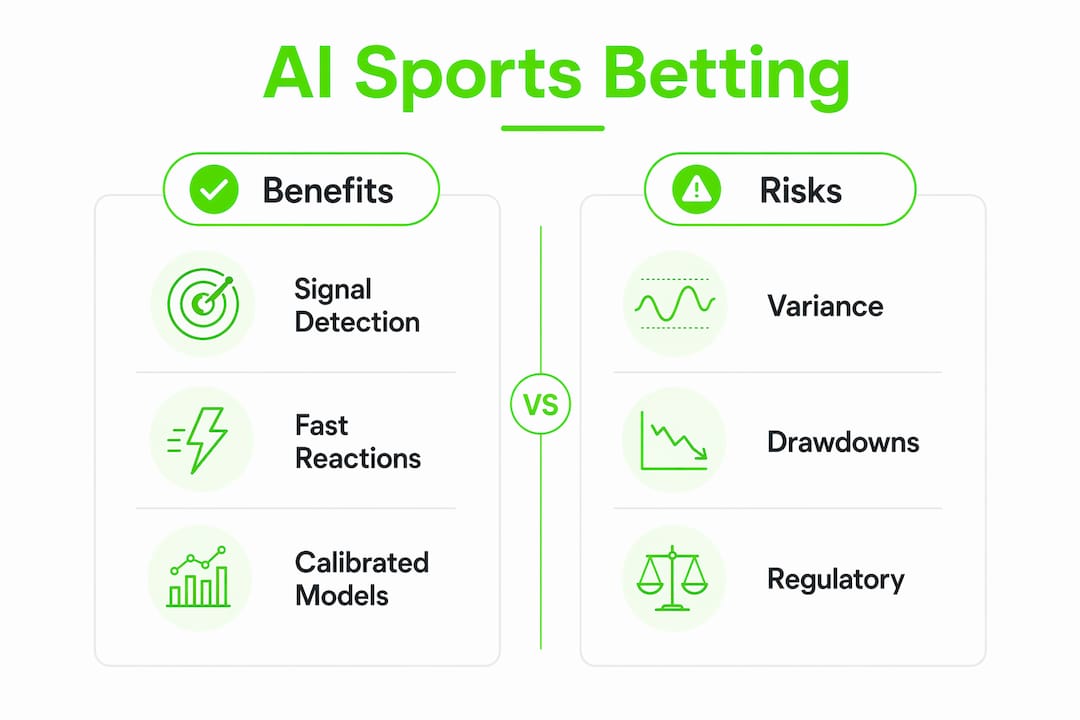
Signal detection in less-efficient markets. Major-league spreads and totals are priced by sharp money and sophisticated bookmaker models. The edge available there is thin. Player props, niche leagues, and early-week lines tend to be less efficient, and AI models with granular player-tracking data can identify persistent small edges that manual analysis misses.

Faster reaction to live game events. A human bettor watching a game can recognize when a key player is injured or a team’s pace has shifted, but quantifying the probability impact in real time is not feasible manually. AI systems recalculate win probability continuously, surfacing in-play EV opportunities within seconds of a game event.
Scale across markets. A single bettor can realistically analyze a handful of games per day. An AI model can process every game across every major U.S. sport simultaneously, running tens of thousands of simulations per matchup to surface rare-value setups that would never appear in a manual review.
Behavioral discipline. Bettors who rely on gut feel tend to chase losses, overbet after wins, and ignore variance. A calibrated probability with a suggested fractional-Kelly stake removes some of that emotional noise by anchoring decisions to a specific number rather than a feeling.
Combining deep learning forecasts with portfolio theory can materially improve returns while controlling risk, treating a day’s bets as a portfolio rather than a series of independent coin flips.
What are the real limits and risks of AI in sports betting?
No AI tool eliminates variance, and expert practitioners are clear that long-term compounding of small edges with disciplined bankroll management creates returns, not single wagers. Understanding where AI fails is as important as understanding where it helps.
Variance and drawdowns. Even a well-calibrated model with genuine edge will produce losing streaks. A model winning 55% of bets will lose 10 or more in a row at some point over a full season. Staking discipline during drawdowns is the primary reason profitable models fail for amateur users.
Market efficiency in major markets. NFL spreads and NBA totals are among the most efficiently priced markets in the world. The exploitable edge in these markets is small and shrinks further as more AI tools chase the same signals. Props and niche markets offer more room.
Model and data risks:
- Overfitting: a model trained on a small sample of seasons may perform well in backtesting but fail on new data
- Survivorship bias: published backtests often exclude the losing models and losing seasons
- Stale features: injury data, lineup changes, and weather updates that arrive after model training can make a prediction obsolete before the game starts
- Garbage in, garbage out: low-quality or incomplete data produces unreliable probabilities regardless of model sophistication
Operational risks:
- Latency: odds move fast; a pick that was EV-positive at 10:00 AM may be EV-negative by 10:05 AM
- Account restrictions: sportsbooks in the U.S. routinely limit or close accounts that consistently beat closing lines
- Fraud: services promising guaranteed returns, 80%+ win rates with no disclosed methodology, or no verifiable pick history are red flags
| Risk Type | Mitigation |
|---|---|
| Variance / drawdown | Fractional-Kelly sizing (0.1–0.3); flat-unit tracking |
| Overfitting | Ask for out-of-sample backtest results and sample size |
| Stale data | Confirm the provider updates features within hours of game time |
| Latency | Use platforms with mobile alerts or API delivery |
| Fraud | Require a permanent, verifiable pick archive before subscribing |
AI picks services are legal in most U.S. states, but sportsbook terms and state gambling laws vary by jurisdiction, so confirm the rules in your state before using any service.
This article is general information, not legal or financial advice. Verify current regulations with your state’s gaming authority or a qualified professional.
How to use AI outputs responsibly
Turning AI predictions into disciplined, testable bets requires a defined process. The following sequence applies whether you are using a prediction engine directly or following a curated pick service.
- Validate model calibration. Before committing real money, ask the provider for calibration metrics: Brier score, Expected Calibration Error (ECE), or a reliability diagram. If none are available, treat the service as unverified. Run a paper-betting trial of 30–50 wagers to observe whether stated win rates hold.
- Set EV and confidence thresholds. Only act on picks where the model’s implied probability exceeds the posted odds by your minimum margin (e.g., EV > 1.05). Set a confidence floor below which you skip the pick regardless of EV.
- Apply fractional-Kelly staking caps. Use 0.1–0.3 of full Kelly per bet. Full Kelly is theoretically optimal but produces drawdowns most bettors cannot sustain behaviorally. Fractional sizing limits variance without sacrificing long-run edge.
- Line shop and account for vig. The model’s EV calculation assumes a specific price. If the best available line is worse than the model’s assumed price, the EV may disappear. Check at least two sportsbooks before placing every bet. Evaluation strategies used by disciplined traders apply directly here: define your entry criteria before you see the line, not after.
- Track every bet and update assumptions. Log the pick, the model’s stated probability, the odds taken, and the result. After 50–100 bets, calculate your actual win rate against the model’s predicted win rate. If they diverge significantly, the model may be miscalibrated for your market or bet type.
- Adjust and iterate. If calibration holds but returns are flat, the issue is likely vig and line quality. If calibration is off, revisit the model’s data sources and feature freshness.
Pro Tip: Run a paper-betting evaluation for at least two weeks before committing real bankroll to any new AI service. Track not just wins and losses but whether the model’s stated probabilities match actual outcomes. That calibration check tells you more than any marketing claim.
How to vet an AI sports betting service before subscribing
The quality gap between AI picks services is wide. A rigorous vetting checklist protects bettors from paying for a service that cannot deliver what it claims.
- Permanent pick archive with verifiable grading. The provider should publish every historical pick with date, sport, line taken, result, and units won or lost. Archives that can be edited or deleted after the fact are not verifiable. Look for a public-facing record with a clear methodology for how units are calculated.
- Disclosed calibration metrics. Brier score, ECE, and calibration plots are the standard measures. A provider that reports only win rate without calibration data is hiding the most important number.
- Sample size transparency. A 70% win rate over 20 picks is statistically meaningless. Ask for the total pick count, the number of seasons covered, and whether the backtest is in-sample or out-of-sample.
- Trial period or refund policy. A legitimate service offers a risk-free way to evaluate performance before a full subscription commitment. A free trial with limited features or a short-term day pass lets you verify the product before paying for it.
- Execution speed and delivery format. Picks delivered hours before game time with no mobile alert are difficult to act on at the best available line. Confirm whether the service offers API access, push notifications, or a live dashboard.
- Methodology documentation. A credible provider publishes at minimum a summary of its model inputs, update frequency, and staking methodology. A full methodology paper is a strong trust signal. Performance optimization principles from disciplined trading apply equally here: the process must be documented and repeatable, not a black box.
- Accessible support. Clear FAQ, responsive customer service, and documentation on model behavior for edge cases (postponed games, late scratches) indicate a professionally operated service.
Mannysvariety: how the AI approach works and what the track record shows
Mannysvariety is an AI-powered sports betting platform built around sport-specific predictive engines covering NBA, MLB, NFL, NHL, PGA, MMA, Soccer, and international tournaments. The platform delivers daily pick reports, player props, parlays, and fantasy football tools through a subscription model with tiered Core and Elite plans, plus short-term day and week passes.
Platform-reported performance figures (as stated by Mannysvariety):
- Win rate: 63.5%
- Total tracked picks: over 1,600
- Net return: 443.9 units
These figures are platform-reported. Bettors should verify them directly through the public pick archive, which stores every historical pick with permanent grading.
The methodology behind Mannysvariety’s picks includes:
- Sport-specific models: separate predictive engines for each sport rather than a single generalist model, which allows feature sets to be tuned to sport-specific dynamics (pace in NBA, pitching matchups in MLB, weather in NFL)
- Thousands of simulations per matchup: Monte Carlo simulation runs to generate probability distributions rather than point estimates, producing confidence bands alongside each pick
- Fractional-Kelly decision layer: stake recommendations sized moderately to limit variance while aiming to preserve long-run edge
- Backtesting with disclosed windows: historical performance tested against published odds, not hypothetical lines
Pro Tip: When reviewing Mannysvariety’s archive, check whether the win rate holds consistently across sports and seasons, not just in aggregate. A 63.5% overall rate that is driven by one sport in one season tells a different story than one distributed across multiple sports and years.
Trust signals to look for on any provider page: a permanent, uneditable pick archive; third-party or independently verifiable grading; disclosed sample size by sport; and a trial or refund option. Mannysvariety’s pricing page lists current subscription tiers and trial options for bettors who want to evaluate the service before committing.
Key Takeaways
AI sports betting tools produce calibrated probabilities and EV signals that can reveal genuine value, but only when paired with disciplined staking, verified calibration, and consistent tracking.
| Point | Details |
|---|---|
| Calibration beats accuracy | Selecting models by calibration produced +34.69% returns vs. -35.17% for accuracy-selected models. |
| Use fractional-Kelly sizing | Cap bet size at 0.1–0.3 of full Kelly to survive drawdowns without abandoning edge. |
| Validate before committing | Paper-bet 30–50 wagers or use a trial period to confirm calibration holds on live data. |
| Track every bet | Log model probability, odds taken, and result; compare predicted vs. actual win rates after 50+ bets. |
| Mannysvariety | Platform-reported 63.5% win rate across 1,600+ tracked picks with a permanent public archive for verification. |
The part most bettors get wrong about AI picks
There is a common pattern among bettors who subscribe to an AI picks service and then quit after two losing weeks: they treated the picks as a guarantee rather than a probability distribution. A model that wins 63.5% of the time will lose 36.5% of the time. Over any short window, that losing percentage can cluster. That is not model failure. That is variance behaving exactly as it should.
The more consequential mistake is skipping the calibration check entirely. Most bettors evaluate a service by its win rate. The research is unambiguous that calibration is the metric that actually predicts economic returns. A service with a 58% win rate and tight calibration will outperform a service with a 65% win rate and poor calibration over a full season, because the staking system built on the calibrated model will size bets correctly and survive the inevitable drawdowns.
Mannysvariety’s approach of publishing a permanent pick archive helps bettors verify historical picks and performance before subscribing. That transparency is the baseline any serious AI picks service should meet. Services that cannot or will not show you a verifiable historical record are asking you to trust marketing copy instead of data.
The practical lesson: treat any AI picks service as a hypothesis to be tested, not a subscription to be trusted. Run the trial, track the calibration, and only scale your stakes when the data supports it.
Mannysvariety gives you a verifiable starting point
Most bettors spend more time picking a sportsbook than evaluating the quality of the picks they act on. Mannysvariety flips that priority. The platform’s sport-specific AI engines cover NBA, MLB, NFL, NHL, PGA, MMA, Soccer, and international tournaments, delivering daily pick reports, player props, parlays, and fantasy tools backed by a publicly accessible pick archive with over 1,600 tracked picks and a platform-reported 63.5% win rate.
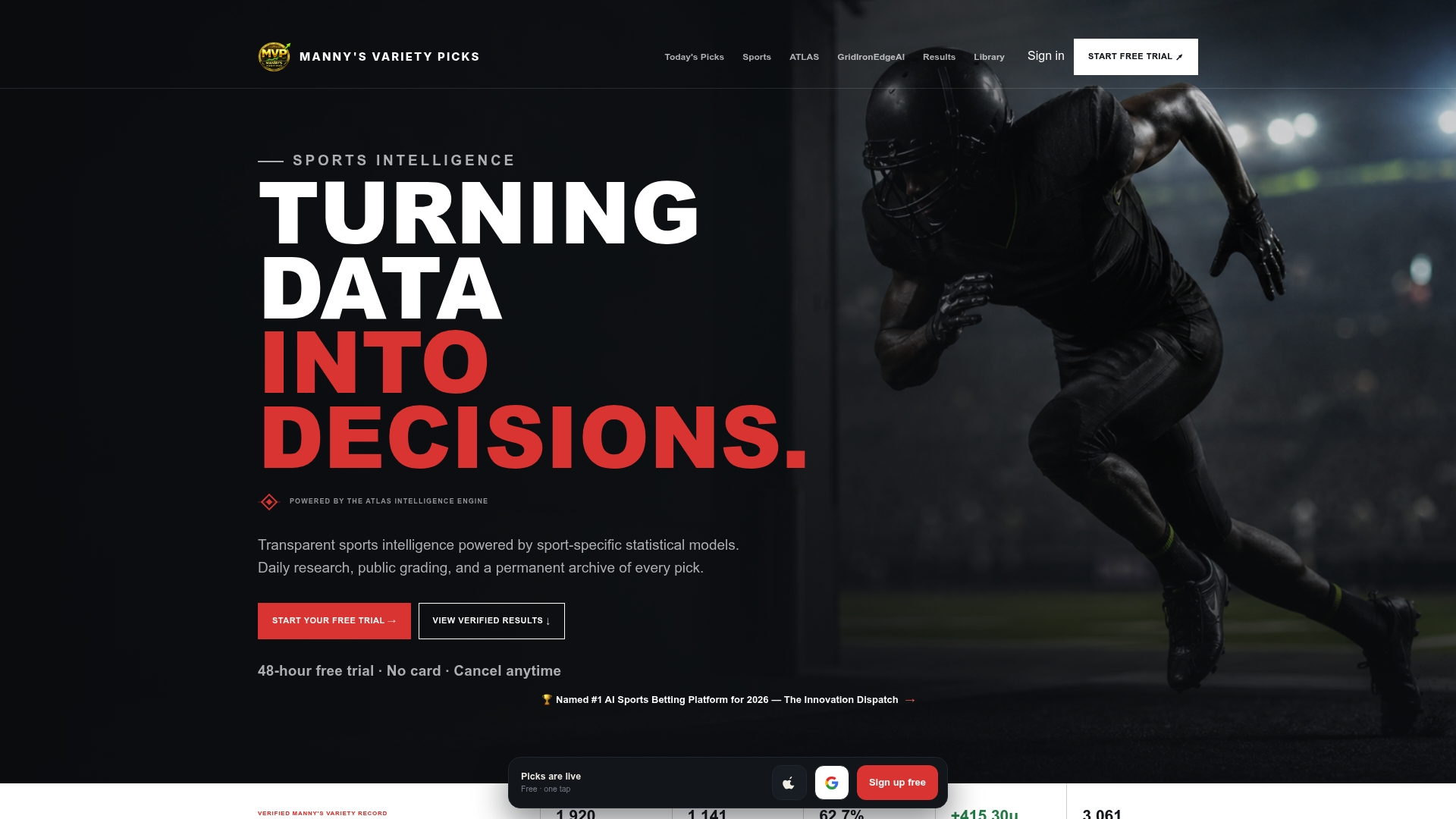
The difference from a generic picks service is the permanent archive. Every pick Mannysvariety has ever published is logged with its result and units returned, giving new subscribers a real dataset to evaluate before committing to a full plan. The platform-reported net return of 443.9 units is a specific, traceable claim, not a marketing range.
For bettors ready to test the service, the recommended first step is a short trial: use the picks alongside the tracking process described earlier, log model probability against actual outcomes, and assess calibration over 30–50 wagers. View current pricing and trial options to find the plan that fits your betting volume, or browse the pick archive to review historical performance before signing up.
Useful sources and further reading
The claims in this article draw on peer-reviewed research, industry methodology pages, and sports analytics guides. The table below identifies the most relevant sources for bettors who want to verify technical claims or go deeper on methodology.
| Source | Why It Matters |
|---|---|
| Machine learning for sports betting: calibration vs. accuracy | Peer-reviewed study showing calibration-selected models return +34.69% vs. -35.17% for accuracy-selected models on NBA data |
| Uncertainty-Aware ML for NBA Forecasting | Demonstrates MC-dropout and fused market/non-market features improve calibration and produce positive equity curves with fractional-Kelly |
| Opta Predictions / StatsPerform | Industry benchmark for simulation-based pregame and live win probability models |
| Sports Betting Analytics — RG | Practical guide to combining structured data, market data, and situational factors for evidence-based betting |
| Neural networks and portfolio theory in sports betting | Research integrating deep learning with portfolio optimization to improve returns and control risk |
When evaluating any source, prioritize studies that report out-of-sample results, disclose sample size by season, and include calibration metrics alongside accuracy figures. Backtests that report only win rate without calibration data should be treated with caution, regardless of how impressive the headline number looks.