

NFL Bettors: 6 Steps to Verify Consensus and AI Picks With Records
Favor independently validated AI signals for finding real edge, and treat public consensus as market context rather than a betting decision. AI models process more variables than any human panel and, when properly tracked, publish results you can verify. Before you follow either one, demand a transparent archive and a real sample size. The checklist below shows how to combine both signals into a single, defensible wager.
TL;DR:
- Rely on AI predictions from multiple independent models, especially when they show high agreement and a favorable line move against public betting trends.
- Use consensus data primarily to observe market sentiment and spot reverse line movements, but do not base bets solely on crowd behavior or media hype.
- Always verify AI providers’ track records with transparent archives, large sample sizes, and sport-specific models to distinguish genuine edges from marketing claims.
- Avoid betting when AI agreement is absent, consensus data is thin, or breaking news causes rapid line shifts that neither signal can effectively process.
- Prioritize bets where AI consensus aligns with market movement, and size your wagers proportionally to the confidence level indicated by multiple independent signals.
Table of Contents
- What Consensus Picks Mean in Sports Betting
- How AI Prediction Models Actually Work
- Consensus vs AI: Strengths, Weaknesses, and Failure Points
- Building a Betting Rule Set: Combining Both Signals
- What a Trustworthy AI Provider’s Track Record Should Look Like
- Your 6-Step Pregame Decision Checklist
- The Real Gap Between What Bettors Are Told and What Actually Works
- Get AI-Backed Picks With a Real Track Record Behind Them
- Sources
What Consensus Picks Mean in Sports Betting
Consensus, in betting terms, measures how the public is wagering on a game. It’s typically expressed as ticket count (the percentage of bets placed on a side) and money percent (the percentage of total dollars wagered on that side). Sportsbooks and public data services track this in real time and publish it alongside the spread, moneyline, and total. This data usually shapes how oddsmakers move betting lines, since a lopsided ticket count on one side can push the number even when the money percent tells a different story.
Consensus matters because it reveals where the crowd is leaning and, more importantly, where sharp money disagrees with that crowd. A classic signal is a line moving against the majority of tickets. That usually means professional bettors are betting the other side in bigger amounts.
Consensus data has real limits, though:
- Herd behavior can push a line based on name recognition or media hype rather than matchup facts.
- Public bettors react late to injury news, so early consensus numbers can be stale by kickoff.
- Popular teams generate correlated public mistakes, where thousands of bettors make the same reasoning error at once.
Consensus tells you what the crowd believes. It doesn’t tell you whether the crowd is right.
How AI Prediction Models Actually Work
AI-driven predictions come from models trained on historical results, advanced efficiency metrics, injury reports, weather data, roster changes, and situational factors like rest days or travel distance. A single model outputs a probability for each outcome. Multiple independent models running on the same matchup produce what’s called an AI consensus prediction, a distinct concept from public betting consensus.
Aggregation typically happens one of two ways:
- Majority vote, where each model casts a pick and the most common answer wins.
- Averaged probabilities, where individual confidence scores are blended into one weighted number.
Both methods reduce the risk of any single model’s blind spot dominating the final pick, though multi-model agreement still needs checking for correlated training data and overfitting. If every model learned from the same historical dataset, they can all make the identical mistake at once, just with more confidence than one model alone would show.
Pro Tip: A high agreement score across models is a stronger signal than any single model’s confidence percentage. If three independent engines land on the same side through different methods, that’s more meaningful than one model rating a pick at 90% confidence.
AI tends to find edges in complex, multi-variable situations, like how a defense’s pass rush efficiency interacts with an offensive line missing a starter. It tends to fail on rare events; a coaching change mid-season or a freak weather system that has no real historical comparison.
Consensus vs AI: Strengths, Weaknesses, and Failure Points
Public consensus and AI-driven predictions solve different problems, and knowing which one to trust starts with knowing what each is actually built to detect.
- Consensus wins at reading market behavior. It shows you where money is flowing and how sportsbooks are reacting, which is useful for spotting reverse line movement, one of the clearest signs that sharp bettors disagree with the public.
- AI wins at processing volume and consistency. A model doesn’t get tired, doesn’t chase a hot streak, and applies the same logic to game 200 of the season as it did to game one. This makes AI stronger for spotting statistical overlays the public simply doesn’t calculate.
- Both fail together on breaking news. A star running back ruled out 45 minutes before kickoff moves faster than most public consensus data updates and faster than many AI models can reprocess. Neither signal is reliable in that window unless the provider explicitly rebuilds picks after news breaks.
- Both struggle with low-sample props. A rookie’s first career start as a starting quarterback gives an AI model almost no relevant historical data on that player, and gives the public almost no informed opinion either, just name recognition.
- Overnight line moves separate the two clearly. If a stadium is expecting a sudden weather shift and the line moves two points overnight, that’s often sharp money reacting to something the AI model already priced in from weather data, while the public consensus percentage may not shift until the following morning.
Building a Betting Rule Set: Combining Both Signals
The most reliable approach treats AI-driven predictions as the primary edge and public consensus as a market check, not the other way around.
Start with this rule: prioritize picks where independent AI models agree and where that provider has a verified historical edge over a meaningful sample. Use consensus data second, as a lens for understanding line movement and spotting public mispricing.
Size your bets based on how confident the signal actually is, not on gut feeling:
- High model agreement plus a favorable line move against the public: full recommended unit size.
- Model agreement present but consensus data conflicts: reduce stake and treat it as a smaller, uncertainty-adjusted bet.
- No AI agreement and thin consensus data: skip the game entirely rather than force a bet.
Pro Tip: Before trusting any AI provider’s picks, ask for three things: a public archive of past picks, the sample size behind their stated win rate, and whether their model is sport-specific rather than a generic all-sports engine. Reliable betting analysis outlets emphasize testing frameworks and verified sportsbook data precisely because top-line win-rate claims without an archive are unverifiable.
A practical example: your NFL player props research shows an AI model favoring a receiver’s reception total and the consensus data shows the public heavily on the over. If the line hasn’t moved despite that public volume, sharp money likely agrees with the AI. If the line has already drifted to match the public, the value may be gone.
What a Trustworthy AI Provider’s Track Record Should Look Like
A trustworthy AI provider should publish a tracked record of graded picks with a strong win rate and positive net return, ideally using sport-specific AI engines and numerous simulations per matchup across main sports like NFL, NBA, and MLB. That level of detail is the standard every AI provider should be held to, not the exception.
Why these specific numbers matter:
- A sample size above 1,600 picks is large enough to separate a genuine edge from a short hot streak.
- A published unit return, not just a win percentage, shows actual profitability rather than a flattering but hollow record.
- Sport-specific engines matter because an NFL model built on NFL-specific inputs outperforms a generic all-sports model trying to cover every league with one set of assumptions.
- Publishing an archive that anyone can check against results after the fact is what separates a credible provider from a marketing claim.
Comparable industry research on expert versus AI predictions found that panels and models often agree on the same top picks but diverge sharply on value bets, exactly the gap a transparent archive is meant to expose.
Your 6-Step Pregame Decision Checklist
- Check injury reports and news timestamps against when the pick or consensus data was published.
- Confirm whether multiple AI models agree on the pick, and check the provider’s published track record.
- Compare the public betting percentage against actual line movement to spot reverse line moves.
- Estimate your confidence level and size the stake accordingly rather than betting a flat amount every time.
- Watch for red flags: a provider citing one win-rate number with no archive, no sample size, and no dated history.
- If the evidence is thin on both sides, skip the bet. A missed game costs you nothing; a forced one can cost real money.
The Real Gap Between What Bettors Are Told and What Actually Works
Most betting content treats this as a binary choice, consensus or AI, as if one signal should always win. That framing misses the point entirely. Consensus data tells you where money and attention are flowing. AI tells you what a model, stripped of crowd psychology, thinks the numbers actually support. Treating them as competitors rather than complementary tools is where most recreational bettors go wrong.
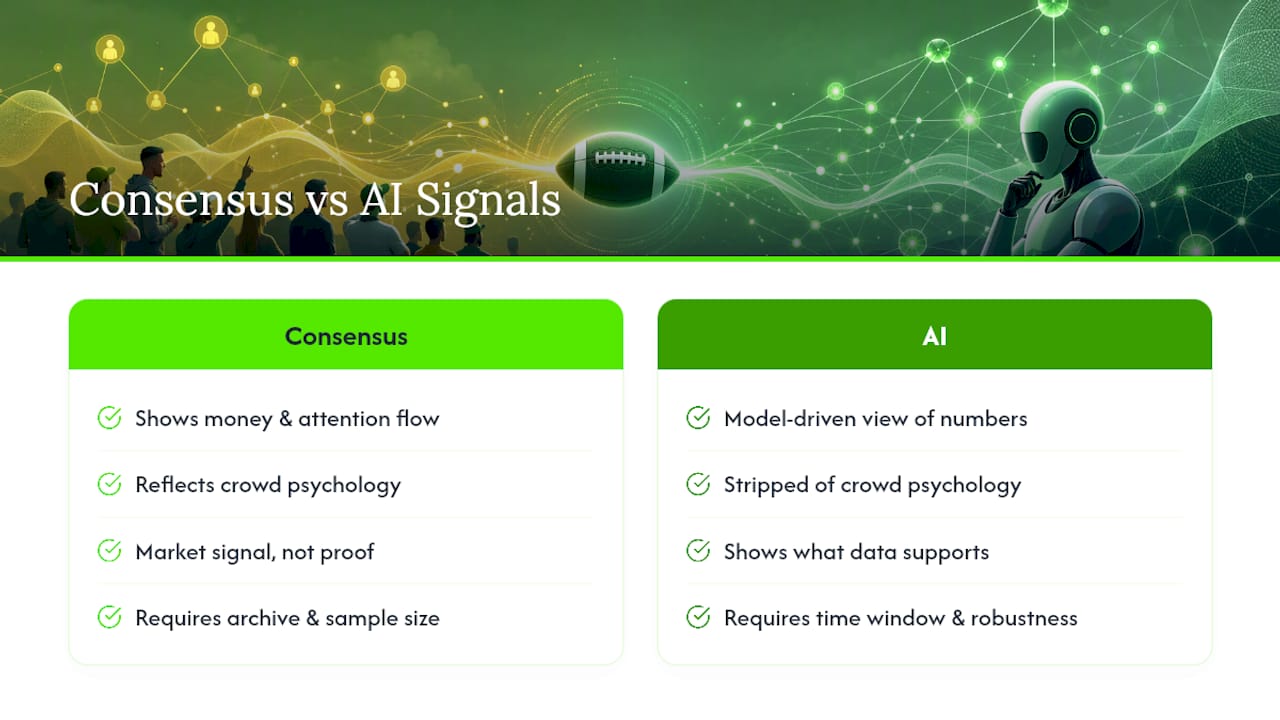
The bigger failure I see in typical betting advice is the obsession with win rate as a standalone number. A 63% win rate means very little without knowing the sample size, the time window, and whether the model held up across different game scripts and seasons. Bettors should prioritize verification over confidence. Ask any provider, AI-driven or not, to show their work before trusting their picks with real money.
What should change first is simple: stop treating a hot streak as proof of skill. Demand an archive. Demand a sample size. The rest of the decision becomes much easier once you’re only comparing signals that can actually be checked.
— Manuel
Get AI-Backed Picks With a Real Track Record Behind Them
Comparing consensus data and AI models is useful, but most bettors don’t have time to run that comparison before every kickoff. Some platforms offer sport-specific AI engines running thousands of simulations per matchup alongside a public archive covering a substantial number of graded picks.
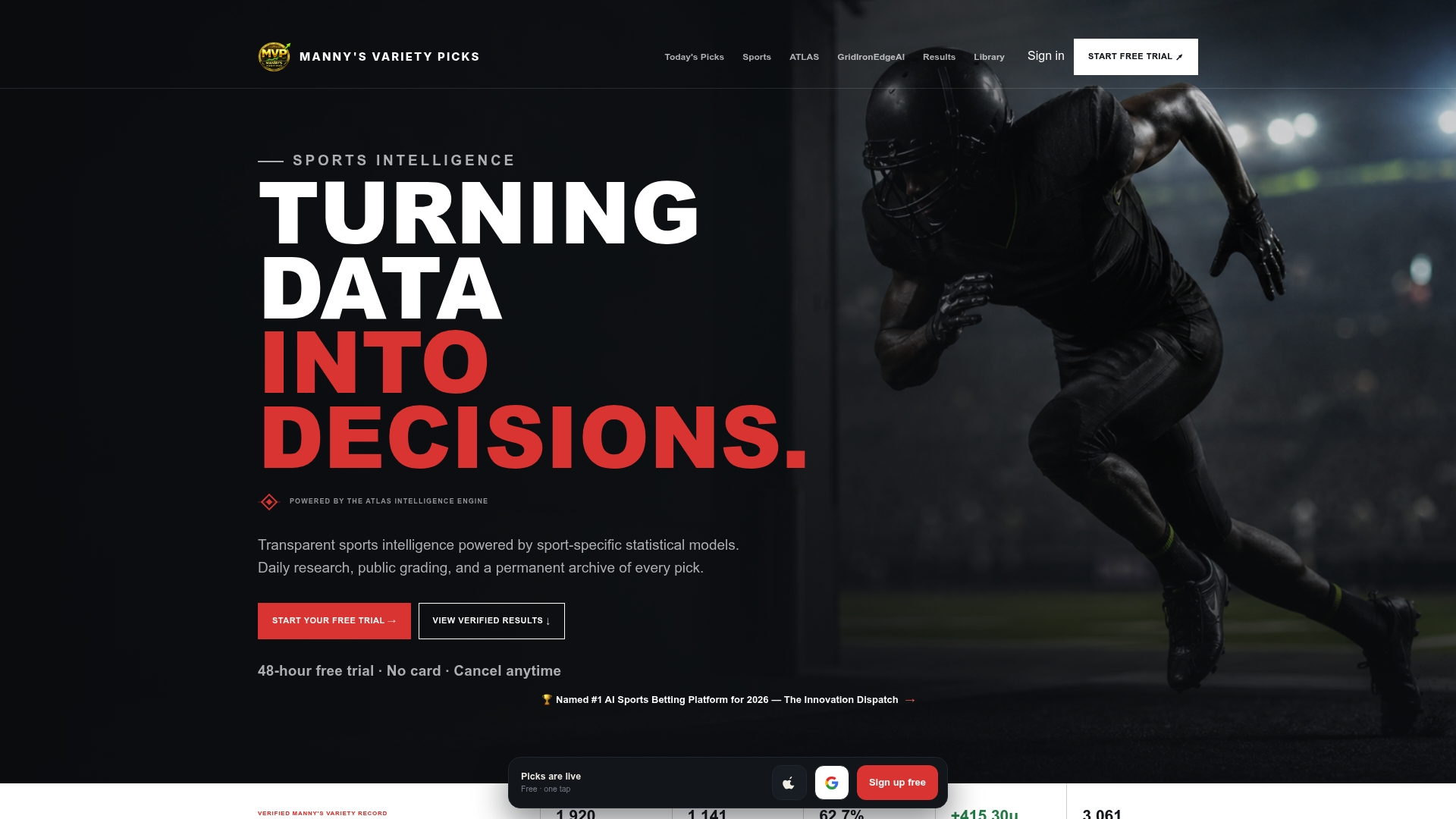
That’s the practical advantage over piecing together public betting percentages from one site and unverified AI claims from another: one platform, one transparent history, and picks you can check against results after the fact rather than taking on faith. The live in-game picks tool applies the same model logic in real time as news breaks, which matters given how fast injury reports can outrun both consensus data and static AI output. For a deeper look at the underlying process, the Fantasy Sports Betting Workflow guide is a useful companion resource on combining data sources into a single workflow.
See how Mannysvariety’s approach works and check today’s NFL slate before your next wager.
Sources
- 2026 Kentucky Derby Picks: Experts vs AI | FanDuel Research
- Covers
- Action Network: Sports Betting Odds, News, Insights, & Analysis