

Break Even at 4–8 Visits: Day Pass vs Subscription for U.S. Coworking
If you plan to use a coworking space fewer than four days a month, a day pass almost always costs less. Once you’re in at eight or more days a month, or you need regular meeting-room access, a subscription usually wins on price and convenience. The gray zone between those two numbers is where the real math happens, and the break-even calculation later in this piece shows exactly how to run it with your own numbers.
TL;DR:
- Using a coworking space fewer than four days a month typically makes a day pass the cheaper option.
- Once visiting around nine days or more monthly, a subscription usually provides better value and convenience.
- Including meeting-room credits and other extras in subscriptions can significantly lower their effective cost, influencing the break-even point.
- Tracking actual usage over 30 days helps determine whether a day pass or subscription suits your work pattern better.
- Factors like travel costs, booking fees, and access hours should be considered when comparing options to avoid hidden expenses.
Table of Contents
- Day Pass vs Subscription: What You’re Actually Buying
- How to Calculate Your Real Break-Even Point
- Why a Day Pass Can Be the Smarter Move
- Why a Subscription Can Be the Smarter Move
- A Practical Checklist for Choosing Between Them
- Two Worked Examples That Show the Math in Action
- Why Switching Between the Two Is Completely Normal
- A Predictable Alternative Worth Knowing About
- Sources
- FAQ
Day Pass vs Subscription: What You’re Actually Buying
A day pass is a single, on-demand purchase that gets you access to a coworking space for one business day, typically during standard operating hours. A subscription, sometimes called a membership, is a recurring monthly (or occasionally weekly) charge that gets you ongoing access, often with extras bundled in. The distinction matters more than most people assume before their first invoice arrives.
Day passes are pay-as-you-go by design, while monthly memberships often provide consistent, sometimes 24/7 access built around habitual use rather than occasional drop-ins. That access difference alone changes who each option serves.
Here’s what you typically get with each:
- Day pass: a hot desk or shared seat, standard Wi-Fi, access during business hours (usually 8 or 9 AM to 6 PM), and coffee or basic amenities. Meeting rooms, printing, and lockers are frequently billed separately.
- Subscription: a dedicated or priority desk, extended or 24/7 access at many locations, a set number of meeting-room credit hours per month, mail handling, and sometimes a business address for registration purposes.
- Common add-ons on either plan: private phone booths, additional meeting-room hours beyond your credits, guest passes, and printing packages.
The inclusions listed as “standard” vary by operator, so the same $35 day pass at one location might include meeting-room access that costs $15 an hour at another.
How to Calculate Your Real Break-Even Point
The basic formula is simple: take your monthly membership price and divide it by the day-pass price. That tells you how many day passes you’d need to buy before a subscription becomes cheaper.
$300 membership ÷ $35 day pass = 8.6 days
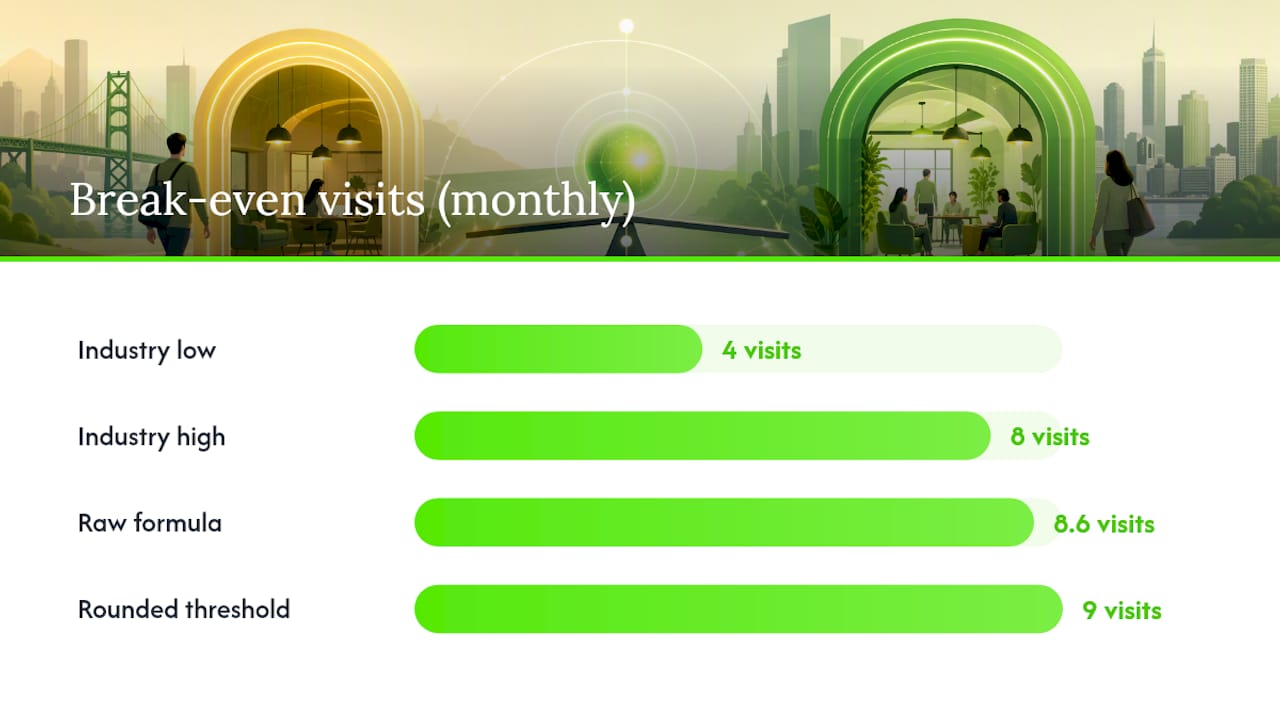
Once you cross roughly nine visits in a month, the math favors the subscription on price alone.
Pro Tip: Don’t stop at the raw formula. Subtract the dollar value of any meeting-room credits, mail handling, or business-address service you’ll actually use from the membership price before you divide. A $300 membership with $60 worth of meeting-room credits you’ll genuinely book is really a $240 membership for break-even purposes.
Run the comparison with these inputs collected upfront:
- The day-pass price at your target location or locations.
- The monthly membership price, including any setup or onboarding fee amortized over your expected commitment.
- The market rate for meeting-room hours if booked separately, compared against included credits.
- Travel time and cost differences if the membership location is farther than a flexible day-pass option.
- Booking fees or platform charges that apply to day passes but not to members, or vice versa.
Industry guidance generally places the break-even in the 4 to 8 visits per month range, though included perks shift that number in either direction. The most common mistake is comparing sticker prices only. A correct comparison folds in every extra, including commute costs and booking fees, because those hidden line items are exactly what make a “cheaper” membership more expensive in practice. When in doubt, run the conservative version of the math: assume you’ll use fewer of the included perks than you expect, not more.
Why a Day Pass Can Be the Smarter Move
Flexibility is the entire case for a day pass. You pay once, you owe nothing next month, and you can test a space’s noise levels, Wi-Fi reliability, and general vibe before signing anything longer. That trial function alone makes day passes useful for validating a location before committing real money to it.
- No monthly obligation if your schedule changes or your travel plans shift.
- Easy to compare multiple locations before settling on one.
- Zero risk of paying for a month you barely use.
- Works well for occasional client meetings or a change of scenery from home.
The trade-off is real. Regular use of day passes adds up fast on a per-day basis, there’s rarely a guaranteed desk, and you lose access to bundled services like mail handling or meeting-room credits. Day passes fit best for occasional remote workers, travelers passing through a city, freelancers with unpredictable client schedules, and anyone still deciding whether a particular space is worth a longer commitment.
Why a Subscription Can Be the Smarter Move
A membership wins on cost per visit once usage climbs, and it wins on predictability regardless of frequency. You know exactly what hits your card each month, and many plans bundle in meeting-room credits, business-address service, mail handling, and extended or 24/7 access that a day pass simply doesn’t offer.
- Lower effective cost per day for anyone working from the space regularly.
- Predictable, fixed monthly billing instead of per-visit charges.
- Bundled extras (meeting rooms, mail, business address) that would otherwise cost extra.
- Often includes evening and weekend access that day passes restrict.
The downsides are the ones people discover too late: minimum commitment periods, cancellation notice requirements, and the risk of paying for a month you barely use because of a vacation or slow client season. Subscriptions fit best for anyone with a consistent weekly routine, small teams that need a stable base, and professionals who genuinely need a business address or regular meeting-room access.
A Practical Checklist for Choosing Between Them
Before you commit either way, track your actual habits and ask the operator direct questions.
- Log every coworking visit on a calendar or app for 30 days before deciding anything.
- Estimate how many meeting-room hours you’d realistically book in a typical month.
- Decide whether you actually need mail handling or a business address, or whether that’s a nice-to-have you’ll never use.
- Confirm the access hours on both options. A day pass restricted to business hours won’t work if you need evening access.
- Ask about freeze or pause options if your usage is seasonal.
Bring these questions directly to the space operator:
- How much advance notice do I need to give to cancel or downgrade?
- Do members get priority booking on meeting rooms over day-pass users?
- Is a desk guaranteed, or is it first-come, first-served even for members?
- What exactly counts as “included” versus billed separately?
Watch for usage friction that erodes the value of a membership on paper: mandatory 60- or 90-day cancellation notice, vague or undisclosed fee structures, and no clear policy on guests or overflow days. Any of those should make you pause before signing.
Two Worked Examples That Show the Math in Action
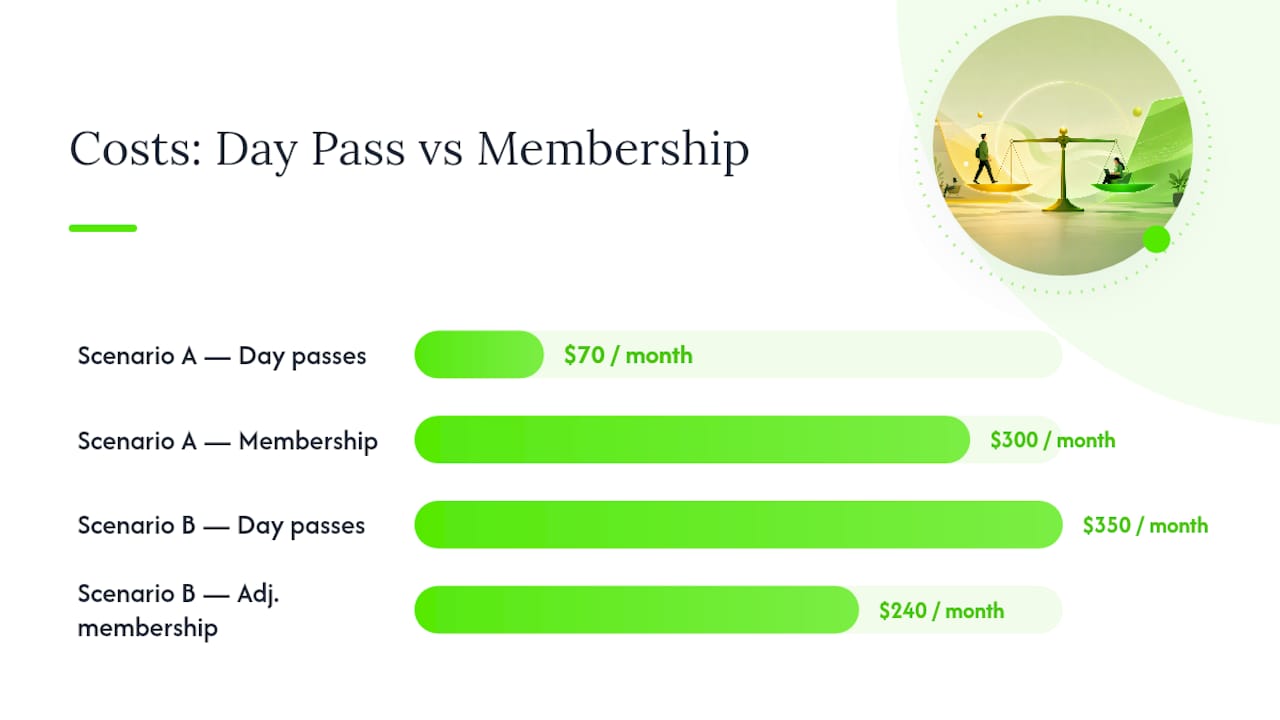
Scenario A: the occasional user. Someone working from a coworking space two days a month faces a simple choice. At a $35 day pass, that’s $70 a month. A $300 membership would cost more than four times that, with no meeting-room use to offset it. The day pass wins clearly, and there’s no reason to overthink it.
Scenario B: the frequent user with meeting-room needs. Someone in the space ten days a month, using four hours of meeting-room time they’d otherwise pay $15 an hour for, faces different math. Ten day passes at $35 each runs $350. A $300 membership that includes those meeting-room hours (worth $60 separately) effectively costs $240 after subtracting that perk’s value.
- Day-pass cost: $350
- Adjusted membership cost: $240
- Savings by subscribing: $110 a month
Pricing across operators typically runs $25 to $50 for day passes and $200 to $600 monthly for memberships depending on city and amenities, so plug in your local numbers rather than these examples directly. A small shift, like adding two more visits a month or a $10 jump in day-pass price, can flip the entire outcome, which is exactly why running the math with your own figures matters more than any rule of thumb.
Why Switching Between the Two Is Completely Normal
Nobody should feel locked into one choice forever. Work patterns shift: a slow freelance month looks nothing like a busy one, and a small team’s office needs change as it grows. Treating a day pass as a trial run before committing to a membership is a sound approach, not an indecisive one, and tracking actual in-person days for a month before switching plans beats guessing every time.
A simple calendar log or a habit-tracking app is enough. Count your real visits, not your intended ones, for 30 days before you sign anything longer than a week. Usage patterns rarely match intentions, and the data settles the argument better than any prediction can.
— Manuel
A Predictable Alternative Worth Knowing About
The same logic that applies to picking a coworking plan applies to picking a sports betting service: paying per pick when you bet occasionally makes sense, but paying for recurring access makes far more sense once you’re checking picks regularly. Some sports betting platforms offer predictable, subscription-based models providing AI-driven picks across multiple sports, so bettors can know what they’re paying each month instead of piecing together one-off purchases.

For readers who want short-term access before committing, Mannysvariety also offers a live picks option that works like a day pass, giving you in-game insights without a recurring charge. If your usage looks more like the frequent-user scenario above, checking out how the subscription works is the natural next step, with transparent billing and no surprise fees buried in the fine print.
Sources
- Coworking Membership vs Day Pass
- Day pass vs membership: choosing the right coworking option for your work style
- Drop-in vs gym membership
- Coworking agreements and usage friction
FAQ
What is a day pass and how does it work?
A day pass is a one-time purchase that gives you access to a coworking space for a single business day, usually covering a desk, Wi-Fi, and standard amenities without any ongoing commitment.
What are two types of subscriptions?
Coworking subscriptions generally split into flexible hot-desk memberships, which give access to shared seating, and dedicated-desk memberships, which reserve a specific spot and often include more meeting-room credits and extended access hours.
Which platforms offer a day-pass style option?
Coworking operators commonly sell day passes directly, and outside coworking, some services apply the same model. Mannysvariety, for example, offers a live, short-term access option for readers who want picks without a recurring subscription.
What does “day pass” mean in coworking terms?
It means paying for a single day of access rather than committing to a recurring membership, giving you flexibility without any monthly obligation.
How many days a month justifies a subscription over a day pass?
Most break-even calculations land between four and eight visits a month, though included meeting-room credits and other bundled perks can lower that threshold significantly.