

Best FiveThirtyEight Alternatives for Sports Bettors 2026
For sports bettors, the best FiveThirtyEight alternatives are AI-powered pick services with verified archives, probabilistic model providers for baseline win probabilities, and odds-integrated analytics platforms. Mannysvariety is the recommended starting point, backed by a publicly tracked 63.5% win rate across 1,600+ picks and 443.9 units returned.
- AI-powered picks service (recommended): Delivers daily picks, props, and parlays generated by sport-specific models with timestamped archives you can audit before paying.
- Probabilistic model provider: Runs Monte Carlo simulations to produce win probabilities across spreads, moneylines, and totals — best for bettors who want to build their own edge calculations.
- Odds/market analytics platform: Tracks line movement, sharp action, and implied probability shifts in real time — most useful as a confirmation layer, not a primary signal.
Start with a free trial or a day pass, pull 30+ archived picks, and measure Net Units per 100 bets before committing to a subscription.
Table of Contents
- Which FiveThirtyEight alternatives should you actually compare?
- How to choose the right alternative — a quick checklist
- What each category of alternative actually delivers
- How to triangulate multiple sources into one daily workflow
- How to verify performance claims before you pay
- Key Takeaways
- Why transparency separates useful analytics from noise
- Mannysvariety is the verifiable trial option for serious bettors
- Sources and further reading
Which FiveThirtyEight alternatives should you actually compare?
The post-FiveThirtyEight ecosystem is fragmented. No single platform dominates, so bettors need a stack, not a single source.
| Dimension | AI-Powered Picks Service | Probabilistic Model Provider | Expert Qualitative Ratings | Odds/Market Analytics |
|---|---|---|---|---|
| Methodology | Sport-specific AI engines, Monte Carlo simulations | Statistical models, historical pattern weighting | Human analyst consensus, qualitative context | Line movement, sharp-money signals, implied probability |
| Best for | Beginners to intermediate bettors, props, parlays | Advanced modelers, baseline probability builders | Injury/context checks, narrative confirmation | Real-time value spotting, live betting |
| Pricing / trial | Tiered subscription; free trial or day passes | Subscription or freemium; limited free tier | Subscription; some free content | Freemium to paid; limited free data |
| Sports covered | NBA, MLB, NFL, NHL, PGA, MMA, Soccer | Varies; strong on major US leagues | NFL, NBA, MLB primary | All major US leagues plus futures |
| Delivery format | Daily picks, props, parlay builders, archives | Model outputs, probability tables, downloadable data | Written reports, ratings, rankings | Odds tables, alerts, line-movement charts |
| Track-record transparency | Timestamped archives, unit ROI, win rate | Published methodology; backtests vary | Rarely archived; qualitative | Market-based; no picks to audit |
Red flags to watch: Any service that cannot show timestamped archived picks or refuses to disclose sample size per market is not verifiable. Top-line win-rate claims without a defined sample window are marketing, not evidence.
How to choose the right alternative — a quick checklist
Choose by methodology fit, transparency, sports coverage, and trial terms. Run through this list before signing up for anything.
- Archived picks with timestamps: Can you view every pick, the odds at pick time, and the result? No archive means no audit trail.
- Sample size: Look for at least 300 picks per market before trusting a win rate. Smaller samples swing wildly on variance.
- Unit ROI disclosure: Net units returned over a defined window (e.g., 90 days, full season) tells you more than a raw win percentage.
- Methodology documentation: Does the service explain its data inputs, model refresh cadence, and how it weights recent vs. historical data?
- Odds integration: Are picks tied to specific lines and books, or are they generic? Line-specific picks are harder to fake.
- Delivery format: Daily picks, props, and parlay builders suit most bettors; raw model outputs suit advanced users who build their own sheets.
- Customer support and cancellation: Can you cancel before the next billing cycle? Is there a refund window for new subscribers?
Pro Tip: Run any new service on a low unit plan (1–2 units per bet) for 30 days. Track Net Units per 100 bets in a simple spreadsheet. That single metric cuts through marketing noise faster than any testimonial.
Practical red flags: no timestamps on picks, aggregated win-rate claims without backtest details, and ROI figures that cover only a cherry-picked winning streak.
What each category of alternative actually delivers
Understanding what you are buying prevents expensive mistakes. Here is what each category looks like in practice.
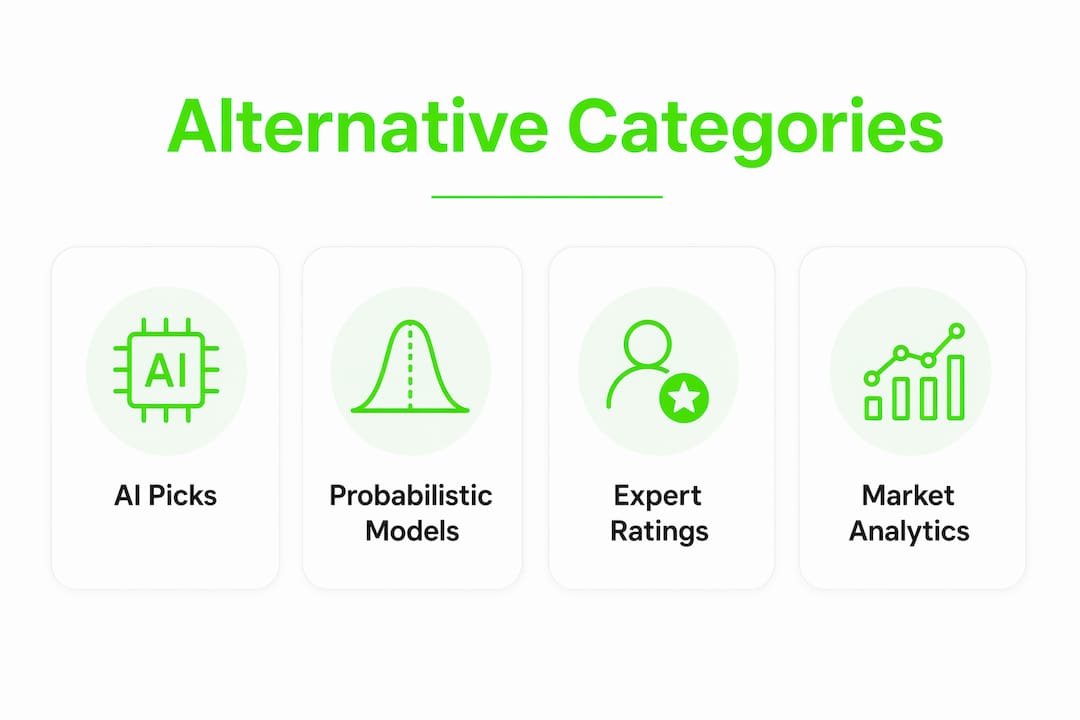
AI-powered picks service
Sport-specific predictive engines run thousands of simulations per game, producing picks with attached probabilities across spreads, moneylines, totals, and player props. The best services publish permanent archives with timestamps so you can verify every pick independently. Mannysvariety operates this way, with sport-specific AI engines covering NBA, MLB, NFL, NHL, PGA, MMA, and Soccer. Check for a public performance dashboard before subscribing.

Probabilistic model provider
These platforms publish win probabilities derived from historical patterns, team fundamentals, and simulation outputs. They are strong for building a baseline before checking market odds. Probabilistic models typically run Monte Carlo simulations and publish methodology notes or code for transparency. The trust signal to verify: a published methodology paper or at minimum a documented data-input list.
Expert qualitative ratings service
Human analysts assign ratings, grades, or confidence tiers to games based on matchup context, injuries, and situational factors. Useful as a secondary check on model outputs, not as a primary signal. Most services in this category do not maintain timestamped pick archives, which makes independent verification difficult. Use them for context, not as a standalone source.
Odds/market analytics platform
Tracks line movement, public vs. sharp betting percentages, and implied probability shifts across multiple sportsbooks. Valuable for confirming that a model’s edge still exists at current market prices. These platforms do not generate picks, so there is no track record to audit in the traditional sense. Pair with a picks service, not as a replacement.
On paywalled depth: Granular model outputs, versioned methodology notes, and downloadable archives are almost always behind a subscription. That is expected — maintaining data pipelines is expensive. Free tiers give you enough to evaluate; paid tiers give you enough to act.
How to triangulate multiple sources into one daily workflow
Use at least three signal types for every bet: a probabilistic baseline, an expert-context check, and a market/odds signal. Sizing by edge and unit plan comes after all three align.
- Pull baseline probabilities. Get the model’s win probability for the game and the specific market (spread, moneyline, total).
- Check expert notes. Scan for injury updates, travel fatigue, or situational factors the model may not weight heavily.
- Check live odds for value. Compare the model’s implied probability to the current market line. If the model says 58% and the market prices the team at +110 (implied ~47.6%), there is a potential edge.
- Calculate implied edge. Edge = Model Probability minus Market Implied Probability. Only bet when edge is positive and above your minimum threshold.
- Size the bet using your unit plan. A flat 1-unit bet per qualifying pick is the standard starting point for most bettors.
- Log the result. Record pick, odds, stake, and outcome in a tracker immediately after the game.
| Input | Example Value |
|---|---|
| Model win probability | 58% |
| Market odds | +110 |
| Market implied probability | 47.6% |
| Suggested stake | 1 unit |
For live props, compress steps 2–3 into a single 60-second check. Prioritize odds lock-in over perfect context — a stale line disappears fast.
How to verify performance claims before you pay
A trustworthy service shows timestamped archives, sample-size breakdowns, unit ROI across multiple time windows, and a clear methodology statement covering data inputs and model structure.
Run this verification checklist on any service you are evaluating:
- Timestamped pick archives: Every pick must show the time it was posted and the odds available at that time.
- Sample size per market: Win rates on fewer than 300 picks per market are statistically unreliable.
- Unit ROI or EV per 100 bets: A net-units figure over a full season or 500+ picks is the most honest performance metric.
- Third-party audits or reproducible backtests: Independent verification beats self-reported numbers every time.
- Published methodology: Data inputs, weighting logic, and model refresh cadence should be documented somewhere on the platform.
Mannysvariety publishes a 63.5% win rate across 1,600+ tracked picks with 443.9 units returned — figures tied to a permanent, timestamped archive you can review at mannysvariety.com. That is the standard to hold any alternative to. Avoid services that claim a “highest win rate” without disclosing sample size or the time window behind the number. Quality-weighted, bias-adjusted methodologies consistently outperform simple averages precisely because they document what they include and why.
Key Takeaways
The most reliable FiveThirtyEight alternatives for sports bettors combine an AI-powered picks service with verified archives, a probabilistic baseline model, and a market/odds layer for real-time value confirmation.
| Point | Details |
|---|---|
| Use a three-source stack | Combine a probabilistic baseline, expert context, and market odds signals for every bet decision. |
| Verify before you pay | Require timestamped archives and unit ROI over 300+ picks before trusting any win-rate claim. |
| Trial on low stakes | Run any new service at 1–2 units per bet for 30 days and track Net Units per 100 bets. |
| Paywalled depth is normal | Granular model outputs and archives are typically behind subscriptions; free tiers are for evaluation only. |
| Mannysvariety as starting point | Offers a free trial, permanent timestamped archives, and a publicly tracked 63.5% win rate across 1,600+ picks. |
Why transparency separates useful analytics from noise
Most bettors switching away from FiveThirtyEight-style data sites make the same mistake: they replace one top-line number with another top-line number from a different source. The platform changes; the verification gap stays the same.
The services worth paying for are the ones that let you audit them. Timestamped archives, documented model mechanics, and unit-level ROI tracking are not premium features — they are the baseline for any service asking for a subscription. A platform that buries its methodology or only shows you a rolling win rate without sample-size context is not being modest. It is protecting a claim it cannot defend under scrutiny.
The triangulation workflow matters for the same reason. Simple averages without quality weighting are vulnerable to skewed inputs, whether in polling or sports modeling. A model probability that disagrees sharply with the current market line is a signal worth investigating, not ignoring. That disagreement is where edge lives.
Mannysvariety is the verifiable trial option for serious bettors
If you want an AI-powered picks service with a documented track record you can audit before committing, Mannysvariety is the place to start. The platform covers NBA, MLB, NFL, NHL, PGA, MMA, and Soccer through sport-specific predictive engines, and every pick is permanently archived with timestamps so you can verify performance independently.
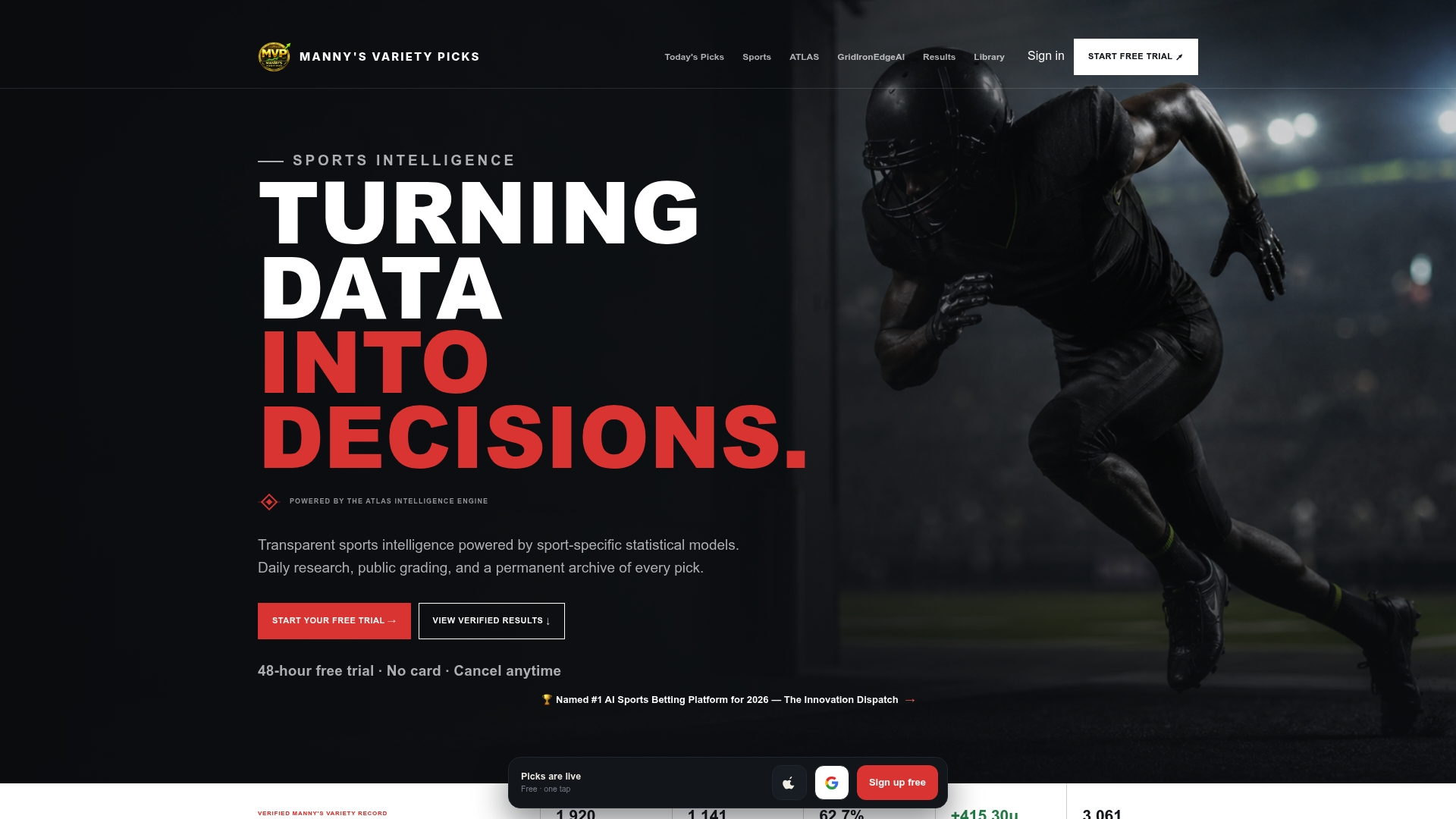
The free trial gives you access to limited features so you can pull archived picks and check the methodology before spending anything. Day passes and weekly passes let you test a full slate of picks on a short time window without a long-term commitment. For bettors ready to go deeper, the Core and Elite plans differ on picks volume, props access, parlay builders, and archive depth.
What to check during your trial: timestamps on every pick, the odds posted at pick time, unit ROI over the most recent 90-day window, and whether the methodology page explains data inputs clearly.
Cancellation is available before the next billing cycle. Check current plan details and trial terms before subscribing.
Pro Tip: Run the trial on a 1-unit flat-bet plan for 30 days. Log every pick result. At the end, calculate Net Units. That number tells you whether the service earns a paid subscription.
Sources and further reading
These sources support the methodology and verification frameworks discussed above. Use them to audit any service’s claims and deepen your understanding of probabilistic modeling and aggregation.
- Polling Aggregators Compared 2026 — USPollingData: Explains why quality-weighted aggregators outperform simple averages; directly applicable to evaluating sports model providers.
- 12 Best Election Forecast Models to Follow in 2026 — Haznos: Covers triangulation methodology (probabilistic model + expert rating + prediction market); the framework maps directly to sports betting workflows.
- 10 Best Polling Aggregators in 2026 — Haznos: Details quality-weighting, bias adjustment, and pollster grading — the same principles apply to evaluating sports data sources.
- A Few Words About FiveThirtyEight — Nate Silver: Explains why granular model outputs and archives are paywalled and what maintaining a data pipeline actually costs.
- Mannysvariety — AI Sports Betting Picks, Props & Parlays: Primary platform for verifiable AI-powered picks with timestamped archives and published performance metrics.