

How to Hedge a Bet: Lock In Profit and Cut Risk
What does it mean to hedge a bet?
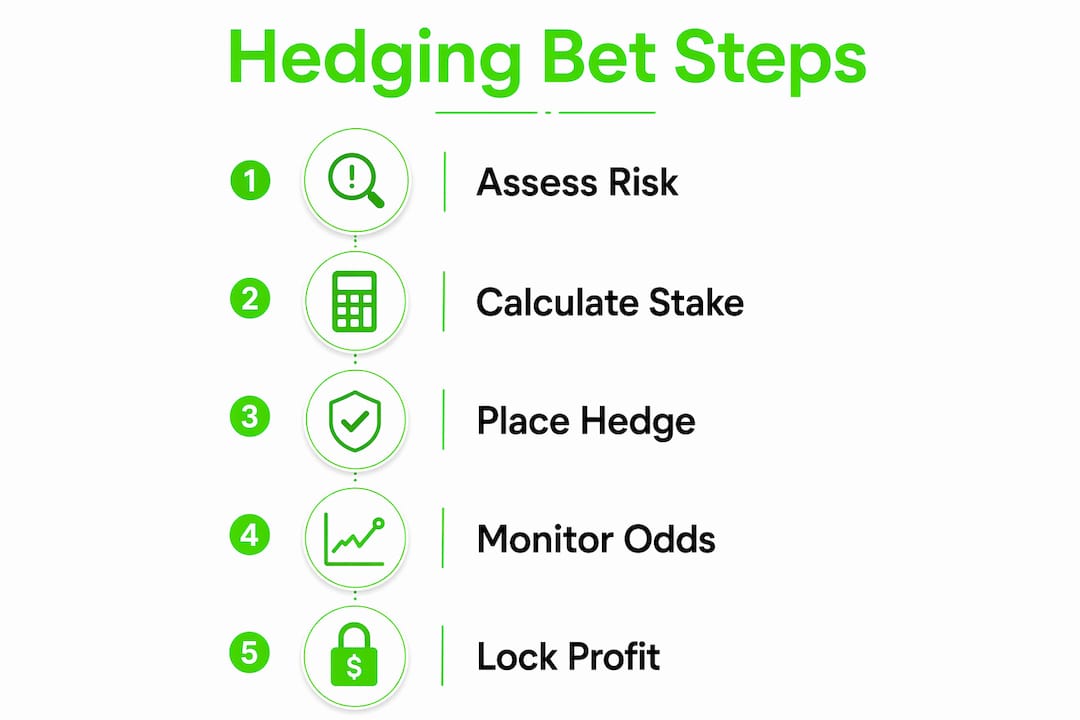
Hedging a bet means placing a second wager on the opposite side of your original bet to guarantee a profit or limit a potential loss. You already hold a position. Circumstances shifted in your favor. Now you decide whether to let it ride or protect what you have.
The core trade-off is straightforward: you sacrifice some upside in exchange for a controlled, known outcome. Hedging shows up most often in three scenarios:
- Futures bets where a longshot team reaches the championship
- Parlays where one final leg stands between you and a large payout
- Live betting where in-game momentum has swung hard in your favor
The financial benefit is real. Hedging smooths variance and protects your bankroll from large swings, though it does reduce your total expected value because you pay the sportsbook’s margin on both sides.
How hedging works in sports betting
The mechanics follow a clear sequence. Once you understand the steps, execution becomes repeatable.
- Place your original bet. You wager on a team, player, or outcome at the odds available at that time.
- Monitor how the position develops. Track odds movement as the event progresses. Hedging only makes sense when your original bet has gained value.
- Identify the opposing side. Determine which outcome you need to bet against to offset your original position.
- Calculate the hedge stake. Use the formula covered in the math section below to find the exact amount needed for a full or partial hedge.
- Shop for the best opposing odds. A better price on the hedge side means less vig paid and a higher guaranteed return.
- Place the hedge bet. Execute the opposing wager at your chosen sportsbook.
- Confirm your net outcome. Verify that both scenarios produce your target profit or acceptable loss reduction before the event resolves.
Partial hedges follow the same steps but stop short of fully equalizing both sides, leaving some upside intact if your original bet wins.
Types of hedging strategies you can use
Hedging is not a single tactic. Bettors apply it differently depending on the bet type, timing, and risk tolerance.
- Full hedge: Size the opposing bet so both outcomes return the same net profit. You eliminate variance entirely but pay vig twice, which lowers total expected value.
- Partial hedge: Place a smaller opposing bet that guarantees some profit while keeping residual upside on the original ticket. Partial hedges sized at 0.25–0.5 units relative to your standard stake often protect enough without crushing expected value.
- Futures ladder hedge: As a team advances through playoffs, stage hedges at key inflection points such as conference clinches. Staging hedges through a season protects profits on longshot futures as odds shorten.
- Parlay final-leg hedge: With one leg remaining on a large parlay, bet the opposite side of that final game. The accumulated payout is largest at this point, making the hedge cost relatively low compared to the guaranteed return.
- Live in-play hedge: React to in-game momentum shifts by placing a live bet against your pregame position. Enter on natural pauses like TV timeouts when spreads normalize rather than clicking in panic after a score.
Pro Tip: Size every hedge in defined betting units, not dollar amounts tied to emotion. If your standard stake is 1.0 unit, a partial hedge of 0.25–0.5 units typically delivers meaningful protection without gutting your long-term return.
When you should consider hedging your bets
Timing and context determine whether hedging adds value or simply costs you money.
- Large payout relative to bankroll: A futures ticket now worth $5,000 on a $10,000 bankroll warrants serious hedging consideration. A $100 win on the same bankroll generally does not.
- Longshot futures reaching the final: The original longshot odds are long gone. The team is now a favorite or near-even. Locking in guaranteed profit converts a paper gain into real money.
- Live betting swings: Your pregame bet is winning big at halftime. A live hedge captures that realized value before the game turns.
- Final parlay leg: All previous legs have hit. The remaining risk is concentrated in one game. A partial hedge secures a portion of the payout regardless of the final result.
- New information changes your conviction: An injury, lineup change, or unexpected performance trend weakens your original thesis. Hedging captures accrued value before the edge disappears.
Hedging is most rational when bankroll stability is genuinely at risk. Casual hedging out of anxiety, without a mathematical basis, erodes long-term profits.
How to calculate the correct hedge amount

The math behind hedging is simpler than it looks. Two inputs and one division give you the exact stake needed.
The core formula:
This formula guarantees equal profit on both sides of the bet.
Converting American odds to decimal:
- Positive odds (e.g., +300): Decimal = 1 + (300 ÷ 100) = 4.0
- Negative odds (e.g., -150): Decimal = 1 + (100 ÷ 150) = 1.667
Worked example:
- Original bet: $100 at +800 (decimal 9.0). Potential payout: $900.
- Team reaches the final. Opposing side is now +120 (decimal 2.20).
- Hedge Stake = $900 ÷ 2.20 = $409.09
- Total invested: $100 + $409.09 = $509.09
- If original wins: $900 payout. Net profit: $900 - $509.09 = $390.91
- If hedge wins: $409.09 × 2.20 = $900. Net profit: $900 - $509.09 = $390.91
Both outcomes return the same profit. For a partial hedge, simply reduce the hedge stake below $409.09. You accept a lower floor but keep more upside if the original bet wins.
Using hedging calculators to get the math right
Online hedge calculators remove the manual work and reduce the risk of mis-sizing a bet. You enter three values: your original stake, the original odds, and the current hedge odds. The calculator returns the exact opposing stake and your net profit under each scenario.
- Accuracy: Calculators handle decimal conversions and rounding automatically, preventing costly errors on large stakes.
- Speed: Live markets move fast. A calculator produces results in seconds, which matters when in-play odds are shifting.
- Scenario modeling: Run a full hedge and a partial hedge side by side to compare guaranteed returns before committing.
- Comparison against cash-out offers: Sportsbook cash-out features often give worse value than a manually calculated hedge. Running both numbers before accepting a cash-out offer frequently reveals a better alternative.
Pro Tip: Before accepting any sportsbook cash-out, calculate your own hedge stake using a free online calculator. The difference in net return can be meaningful, especially on large futures tickets.
Line shopping matters here too. A better price on the hedge side directly increases your guaranteed profit without changing your original position.

The psychology behind hedging decisions
Emotion drives most premature and unnecessary hedges. Anxiety about a close game or fear of losing a large paper profit pushes bettors to hedge at poor prices, which reduces long-term ROI more than the variance they were trying to avoid.
The distinction between emotional comfort and mathematical rationale is where discipline separates profitable bettors from the rest. A hedge that feels reassuring but offers poor expected value is still a bad hedge.
- Avoid over-hedging: Hedging every position that moves in your favor compounds vig costs into a meaningful drag on results over time.
- Predefine your triggers: Set specific odds thresholds, profit targets, or bankroll percentage rules before the event starts. Stick to them regardless of how the game feels in the moment.
- Enforce cooldowns: After a big win or loss, wait before placing any hedge. Reactive decisions in either direction tend to be poorly sized.
Pro Tip: Write your hedge rules before the game starts: the odds level at which you will hedge, the stake size, and whether you want a full or partial hedge. Decisions made in advance are almost always better than decisions made during a tense fourth quarter.
Risks and disadvantages of hedging a bet
Hedging has a real cost that casual bettors often underestimate. Every hedge bet pays the sportsbook’s margin again, meaning you pay vig twice. A full hedge locks profit but lowers net gains compared to letting the original bet ride without a guarantee.
Compulsive hedging destroys ROI over time. If you consistently hedge every bet that moves in your favor, you cap your upside while still absorbing losses when early bets go wrong. The bettors who hedge profitably do it selectively, only when the guaranteed profit is substantial relative to the original stake and the hedge odds are close to fair value.
Hedging also requires sufficient funds available at the time of the hedge. If your bankroll is tied up, you may not be able to execute the opposing bet at the right moment.
Calculating break-even points for hedging
The break-even point tells you the minimum hedge return that justifies paying the vig. Calculate it by comparing the expected value of not hedging against the certain return of hedging.
If your original parlay has a 45% implied probability of winning and pays $1,200, the expected value of letting it ride is: (0.45 × $1,200) minus (0.55 × $50) = $540 minus $27.50 = $512.50 in expected value. If a full hedge locks in $400 regardless of outcome, the hedge is worth less in expected value terms but eliminates all variance. Whether $400 certain beats $512.50 expected is a personal risk tolerance question, not a universal answer.
The break-even hedge is the stake at which your guaranteed return equals your expected value from not hedging. Any hedge that returns less than that threshold costs you more in EV than it saves in risk.
How odds fluctuations affect your hedge outcome
Odds movement directly determines how profitable a hedge can be. When the opposing side’s odds shorten after your original bet was placed, the hedge stake required to equalize both outcomes increases, which reduces your guaranteed profit.
Hedging too early on high-value futures often reduces expected value unnecessarily. If a team you backed at +800 is now +300 with two playoff rounds remaining, the odds may compress further. Waiting for odds to shorten more before hedging can increase your guaranteed return, though it also increases the risk that the team is eliminated before you act.
Odds can also move against you. A key injury or poor performance can lengthen the opposing odds, making the hedge more expensive or less effective. Monitoring line movement and acting at the right moment is as important as the calculation itself.
Common mistakes to avoid when hedging a bet
Most hedging errors fall into a small number of repeatable patterns.
- Hedging prematurely on futures: Letting a strong edge develop before hedging yields better expected value. Premature hedges on early futures sacrifice value that the market has not yet fully priced in.
- Ignoring the vig on the hedge side: The sportsbook margin on the opposing bet reduces your net return. Always calculate the total cost of both bets before deciding.
- Accepting cash-out without comparing: Sportsbook cash-out offers are convenient but frequently priced below fair value. Calculate your own hedge first.
- Sizing by feel instead of formula: Guessing the hedge stake leads to unequal outcomes. Use the formula or a calculator every time.
- Over-hedging small bets: For bets that are small relative to your bankroll, the vig cost of hedging eats a disproportionate share of expected profit. Ride small positions and hedge only when the stake is meaningful.
- No predefined plan: Deciding whether and how much to hedge during a live game, under pressure, produces inconsistent results. Set the rules before the event starts.
How Mannysvariety helps you make better betting decisions

Hedging works best when you know the true value of your original position. Mannysvariety provides AI-powered betting picks built on real-time analytics and thousands of simulations across NBA, MLB, NFL, NHL, and more. With a publicly tracked win rate of 63.5% and over 1,600 graded picks delivering 443.9 net units, the platform gives you the data foundation to know when a position is worth protecting and when letting it ride is the stronger play.
Every pick comes with transparent grading and a permanent archive, so you can evaluate your open positions with confidence rather than guesswork. View current pricing plans to see which subscription tier fits your betting volume and goals.
Key Takeaways
Hedging a bet is a risk management tool that pays vig twice, so use it selectively when the guaranteed return is meaningful relative to your bankroll and the hedge odds are close to fair value.
| Point | Details |
|---|---|
| Core hedge formula | Hedge Stake = Original Potential Payout ÷ Hedge Decimal Odds to equalize both outcomes. |
| Full vs. partial hedge | Full hedges eliminate variance; partial hedges preserve upside while establishing a profit floor. |
| Best timing for hedging | Hedge when a longshot futures bet reaches the final, a parlay has one leg left, or live odds shift dramatically. |
| Vig costs compound | Every hedge pays the sportsbook margin twice, reducing long-term expected value if applied too frequently. |
| Predefine your rules | Set odds thresholds and stake sizes before the event starts to avoid emotion-driven decisions under pressure. |