

NHL AI Predictions: Top Picks and Betting Insights
Mannysvariety is a publicly verifiable source for daily NHL AI predictions, publishing every pick along with a publicly archived record of results showing consistent profitability. That combination of volume and verifiable results separates it from services that post picks without a permanent, auditable record. You can view today’s AI-generated NHL picks directly through the Mannysvariety picks feed.
- Public win rate: Demonstrates a winning percentage above average across many tracked picks
- Net return: Shows a profitable return over an extensive sample, publicly archived
- Per-pick data: confidence rating, suggested unit size, and timestamped archive for every selection
Pro Tip: Before acting on any NHL pick, check the archived results page first. A service that publishes every result, including losses, is the only kind worth trusting.
Table of Contents
- What do NHL AI picks actually look like in a daily feed?
- How does the AI generate NHL predictions?
- How to use AI NHL predictions for smarter betting
- What is Mannysvariety’s public track record and how do you audit it?
- Where should U.S. bettors shop lines for NHL games?
- How do you vet an AI NHL prediction service?
- How do AI NHL predictions compare to expert human analysis?
- Key Takeaways
- Why transparency is the only metric that matters in AI sports betting
- Mannysvariety AI NHL picks: what you get and how to start
What do NHL AI picks actually look like in a daily feed?
A well-structured AI picks feed gives you everything you need to act without guessing. Each entry should include the game date and time, the matchup, the market type, the model’s selected side, a probability or expected-value estimate, a confidence rating, and a suggested unit size. Here is what that looks like in practice:
- Date/Time: When the game starts (e.g., March 14, 7:00 PM ET)
- Matchup: Home vs. Away team
- Market: Moneyline, puck line (±1.5), total (over/under), or player prop
- AI Pick: The model’s selected side
- Probability/EV: Model-estimated win probability or positive expected value
- Confidence: Rated on a scale (e.g., 1–5 stars or Low/Medium/High)
- Unit Size: Suggested wager relative to bankroll (e.g., 1 unit, 2 units)
| Field | What It Means | Example |
|---|---|---|
| Market | Bet type being targeted | Moneyline |
| AI Pick | Model’s selected side | Colorado Avalanche ML |
| Probability | Model’s estimated win chance | — |
| Confidence | Strength of the edge | High (4/5) |
| Unit Size | Suggested wager size | 2 units |
| Archive Link | Timestamped result record | Graded Win |
Every pick in the Mannysvariety feed carries a timestamp and a permanent archive link. That means you can pull up any historical pick, verify the line at the time of posting, and confirm the graded result. No retroactive edits, no selective memory.
How does the AI generate NHL predictions?
The model is an ensemble of sport-specific engines that ingest player and puck tracking data, confirmed lineups, goalie starts, injury reports, live odds, and public betting volume to simulate thousands of game outcomes before producing a pick.
Primary model inputs include:
- NHL player and puck tracking feeds, including Hawk-Eye skeletal data that captures dozens of body-position points per player
- Confirmed goalie starts and recent save-percentage trends
- Injury and lineup reports from official sources
- Live odds and line movement across major U.S. sportsbooks
- Public betting volume and sharp-money signals
- Situational factors: rest days, travel schedules, back-to-back games
At the modeling layer, the system uses feature engineering to weight each input, runs Monte Carlo simulations to generate a probability distribution of outcomes, and applies an expected-goals framework to evaluate shot quality and defensive structure. The ensemble then weights each sub-model’s output and calibrates a per-pick confidence score based on how consistently the simulations converge on one side.
Why tracking data matters: The NHL’s real-time AI engine draws on a century of archived footage and live feeds, giving models access to metrics that go well beyond traditional box scores. Teams are already using this infrastructure to build new defensive metrics like “total danger,” which captures shot-quality context that expected goals alone misses.
NHL teams themselves are investing heavily in AI analytics, using tracking data and proprietary models to build new expected-value metrics. Models that tap the same data layer benefit from the same signal quality.
Pro Tip: A high confidence rating means the simulations converged strongly on one side, not that the outcome is guaranteed. Treat it as a measure of model agreement, not certainty.
How to use AI NHL predictions for smarter betting
Use AI picks as a probabilistic input to an expected-value framework. The model tells you where the edge likely is; your job is to capture that edge at the best available price and manage your exposure correctly.
- Check confidence and suggested unit size first. High-confidence picks justify larger unit sizes; low-confidence picks should be capped at one unit regardless of how appealing the line looks.
- Shop lines across at least three U.S. sportsbooks before placing. A moneyline that opens at -130 on one book may be -115 on another. That 15-cent difference compounds significantly over a season.
- Adjust units for parlays and props. Correlated parlays (e.g., a team moneyline plus their puck-line) reduce variance but also reduce expected value. Props carry higher variance than moneylines; size them at half your standard unit.
- Set a daily loss limit before you start. A reasonable ceiling is 5% of your total bankroll per session. Once you hit it, stop for the day regardless of what the model shows.
- Confirm goalie starts before placing. A pick built on a projected starter loses its foundation if the starter is scratched. Always verify the confirmed goalie before wagering on any goalie-sensitive market (totals, puck lines).
Market-by-market guidance:
- Moneyline: Best for heavy edges where the model shows 60%+ probability. The full payout is worth the risk when the edge is clear.
- Puck line (±1.5): Most valuable in strong-skill mismatches where the favorite is likely to win by multiple goals.
- Totals: Highly goalie-driven. AI models that track save percentage and shot quality add real value here.
- Props: Stick to markets the model explicitly tracks (shots on goal, goalie saves). Avoid props where the model has no dedicated input.
Pro Tip: Expected value formula: EV = (Win Probability × Profit) minus (Loss Probability × Stake). If the model gives a team 58% and the sportsbook implies 50%, you have a positive EV bet. Run this check on every pick before placing.
What is Mannysvariety’s public track record and how do you audit it?
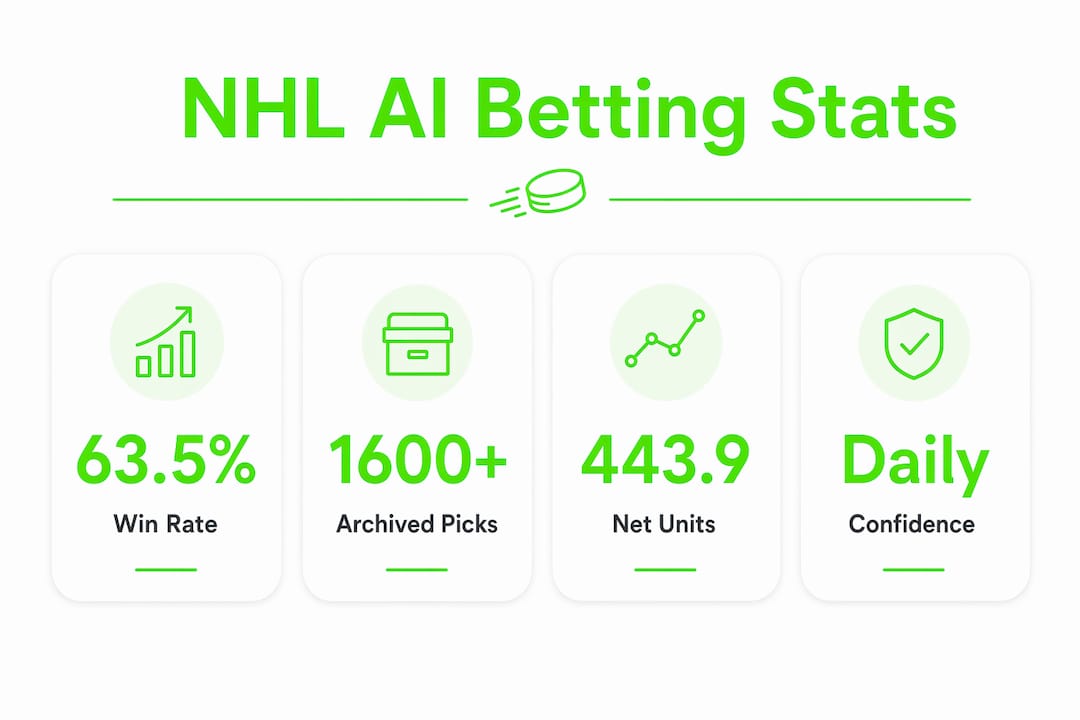
Mannysvariety publishes a 63.5% win rate across 1,600+ tracked picks, with a profitable net return of 443.9 units. Those metrics indicate consistent model performance and a substantial sample size.
| Market | Metric to Check | What It Tells You |
|---|---|---|
| Moneyline | Win rate, units returned | Raw directional accuracy |
| Puck line | Win rate, closing line value | Skill vs. spread coverage |
| Totals | Win rate by goalie matchup | Model’s goalie-market edge |
| Props | Win rate, sample size | Whether the model tracks this market |
When auditing any pick service, watch for three common pitfalls. First, selective reporting: a service that only publishes winning streaks and omits losing runs is not giving you a real picture. Second, sample bias: a 70% win rate over 20 picks is noise; 1,600+ picks is a credible sample. Third, vague unit definitions: a “unit” means nothing if the service never defines its size relative to bankroll. Mannysvariety’s permanent pick archive timestamps every pick at posting, so you can verify the line, the pick, and the graded result independently.
Where should U.S. bettors shop lines for NHL games?
Always shop lines across multiple sportsbooks before placing any NHL bet. A single-book approach leaves money on the table every time the model finds an edge, because the edge is only worth capturing at the best available price.
Practical line-shopping steps:
- Maintain accounts at three to five regulated U.S. sportsbooks to cover the spread of available lines
- Use odds-aggregation tools to compare moneylines, puck lines, and totals in real time
- Monitor line movement in the hour before puck drop; sharp money often moves lines 10–20 minutes after opening
- Track vig differences across books, not just the line itself; lower vig means more value on the same pick
Beyond traditional sportsbooks, U.S. bettors now have access to regulated prediction markets. The NHL announced multiyear partnerships with Kalshi and Polymarket, granting both platforms access to official NHL data and marks. Kalshi, which operates under federal regulation, will appear across national broadcasts and offer event contracts on NHL outcomes. These venues can complement traditional sportsbooks, particularly for bettors who want exchange-style pricing and federally regulated markets.
Pro Tip: Take early value on moneylines when the model shows a strong edge and the line is soft at open. Wait for goalie confirmation before placing totals or puck-line bets, since a backup goalie can shift a total by half a goal or more.

Betting on NHL games is legal in a growing number of U.S. states, but regulations vary by jurisdiction. Confirm that online sports betting is permitted in your state before opening an account.
How do you vet an AI NHL prediction service?
Five criteria separate credible AI services from low-quality ones. Check every one before committing to a subscription.
Vetting checklist:
- Public pick archive with timestamps: Every pick should be posted before the game starts, with a visible timestamp. No timestamp means the service could be back-filling results.
- Audited win rate with sample size: A published win rate is only meaningful if the sample size is stated. Fewer than 200 picks is too small to draw conclusions.
- Per-pick confidence ratings: Services that assign the same confidence to every pick are not calibrating their model. Look for tiered ratings tied to unit-size recommendations.
- Input transparency: The service should describe what data the model uses (tracking feeds, odds, lineups, goalie confirmations). Vague claims about “proprietary AI” with no methodology detail are a red flag.
- Clear terms and pricing: Refund policies, trial terms, and subscription tiers should be stated plainly. Hidden auto-renewals and opaque cancellation terms are warning signs.
Red flags to avoid:
- Cherry-picked results with no losing picks published
- Unit definitions that shift between reports
- No goalie or lineup timestamps on picks posted hours before game time
- Testimonials with no verifiable pick archive to back them up
How do AI NHL predictions compare to expert human analysis?
AI models and experienced human analysts each bring distinct strengths, and the most effective bettors understand where each has an edge.
Human analysts excel at reading context that is hard to quantify: locker-room dynamics, a coach’s tendency to pull a goalie early, or how a team historically responds after a blowout loss. That qualitative layer matters, and no model fully captures it. NHL analytics teams themselves treat AI as a tool that speeds up analysis and surfaces patterns, not one that replaces the analyst making the final call.
Where AI outperforms human intuition is in processing volume and consistency. A model can ingest hundreds of variables simultaneously, run thousands of simulations, and produce a calibrated probability without fatigue or recency bias. A human analyst who watched last night’s game may unconsciously overweight what they just saw. The model weights every data point according to its historical predictive value, not its emotional salience.
The practical implication for bettors: use AI picks as the quantitative foundation and apply human judgment at the margins. If the model shows a 58% edge on a moneyline but you have credible information about a lineup change that has not yet hit the wire, that context should inform your unit size. The NHL’s own partnership with AWS to build machine learning stats like Face-off Probability illustrates how the league itself views AI: as a layer of analysis that enhances decision-making, not one that replaces it.
Key Takeaways
Mannysvariety’s AI-generated NHL picks combine a 63.5% public win rate, 1,600+ archived picks, and 443.9 net units returned, making it the most verifiable source for data-driven NHL betting decisions in the U.S.
| Point | Details |
|---|---|
| Verified track record | Mannysvariety publishes a 63.5% win rate with a large archived pick history and 443.9 net units returned. |
| Read confidence ratings | High-confidence picks justify larger unit sizes; low-confidence picks should be capped at one unit. |
| Always shop lines | Compare odds across at least three U.S. sportsbooks before placing any bet to capture the best price. |
| Vet before you subscribe | Demand a timestamped public archive, stated sample size, and clear unit definitions from any AI service. |
| Start with Mannysvariety | View today’s picks and the full archived record at Mannysvariety before placing your next NHL wager. |
Why transparency is the only metric that matters in AI sports betting
Most AI pick services make the same promise: a proprietary model, a high win rate, and a track record you should trust. The problem is that most of them ask you to take that on faith. No timestamps, no losing picks published, no methodology you can actually examine.
Mannysvariety was built around the opposite premise. Every pick goes into a permanent archive at the time of posting, graded publicly after the result. The 63.5% win rate and 443.9 net units are not marketing claims; they are figures any subscriber can verify pick by pick. That commitment to auditable results is what makes the AI useful rather than just impressive-sounding.
The responsible betting note belongs here too: AI predictions improve your decision-making process; they do not eliminate risk. Set loss limits, size units relative to your bankroll, and treat every pick as a probabilistic input, not a guarantee.
Mannysvariety AI NHL picks: what you get and how to start
Mannysvariety delivers daily AI-generated NHL picks with per-pick confidence ratings, suggested unit sizes, and a fully public archive, so you can verify performance before spending a dollar.
Subscription options:
- Core tier: Daily picks across NHL and other sports, access to the public archive, and confidence ratings per pick
- Elite tier: Everything in Core plus advanced analytics, player props, parlays, and priority access to the Atlas analytics tools
- Day and week passes: Short-term access for bettors who want to test the service around a specific game or series
- Free trial: Limited access to sample picks and the archive so you can evaluate the track record before subscribing
The free trial is the logical starting point. Pull up the archived picks, check the timestamps, verify a few graded results against the lines that were available at posting time, and decide based on what you see. Visit Mannysvariety’s pricing page for current tier details, or go directly to mannysvariety.com to view today’s NHL picks and start your trial.
Primary sources and further reading
- NHL multiyear partnerships with Kalshi and Polymarket: The official league announcement confirming regulated prediction market access to NHL data and marks.
- Kalshi NHL partnership press release: Details on federal regulation, broadcast visibility, and what the partnership means for U.S. event trading.
- theScore: How AI is impacting NHL teams: Reporting on team-level AI investment, Hawk-Eye tracking, and new metrics like “total danger.”
- Vast Data: NHL’s real-time AI engine: Technical background on how the NHL built a real-time AI infrastructure from a century of archived footage.
- The Gossip Wire: AI in NHL front offices: Practitioner perspective on AI as a force multiplier, not a replacement for human judgment.
- Is number 69 banned in the NHL?: Clarifies that no official NHL rule bans the number; only 99 is retired league-wide.
- NHL and AWS Face-off Probability: Illustrates how the league itself applies machine learning to in-game prediction and broadcast analytics.
This article is general information for educational purposes, not professional financial or legal advice. Confirm sports betting regulations in your state before placing any wager, and bet responsibly.