

Soccer Player Props: A Data-Driven Research Playbook
Find playable soccer player props by filtering for confirmed starts, expected minutes, recent shots per 90, and shots on target (SOT) rate, then compare odds across at least three books before sizing your bet with implied probability math. That single rule eliminates most losing prop ideas before you spend a minute on deeper research.
Run these filters first, in order:
- Minutes filter: Target players expected to play 70+ minutes. Lineup news, manager patterns, and injury reports are your primary inputs.
- Role filter: Confirm the player is a starter in an attacking or central midfield role, not a rotational piece.
- Shots per 90 filter: Look for players averaging more than 1.8 shots per 90 minutes over their last five starts.
- SOT rate filter: Narrow to players with an SOT rate above 40% of total shots in recent games.
- Odds threshold: Only proceed if the market price implies less probability than your own model suggests.
Manny’s Variety Picks runs these filters automatically, delivering pre-screened soccer player props with a published track record with qualitative performance insights so you skip the manual screening step entirely.
Table of Contents
- What are soccer player props and which markets matter most?
- Where can you find soccer player prop markets and research tools?
- How do you research a soccer player prop step by step?
- How do you compare odds and size your bets on player props?
- Worked example: evaluating a shots-on-target over prop
- Why does a verified picks service accelerate your prop research?
- Key Takeaways
- The workflow most bettors skip
- Manny’s Variety Picks gives you pre-filtered props with a verified edge
- Useful sources and tools to bookmark
What are soccer player props and which markets matter most?
Player props are bets on individual player outcomes, not team results. Whether the match ends 0–0 or 4–3 is irrelevant; what matters is whether your targeted player hit a specific statistical threshold during that game.
The most common soccer prop categories you will see at U.S. sportsbooks include:
- Anytime scorer / first goal scorer
- Shots over/under (e.g., over 2.5 shots)
- Shots on target over/under (e.g., over 0.5 or 1.5 SOT)
- Assists (anytime assist, over/under)
- Yellow cards (to be booked yes/no)
- Fouls committed or drawn
- Tackles over/under
- Minutes played over/under
Soccer’s low-scoring nature makes action-based props like shots and cards especially attractive, because they occur far more frequently than goals. A striker might score once every four games but register two or more shots in three of those four. SOT over/under markets settle on whether a player records at least one or two shots on target during the match. Anytime scorer markets settle the moment the player scores, regardless of the final result.
Market structure note: Props use over/under and yes/no formats most often, though some books offer head-to-head player comparisons (e.g., which of two forwards records more shots). Market availability expands significantly during major tournaments like the FIFA World Cup and UEFA Champions League knockout rounds.
Where can you find soccer player prop markets and research tools?
No single tool does everything. The most efficient research stack combines at least three tool types.

| Tool type | Best for | Freshness | Typical cost |
|---|---|---|---|
| Sportsbook markets (DraftKings, FanDuel) | Final odds, line shopping | Real-time | Free |
| Odds aggregators (Oddschecker) | Cross-book price comparison | Near real-time | Free |
| Prop finder tools (PlayerStats.Football) | Threshold filters, streak data | Daily updates | Free/freemium |
| Advanced stat hubs (FBref) | Season and per-90 metrics | 48 hr lag | Free |
| Live match trackers | In-game SOT, possession, pressure | Live | Free/freemium |
Sportsbooks like DraftKings Sportsbook and FanDuel Sportsbook are the starting point for seeing which prop markets are actually available and at what price. Odds aggregators like Oddschecker let you compare prices across books in one view, which is where you capture extra value on a researched idea. Prop finder tools are where you do the screening work: dedicated prop finders let you filter by stat thresholds, consecutive-game streaks, and position to surface repeatable patterns quickly.
Advanced stat hubs like FBref provide the per-90 metrics (shots/90, xG, xA, progressive carries) that underpin any serious filter. Live match trackers give you real-time SOT counts and possession data, which are most useful for in-play prop markets.
Pro Tip: Cross-reference prop finder outputs with a live tracker during warm-up windows. If a player you screened is listed as a substitute on the team sheet, discard the prop immediately rather than hoping for a late appearance.
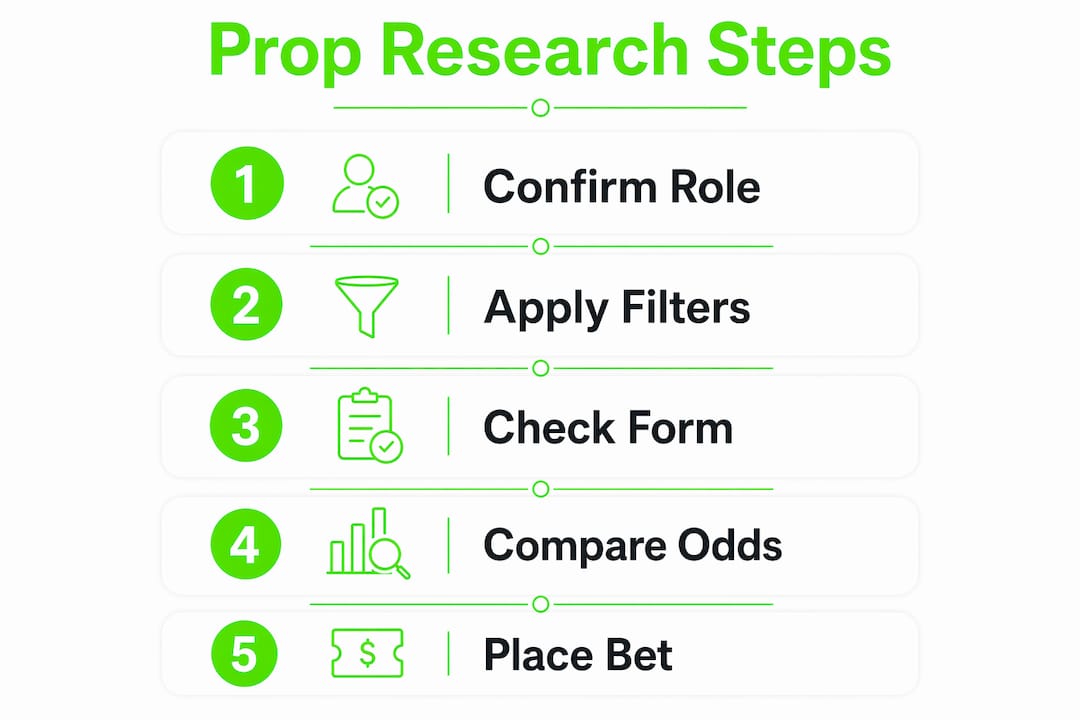
How do you research a soccer player prop step by step?
A repeatable checklist beats intuition every time. Work through these steps in sequence before committing to any player performance bet.

Step 1: Confirm role and expected minutes. Check the projected lineup from a reliable team news source. Filtering for expected minutes and starts reduces false positives far more reliably than scanning recent highlight clips. Target starters with a history of playing 70+ minutes in similar fixtures.
Step 2: Apply offensive filter presets. For shots and SOT props, require at least 1.8 shots per 90 and a 40%+ SOT conversion rate over the last five starts. For card props, require a yellow card frequency of at least once every four games and a referee with a high booking rate in the assigned competition.
Step 3: Check recent form and event rate. Look at the last three to five starts, not the season average alone. A player returning from injury or playing in a new tactical role may have a season average that overstates current output.
Step 4: Apply contextual signals. Assess the opponent’s defensive shape, weather and pitch conditions, and the referee’s tendencies. A referee averaging 4+ bookings per game raises card-prop value. A wet, heavy pitch suppresses shots and favors physical duels.
Step 5: Validate the historical hit rate. Use a prop finder to check how often the player has cleared the specific threshold (e.g., 1+ SOT) across consecutive games and over the full season. A player hitting 1+ SOT in eight of their last ten starts is a stronger candidate than one with a high season average but inconsistent game-to-game output.
Minutes-expectation scoring: Build a quick minutes score using the last five starts (weighted 60%), season minutes per start (30%), and manager substitution tendencies (10%) from match reports. This approach, drawn from prop research methodology, directly reduces the biggest single source of variance in player prop outcomes.
Pro Tip: Screening by role and expected minutes eliminates more bad bets than any other single filter. A star player who comes off at 60 minutes in a rotation game kills an SOT prop regardless of his season stats.
How do you compare odds and size your bets on player props?
Once you have a researched prop idea, the math takes over. Here is the core workflow.
Convert odds to implied probability. For American odds, the formula is:
- Negative odds: Implied probability = |odds| ÷ (|odds| + 100)
- Positive odds: Implied probability = 100 ÷ (odds + 100)
Example: A player listed at +120 to record 1+ SOT carries an implied probability calculated from the odds. If your research model puts the true probability at 55%, you have a positive expected value edge.
Calculate expected value. EV = (your probability × potential profit) minus (opponent probability × stake). On a $100 bet at +120: EV calculation: expected profit minus expected loss results in positive expected value per $100 wagered.
Size the bet. Two practical approaches:
- Flat unit staking: Bet the same fixed unit (e.g., 1–2% of bankroll) on every prop regardless of edge size. Simple and protects against overconfidence.
- Fractional Kelly: Bet a fraction (typically 25–50%) of the Kelly Criterion output to reduce variance while still scaling to edge size.
Odds-shopping checklist:
- Compare at least three books before placing.
- Note the vigorish (vig) embedded in each line; prop markets carry higher vig than match lines, often 8–12%.
- Use an odds aggregator to spot the best available price in one view.
- Watch for line movement: sharp money moving a prop line before kickoff signals that informed bettors have found value.
Pro Tip: Prop lines move faster and with less liquidity than match lines. A +120 that drops to +105 within two hours of kickoff has likely been bet down by sharp action. Either get in early or reassess whether the edge still exists at the new price.
Worked example: evaluating a shots-on-target over prop
Here is the full workflow applied to a realistic SOT prop.
-
Screen the candidate. A central attacking midfielder in a top-five European league averages 2.1 shots per 90 and a 48% SOT rate over his last six starts. He is confirmed in the starting lineup and expected to play the full 90 minutes based on the manager’s recent substitution pattern.
-
Apply the matchup adjustment. The opponent allows an average of 4.8 shots on target per game from opposing midfielders and forwards combined, above the league median. Tactical notes show they defend in a mid-block, which creates space for shots from the top of the box.
-
Build the model probability. Raw expected SOT per 90 is calculated from shots multiplied by SOT rate. Adjusting for opponent factors raises the expectation, leading to a high probability of recording at least 1 SOT in the game.
-
Compare to the market. The book prices 1+ SOT at −115, implying 53.5% probability. Your model says 62%. EV is calculated as expected profit minus expected loss, producing a positive expected value per $100 wagered. At a 1-unit flat stake, this clears the minimum threshold for a playable prop.
-
Determine stake and place. At 1% of a $1,000 bankroll ($10 per unit), the bet is $10 at −115.
Pro Tip: The most common surprise in SOT props is an early red card to your player’s team. A man-down scenario forces defensive shape, suppresses attacking output, and kills an SOT prop faster than any other in-game event. Check the player’s disciplinary history and the referee’s red-card rate before finalizing.
Why does a verified picks service accelerate your prop research?
Manual prop research across multiple leagues, data sources, and books takes time. AI tools aggregate fragmented datasets and detect potential prop value where manual screening struggles, which is the core efficiency argument for using a data-driven picks service alongside your own process.
Manny’s Variety Picks applies sport-specific AI engines and thousands of simulations to surface pre-filtered player props across soccer and other major sports. The service publishes a transparent track record with a 63.5% win rate across more than 1,600 tracked picks and a net return of 443.9 units. Those figures are publicly graded and archived, which is the standard verifiable performance benchmark that separates credible services from unverifiable tip sheets.
How to integrate it into your workflow:
- Use picks as trade ideas, not blind bets. Run the researched prop through your own minutes and matchup filters before placing. The service accelerates the screening step; your contextual check is the final gate.
- Cross-check the odds. Manny’s picks come with odds-ready recommendations. Verify the price at your book and shop for a better line before placing.
- Track your own results alongside the archive. The platform’s permanent pick archive lets you compare your outcomes against the published record and identify where your filters add or subtract value.
- Use the Atlas feature for deeper analytics when you want to go beyond the daily pick list and examine the underlying model signals.
Key Takeaways
The fastest path to playable soccer player props is a sequential filter: minutes, role, shots per 90, SOT rate, and implied probability comparison before any bet is placed.
| Point | Details |
|---|---|
| Minutes filter first | Confirm 70+ expected minutes before any other stat check to eliminate the biggest prop variance. |
| SOT rate over raw shots | A 40%+ SOT conversion rate over the last five starts is a stronger signal than season shot volume alone. |
| Implied probability math | Convert every line to implied probability and only bet when your model probability exceeds the book’s by a meaningful margin. |
| Vig awareness on props | Prop markets carry higher vig than match lines; always compare at least three books before placing. |
| Mannysvariety as a shortcut | Manny’s Variety Picks delivers pre-filtered props with a published 63.5% win rate and 443.9 units net return, replacing the manual screening step. |
The workflow most bettors skip
The soccer prop market rewards process, not instinct. The single most common mistake is anchoring on a player’s name recognition rather than his role and minutes in a specific fixture. A world-class forward who plays 55 minutes in a rotation game and comes off before the 60th minute is a losing SOT prop regardless of his season statistics. The research workflow described here exists precisely to catch that scenario before money is on the line.
The second mistake is treating a picks service as a replacement for judgment rather than a filter accelerator. Mannysvariety’s AI engines run thousands of simulations and surface pre-screened props with a verified track record, but the contextual signals — a referee’s booking tendencies, a wet pitch, a lineup change announced 45 minutes before kickoff — still require a human check. The most effective bettors use AI-driven picks as a starting point, then apply the matchup and minutes filters before placing. That combination, not either approach alone, is where the edge compounds over time.
Manny’s Variety Picks gives you pre-filtered props with a verified edge
Daily prop research across multiple soccer leagues, books, and data sources takes hours. Manny’s Variety Picks compresses that process into a daily report: pre-screened player props, AI-generated picks across soccer and other major sports, and a publicly archived track record you can verify before subscribing.
What you get with a subscription:
- Daily soccer player prop picks with odds-ready recommendations
- Permanent pick archive with public win/loss grading
- Access to the Atlas analytics platform for deeper model signals
- Picks across MLB, NBA, NFL, NHL, PGA, MMA, and international soccer tournaments
- Flexible plans: day passes, weekly access, and monthly tiers
The service has tracked many picks with a strong win rate and positive net return. Check the pricing page to compare subscription tiers, or visit Mannysvariety to review the pick archive before committing.
Sports betting involves financial risk. This article is general information, not financial or legal advice. Confirm applicable laws and regulations in your state before placing any wager.
Useful sources and tools to bookmark
The following resources cover the core research stack for soccer player prop betting.
| Resource | Type | Best use |
|---|---|---|
| Mannysvariety | AI picks service | Pre-filtered daily props with verified track record |
| PlayerStats.Football | Prop finder | Threshold filters, consecutive-game hit rates, streak data |
| DraftKings Sportsbook | Sportsbook | Live soccer prop markets and odds |
| FanDuel Sportsbook | Sportsbook | Alternative prop lines for price comparison |
| Oddschecker | Odds aggregator | Cross-book price comparison in one view |
| BetsyScore live tracker | Live match data | Real-time SOT, possession, and pressure stats for in-play props |
| BetsyScore stat guide | Analytics guide | How to read and apply live match statistics |
Setup tip: Bookmark the prop finder and at least two sportsbooks in a single browser folder. Before any match day with live soccer props, open all three simultaneously, run the minutes and SOT filters, then check the odds aggregator for the best available price. Setting a browser alert or calendar reminder for lineup announcement windows (typically 60–75 minutes before kickoff) ensures you catch late team news before lines move.