

Tilt Control in Sports Betting: How to Stop Chasing Losses
Tilt control in betting means keeping emotion out of your wagers: setting your limits and your plan while you are calm, then following them when a bet goes wrong. The most reliable way to stop chasing losses is to decide your budget, stake size and stopping point before you place a single bet, and to put real friction between you and the next impulse bet. This guide covers what tilt looks like in sports betting, how to spot it early, and the steps that keep one bad night from turning into three.
TL;DR
- Tilt is the point where frustration, urgency or overconfidence starts making your betting decisions instead of your plan.
- Set your time and money limits before the session, use only non-essential income, and stop when you hit the limit.
- Watch behavior, not mood: bigger stakes, faster bets and unplanned sports or markets are the early signals.
- Add friction: close the app, step away, and make the next bet harder to place than the last one.
- If gambling stops being fun or affects your finances, call or text 1-800-MY-RESET for free, confidential support, 24/7.
Table of Contents
- What tilt means in sports betting
- Why tilt is worth taking seriously
- How to spot tilt before it costs you
- Set the rules before the session starts
- How to stop chasing losses
- Add friction when you feel tilted
- What to do in the moment
- Perspective
- Build a betting process that resists tilt
- Where Manny’s Variety fits
- When to get help
- FAQ
- Sources
What tilt means in sports betting
Tilt comes from poker, where it describes a player who can no longer make rational decisions after a bad run or a bad beat. Researchers describe it as an episode in which a player loses control of their game. The same pattern shows up in sportsbooks, only the triggers look different.
In sports betting, tilt usually follows one of these events:
- A late collapse: your team covers for 57 minutes, then loses the spread on a meaningless garbage-time score.
- A near miss on a parlay: you hit four legs and the fifth fails by a single point.
- A run of losses on one slate, followed by the urge to “get it back” before the night ends.
- An unexpected big win that makes you feel invincible and pushes you to bet bigger.
That last one matters. Tilt is not only anger. Overconfidence after a hot streak distorts decisions just as much as frustration after a cold one.
A simple example
Say you planned three bets at $25 each on a Sunday NFL slate. Your first two lose. Instead of stopping, you add a $75 moneyline on the late game because you “need” one win, then a same-game parlay on Monday night to make up the difference. None of those three extra bets came from your pre-game analysis. They came from the losses. That gap between the plan and the action is tilt.
Why tilt is worth taking seriously
Tilt is usually temporary, but it is not always harmless. The same academic research notes that in online poker, tilt is a transitory state that may be a gateway to more durable problem gambling. That is the reason to treat it as a skill to train rather than a character flaw. Strong reactions to losses are normal. What you control is what you set up around them.
How to spot tilt before it costs you
Mood is a poor alarm. You may feel fine while your behavior has already changed. The more dependable check is to compare what you are doing now against the plan you wrote when you were calm.
Watch for these signals:
- Stake creep. Your bets are larger than your standard unit.
- Speed. You place bets within seconds of a result, with no time to look at the number or the matchup.
- Off-plan markets. You are betting sports, leagues or prop types you never researched, because they have a game starting soon.
- Rule bending. You raise your daily limit, reload your account or tell yourself this one is different.
- Narrative thinking. You catch yourself saying a team is “due” or that the books owe you one.
- Physical signs. Tight jaw, racing pulse, or an urge to keep checking scores.
If two or more of these show up, the session is over, whatever the balance says.
Set the rules before the session starts
The best anti-tilt move happens before you open the app. The National Council on Problem Gambling (NCPG) advises bettors to set a budget before betting, stop when they reach their limits and never chase losses. It also recommends setting time and financial limits ahead of a session, avoiding betting while impaired, and using only non-essential income.
Turn that into a written plan with five lines:
- Bankroll for the week. Money you could lose entirely without touching rent, bills or savings.
- Unit size. A fixed stake, for example a small percentage of the bankroll, that you do not change mid-session.
- Daily loss limit. The amount at which you stop for the day.
- Time limit. How long you will bet or research, and when you stop.
- Approved bets. Only the sports and markets you analyzed before the first game.
Write it down. A plan in your head is easy to renegotiate at 11 p.m. after a loss. A plan on paper is harder to argue with.
Use limit tools the way they are meant to work
The NCPG notes that self-set limits are most effective when they are user-driven, and that operators share responsibility for encouraging these tools. In practice, that means you should set deposit and time limits in your sportsbook account while calm, not after a bad night. Many regulated U.S. sportsbooks offer these controls and cooling-off options; check the responsible gaming section of each account you use.
Do not bet impaired
Alcohol and drugs weaken the exact judgment that tilt control relies on. If you have been drinking, the rule is simple: no betting that night.
How to stop chasing losses
Chasing is the clearest form of tilt. You raise stakes, add legs or switch to longer odds because you want the lost money back tonight. The wager is no longer about an edge. It is about the deficit.
These steps break the loop:
- Name it out loud. “I’m trying to win back $80” is a different sentence from “I like this total.” If you cannot justify the bet without mentioning the loss, skip it.
- Treat losses as already spent. The money is gone whether or not you place another bet. A new bet starts from zero and must stand on its own.
- Stop at the limit, not after one more. The “one more” bet is the one that breaks the plan.
- Wait before the next session. A fixed pause, such as until the next day, gives the emotional spike time to fade.
- Never reload to recover. Adding funds after hitting your limit turns a bad night into a larger one.
Why the same bet feels different after a loss
Losing sets off a pull to act. Dr. Manassa Hany of Northwell Health explains that the brain builds automatic habits around gambling cues, so recovery depends on friction, meaning physical and digital barriers that give the brain time to pause before acting on an impulse. You do not need to win an argument with yourself. You need to make the next bet slower and harder to place.
Add friction when you feel tilted
Here are practical barriers you can build in under ten minutes:
- Log out of your sportsbook apps after each session so reopening takes effort.
- Remove saved cards and payment methods from betting accounts.
- Turn off push notifications for odds boosts and live-bet alerts.
- Move betting apps off your home screen.
- Keep a fixed bet window, for example one hour before the first game, and no betting after it starts.
- Tell a friend your limit so someone else knows the number.
What to do in the moment
If you feel the urge to bet right now, use this short routine:
- Stop and put the phone down. Do not place the bet “to see how it feels.”
- Leave the screen. Walk, drink water, step outside for ten minutes.
- Check your written plan. Is this bet on it? If not, it does not happen.
- Check the signals. Stake, speed, market, narrative. Count how many apply.
- Decide to end the session. Closing the day is a valid betting decision and often the best one.
This works because it replaces an emotional choice with a procedure.
Perspective
Most bettors we talk to do not lose control because they lack knowledge. They lose control because the next bet is a reaction to the last one. Our view is that the fix is evidence and structure, not willpower.
That is why we built Manny’s Variety around a public record. Every pick is graded in public and kept in a permanent archive. We report a 63.5% win rate across more than 1,600 tracked picks, with a net return of 443.9 units. When your decisions rest on a record you can read, there is less room for a hunch after a loss to take over.
Sport-specific AI engines run thousands of simulations and use real-time analytics for the picks, props and parlays we publish. That gives you a daily, repeatable starting point. A defined slate of plays you reviewed before the games begin is the opposite of a rushed late-night bet.
Use the picks the way you would use any plan: fixed units, fixed limits, and a stop when the day is done. The discipline is yours. We aim to give you better information to be disciplined about.
Manuel
Build a betting process that resists tilt
Tilt thrives where decisions are improvised. A process removes most of the choices that emotion can hijack.
Decide your bets in the morning
Pick the games and markets you will bet before the first kickoff or tip-off. Review spreads, moneylines, totals and player props with a clear head, then lock the list. Anything not on it does not get a bet.
Use fixed units
A flat unit makes every bet the same size relative to your bankroll, which takes the stake-creep signal away. If you are tempted to bet two or three units “because this one is a lock,” that is the moment to check yourself.
Keep a simple log
Track the date, sport, market, odds, stake, result and one line on why you bet. Add a column marked “on plan: yes or no.” Reviewing it weekly shows you which bets came from research and which came from emotion. Most bettors find the off-plan bets perform worst.

Judge the process over small samples
A single game, a single night or a single parlay says little. Judging your approach across a large number of bets, rather than the last result, lowers the sting of any one loss. This is also why a transparent, long-run record matters when you choose where to get your information.
Where Manny’s Variety fits
If your plan includes research from a model, a verified record helps you stick to it. Manny’s Variety provides picks for MLB, NBA, NFL, NHL, PGA, MMA and soccer, plus daily reports, market analysis, player props, parlays and fantasy football tools. Every pick sits in a permanent public archive with public grading.
Plans are published on the Manny’s Variety pricing page:
- Free: $0, a way to see how the platform works with limited features.
- Core: $39.99 per month.
- Elite: $79.99 per month.
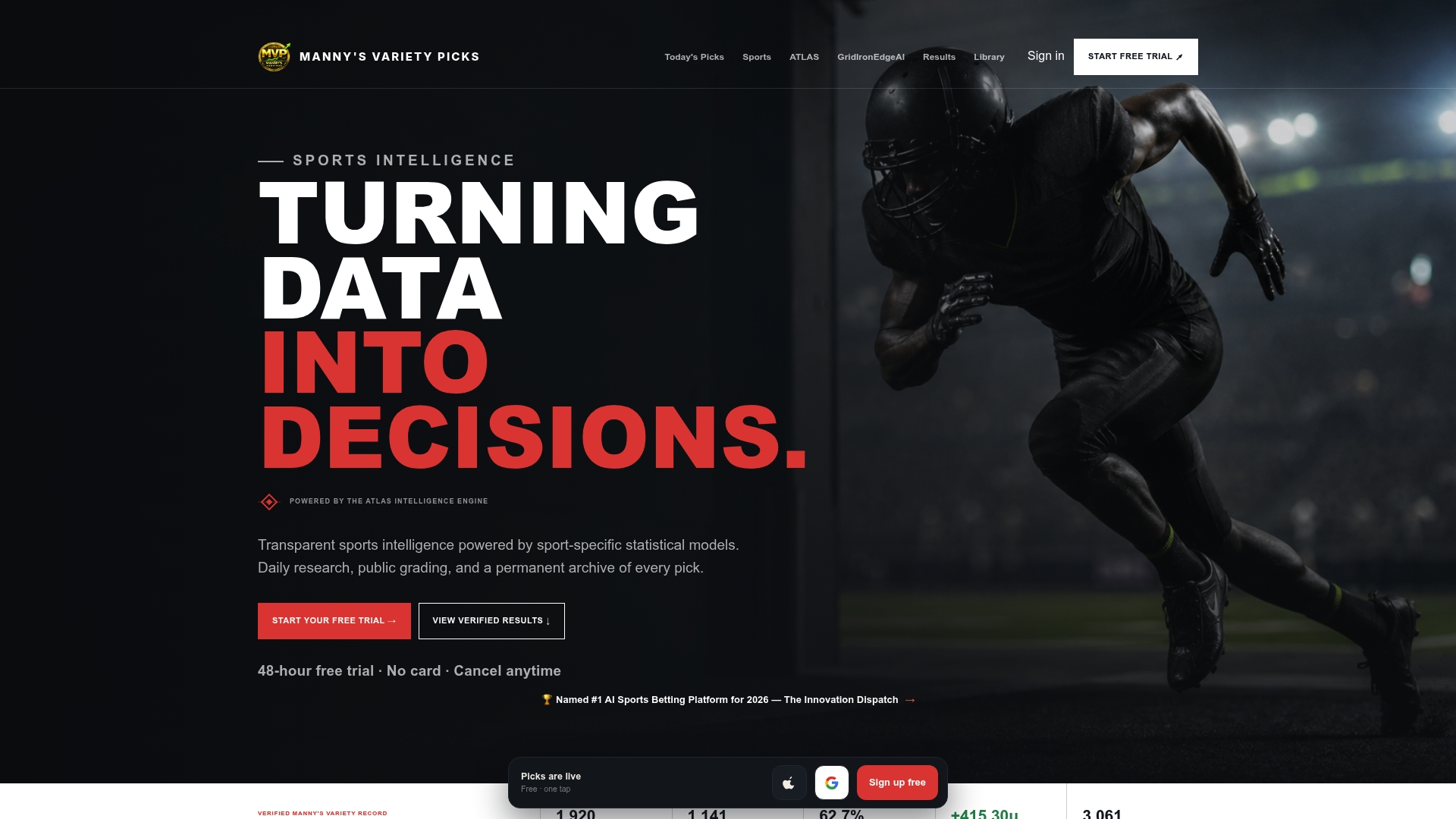
Start with the free plan, review the graded archive, and decide what fits your budget. Subscription cost should come out of your non-essential money, and it should sit inside the same limits as your bets. You can also visit the Manny’s Variety homepage for an overview of the sports covered.
When to get help
Tilt and chasing are common. Still, some patterns call for more than a better routine. The NCPG says gambling should not interfere with financial responsibilities, and that support is available if gambling stops being fun or hurts your life.
Talk to someone if you notice any of these:
- You bet money meant for rent, bills or debt payments.
- You break your own limits repeatedly, or you hide your betting from people close to you.
- You feel anxious, irritable or low when you are not betting.
- You keep chasing after losses even though you have promised yourself you would not.
In the U.S., the National Problem Gambling Helpline offers free, confidential support 24/7/365 by call or text at 1-800-MY-RESET. You can contact it for your own gambling or for someone else’s.
A licensed therapist can also help. Cognitive-behavioral therapy (CBT) is an evidence-based approach that helps people identify and correct distorted gambling thoughts and build coping strategies. If you want to take a break from betting, use the self-exclusion and cooling-off tools in your sportsbook account and ask the helpline about additional options.
FAQ
What does tilt mean in betting?
Tilt is a state in which frustration, urgency or overconfidence drives your decisions in place of your plan. The term comes from poker, where it describes a player who can no longer decide rationally. In sports betting it shows up as bigger stakes, rushed bets and wagers on markets you did not research.
How do I stop chasing losses?
Set a budget before you bet, stop when you reach your limit and never try to win back losses in the same session. Pre-set deposit and time limits, a written plan and a pause before your next session make this easier. If you cannot stop, call or text 1-800-MY-RESET.
How do I know I am on tilt?
Compare your behavior to your calm-state plan. Larger stakes, faster bets, off-plan sports and the thought that you are “due” are the usual signals. If two or more appear, end the session rather than trying to bet through it.
Can a betting model help with tilt?
A defined list of picks made before the games gives you a plan to follow, which reduces reactive bets. At Manny’s Variety, picks are graded publicly and archived, so you can review the record behind them. Keep your own units and limits regardless of the source.
When should I seek help for my betting?
Seek help when gambling affects your finances, your relationships or your mood, or when it stops being fun. The National Problem Gambling Helpline is available around the clock, and a therapist trained in CBT can help with the thinking patterns that fuel chasing.