
Find +EV NFL Props by Pairing Five Tool Types Each Day
The fastest route to a repeatable edge on NFL player props is a workflow that pairs a projection engine, an odds scanner, line shopping, and a bet tracker. The same prop can carry very different lines at different books, so line spreads across platforms are where value hides. Pair every hit rate with a consistency grade, and log every wager.
TL;DR:
- A hit rate is trustworthy only when the tool states its sample window, shows archived picks, and supplies a consistency grade for those props.
- Screen for props at 55% or better, check usage and opponent context, compare prices across books, then confirm value with a fair odds calculation.
- PropCruncher reported that the average line spread for the same prop across 51 platforms was 23.0 points, with some gaps reaching 200.0 points.
- Skip bets with small samples, high variance, or prices matching sharp books’ consensus, and log each wager to compare it with the closing line.
Table of Contents
- What should you look for in an NFL prop tool?
- Which types of tools matter for NFL player props?
- How do you find +EV props in a daily workflow?
- What data and models power credible prop tools?
- Why we build around records, not hunches
- How does Manny’s Variety put this workflow to use?
- FAQ
- Sources
What should you look for in an NFL prop tool?
Most tools look alike on a landing page. These checks separate the ones worth paying for from the ones that only repackage public odds:
- Public track record. A hit rate means little without a stated sample window and an archive of past picks you can inspect.
- Update cadence. Props move fast around injury news and lineup changes, so lines that sync in real time beat daily snapshots.
- Book coverage. A tool that shows the best price and the spread between books gives you more than one that shows a single sportsbook.
- Documented no-vig math. Positive-EV claims should come with an explanation of how fair odds are calculated.
- Consistency grades. A volatility filter keeps a lucky two-week streak from passing as an edge.
- Export options. CSV or API access lets you run your own analysis and feed results into a bet tracker.
Audited, archived picks are the strongest trust signal on the list. Anyone can post winners after the fact, but only a permanent record shows what was published before kickoff.
Pro Tip: Ask any tool for its hit rate over a defined window, then ask for the consistency grade on the same props. If it can only supply one of the two, treat the number as marketing.
Which types of tools matter for NFL player props?
Each category answers a different question, and none of them replaces the others.
- Projection engines model a fair line and a probability distribution for a stat such as receiving yards. Check the sample size, the inputs, and whether the method is explained.
- Aggregators and odds scanners pull prices from many books at once. Their value is coverage and speed, because a stale price is the one that looks like an edge and is not.
- Positive-EV scanners strip the sportsbook’s margin to estimate a fair price, then flag lines that beat it.
- Matchup explorers and injury overlays adjust a projection when context changes: a cornerback is out, a receiver’s snap share jumps, a game script tilts toward the run.
- Bet trackers record your price against the closing line. If you consistently beat the close, your process is working even when a short stretch of results says otherwise. Our guide to closing line value walks through that measurement.
Casual bettors can start with a cheatsheet that ranks props by hit rate. Statsbench’s 2026 guide suggests that approach for casual bettors, consistency grades for regular bettors, and positive-EV scanners with broad line shopping for grinders. If you want to see how line-tracking tools differ, we break down four types of line movement tools separately.
How do you find +EV props in a daily workflow?
Run the same routine every slate so you can test it. This is the sequence we use:
- Screen for candidates. Start with a projection tool or cheatsheet and pull props showing a hit rate of 55% or better, or a clear gap between projection and posted line.
- Check consistency and context. Look at the consistency grade, then at snap share, usage, and how the opponent defends that position.
- Shop the price. Use an aggregator to find the best number across books, and note how far it sits from the worst.
- Run the fair-odds check. A no-vig calculation confirms whether the best price is a real mispricing or just a different margin.
- Size and log the bet. Stake a fixed share of your bankroll, then record the price so you can compare it to the close later.
Skip the prop when the sample is small, when variance is heavy, or when the best price sits inside the consensus of sharp books. A line that every sharp book agrees on rarely leaves room for you.
Pro Tip: Treat the logging step as non-negotiable. A routine you cannot measure cannot be improved, and closing line value can help you assess whether your process holds up.

What data and models power credible prop tools?
When a tool claims a model-based edge, these are the foundations to recognize:
- Open play-by-play data. nflfastR and nfl_data_py supply play-level rows with EPA, WPA, air yards, and CPOE, which form the backbone of modern NFL projection models.
- Opponent adjustment. Raw production misleads when schedules differ, so DVOA-style thinking adjusts for the strength of the defense faced.
- Sample size. A projection built on a small sample can swing wildly. Stable models weight longer windows and shrink small samples toward a mean.
- No-vig fair odds. Removing the sportsbook’s margin is not one calculation. A 2024 analysis of 12,624 prop bets across four major sportsbooks found that power and multiplicative adjustments produce different probability estimates, and that favorite-longshot bias affects the result.
PropCruncher found that across 51 platforms the average line spread for the same player prop was 23.0 points, with some gaps reaching 200.0 points. That spread is the room line shopping gives you to work with.
Why we build around records, not hunches
Tools only help if you can verify them, and that conviction shapes how we work. In our own routine we combine sport-specific simulations, a daily slate of props, and fixed staking rules, then grade every pick publicly so the record cannot be quietly edited. Our AI-driven engines and archived picks are one example of how these categories fit together in practice. If you are starting out, begin with a cheatsheet, track closing line value across your first batch of bets, and only raise your stake once the numbers confirm the process. A record you can audit is worth more than any single hot week.
— Manuel
How does Manny’s Variety put this workflow to use?
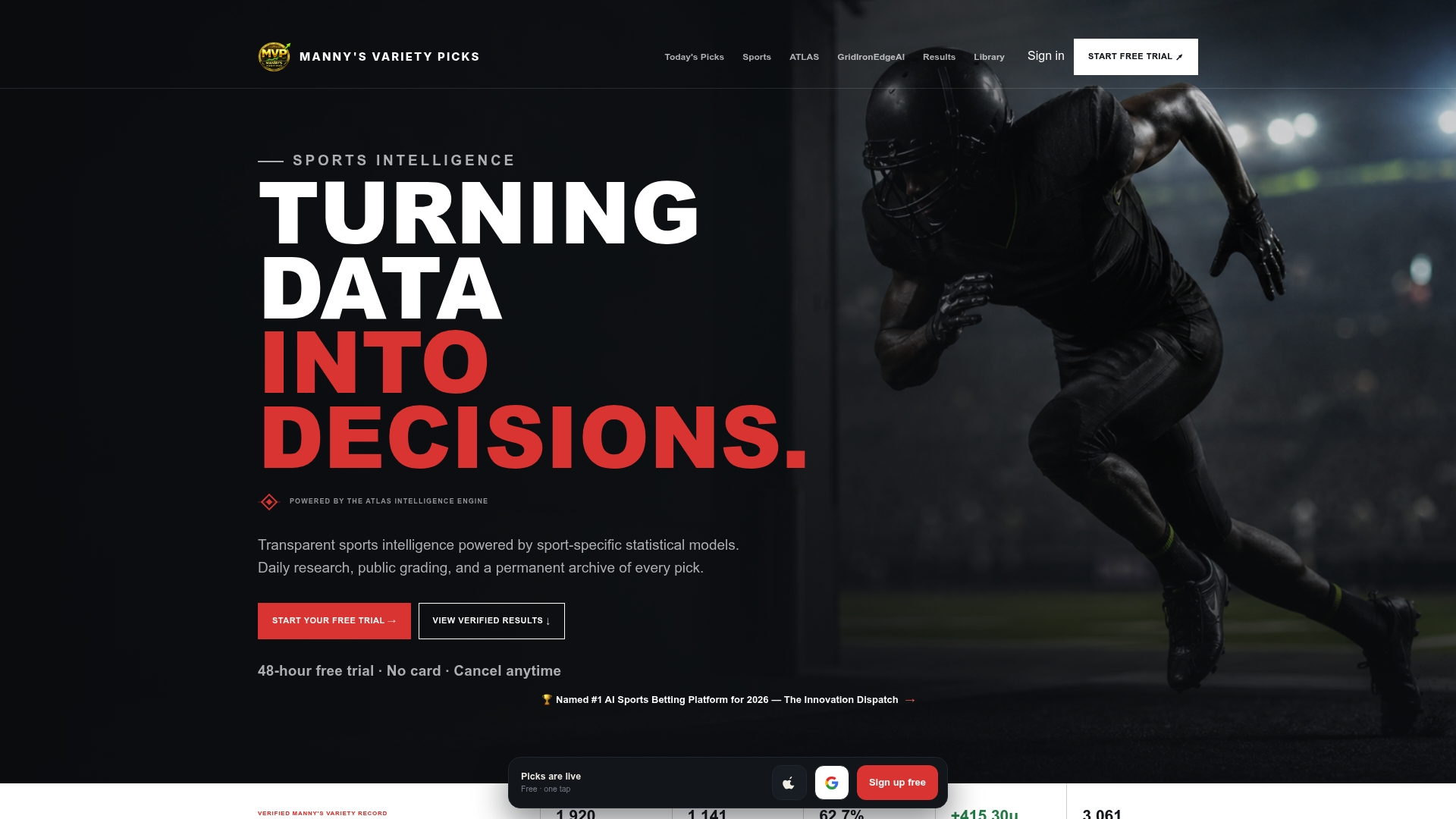
We built our platform around the routine above. Our sport-specific AI engines run real-time simulations, and every pick goes into a permanent archive that is graded in public. You can see how it works on our how it works page or browse our player props hub.
- Free: try the platform at no cost.
- Core: $39.99 per month.
- Elite: $79.99 per month.
Compare the access levels on our pricing page and pick the tier that fits how you bet.
FAQ
What is the best way to find value in NFL player props?
Combine a projection tool, an odds scanner, and a bet tracker. Screen props for a strong hit rate, shop the price across books, and confirm the edge with a no-vig fair-odds check before staking anything.
How many sportsbooks should you check before betting a prop?
As many as you can access. PropCruncher’s data shows the same prop can carry meaningfully different lines across platforms, so checking more books raises your chances of finding the best number.
Is a high hit rate enough to trust a prop tool?
No. A hit rate needs a stated sample window and a consistency grade beside it. Without both, a strong percentage can reflect a short hot streak rather than a durable edge.
What is closing line value and why track it?
Closing line value compares the price you bet to the final price before kickoff. Beating the close consistently suggests your process finds real value, even when short-term results swing the other way.
Where can you get help if betting stops being fun?
If gambling is causing stress or financial strain, resources such as Mdgamblinghelp offer support and guidance for bettors who need help.
Sources
- Prop Bet Strategy — How to Find Value Every Day | PropCruncher
- Best Player Prop Betting Strategies for 2026 - Statsbench
- Datafield
- shaan c