

Convert Odds to Probability: Quick Formulas & Examples
To convert odds to probability, apply one of four direct formulas depending on the format. Decimal: divide 1 by the decimal odds. Fractional: divide the denominator by the sum of denominator and numerator. American positive: divide 100 by (odds + 100). American negative: divide the absolute value of the odds by (absolute value of the odds + 100).
Quick reference:
- Decimal 2.50 → 1 ÷ 2.50 = approximately 40%
- Fractional 3/1 → 1 ÷ (3 + 1) = approximately 25%
- American +200 → 100 ÷ (200 + 100) = approximately 33%
- American −150 → 150 ÷ (150 + 100) = approximately 60%
Market overround note: When you add the implied probabilities of all outcomes in a market, the total typically exceeds 100%. That excess is the bookmaker’s margin, also called the vig or overround.
Key Takeaways
Converting odds to implied probability is the foundation of value betting: the no-vig fair probability, not the raw implied number, is what you should compare against your own assessment.
| Point | Details |
|---|---|
| Decimal formula | Divide 1 by the decimal odds to get implied probability instantly. |
| American odds split | Use two separate formulas: positive odds use 100 ÷ (odds + 100); negative use |
| Overround check | Sum all implied probabilities; anything above 100% is the bookmaker’s margin. |
| No-vig normalization | Divide each implied probability by the market total to get fair (no-vig) probabilities. |
| Decimal-first workflow | Convert all formats to decimal before batch comparisons or analytics runs. |
Table of Contents
- What implied probability means and how odds formats work
- How to convert odds to probability step by step
- Common market lines and their implied probabilities
- Why implied probabilities exceed 100% and how to remove the vig
- How professional bettors and analytics platforms use implied probability
- How to handle zero or extremely unlikely odds
- How bookmaker margins distort implied probability beyond the basics
- When to trust implied probability and when to look deeper
- Recommended calculators and resources
- Sources
What implied probability means and how odds formats work
Implied probability is the likelihood of an outcome as priced by a bookmaker. It translates a betting line into a percentage, letting you compare the market’s assessment against your own.
The three formats you’ll encounter in U.S. sportsbooks each express the same information differently:
- Decimal odds (common in Europe and on exchanges) show total return per $1 staked. Decimal 2.00 means you get $2 back for every $1 wagered, including your stake.
- Fractional odds (traditional in the UK and horse racing) show profit relative to stake. 3/1 means $3 profit for every $1 staked.
- American (moneyline) odds use a +/− sign. Positive numbers show profit on a $100 stake; negative numbers show how much you must stake to win $100.
The vig inflates each implied probability slightly above its true fair value. That inflation is covered in detail in the overround section below.
How to convert odds to probability step by step
1. Decimal odds
Formula: Implied probability = 1 ÷ decimal odds
Steps:
- Take the decimal price (e.g., 1.80).
- Divide 1 by that number: 1 ÷ 1.80 = 0.5556.
- Multiply by 100: approximately 56%.
The decimal-first approach is the cleanest entry point because the arithmetic never changes regardless of sport or market.
2. Fractional odds
Formula: Implied probability = denominator ÷ (numerator + denominator)
Steps:
- Take the fraction (e.g., 4/1).
- Add numerator and denominator: 4 + 1 = 5.
- Divide denominator by that sum: 1 ÷ 5 = 0.20.
- Multiply by 100: approximately 20%.
3. American odds — positive (underdogs)
Formula: Implied probability = 100 ÷ (odds + 100)
Steps:
- Take the positive line (e.g., +200).
- Add 100: 200 + 100 = 300.
- Divide 100 by that result: 100 ÷ 300 = 0.3333.
- Multiply by 100: approximately 33%.
4. American odds — negative (favorites)
Formula: Implied probability = |odds| ÷ (|odds| + 100)
Steps:
- Take the negative line (e.g., −110). Drop the minus sign: 110.
- Add 100: 110 + 100 = 210.
- Divide 110 by 210 = 0.5238.
- Multiply by 100: approximately 52%.
A common input mistake: entering −110 as 110 in a calculator that expects the sign. Always include the minus sign when using tools like the Oddsconv.
5. Reverse conversions: probability back to odds
- Probability → decimal: decimal = 1 ÷ probability (e.g., 40% → 1 ÷ 0.40 = 2.50)
- Probability → American (underdog, <50%): odds = (100 ÷ probability) − 100 (e.g., 33.33% → +200)
- Probability → American (favorite, >50%): odds = −(probability ÷ (1 − probability)) × 100 (e.g., 60% → −150)
Common market lines and their implied probabilities
The table below maps frequently seen prices across formats. Fractional values follow market convention, which sometimes rounds to the nearest tradeable fraction rather than the mathematically exact equivalent.
Market fractions sometimes differ from the exact decimal equivalent. A price of decimal 2.10 converts precisely to 10/11 fractionally, but books often display it as 11/10 for readability. When precision matters, work from the decimal. For a broader odds conversion table covering dozens of additional lines, the bitodds reference is a reliable quick-check resource.
Why implied probabilities exceed 100% and how to remove the vig
That excess is the overround, and it represents the book’s built-in margin.
Example: A standard NFL spread is priced at −110/−110 on both sides.
- Each side: 110 ÷ (110 + 100) = 52.38%
- Market total: 52.38% + 52.38% = 104.76%
- Overround: 4.76%
To find the no-vig (fair) probability, normalize each implied probability by dividing it by the market total:
- Fair probability (Side A) = 52.38% ÷ 104.76% = 50.00%
- Fair probability (Side B) = 52.38% ÷ 104.76% = 50.00%
On a balanced spread, the fair probabilities are exactly even. On a moneyline with a clear favorite, the normalization shifts the fair split accordingly. The Smarkets guide on implied probability walks through this normalization in detail.
At that level, you need a significant edge just to break even.
How professional bettors and analytics platforms use implied probability
Professionals rarely work in a single odds format. The standard practice is to convert all lines to decimal first before running any batch comparison or feeding prices into a model. Decimal math scales cleanly: 1 ÷ decimal gives implied probability in one step, and stake × decimal gives total return in one step. That consistency matters when you’re comparing lines across multiple sportsbooks or running hundreds of simulations.

The core value bet check is straightforward: if your assessed probability for an outcome is higher than the market’s implied probability, you have a potential edge.
Mannysvariety applies this logic at scale. Its sport-specific AI engines run thousands of simulations per game, comparing model-derived probabilities against live market lines to surface picks with genuine edges. For bettors who want to go beyond manual conversions, the Mannysvariety how-it-works page explains how those AI engines translate implied probability into daily picks across NBA, NFL, MLB, and more. Static reference charts are useful for quick mental checks, but automated pick tracking provides a stronger edge for portfolio-level decisions.
How to handle zero or extremely unlikely odds
Prices below 1.01 are theoretically possible but rarely appear in regulated U.S. markets.
No sportsbook prices a market there.
For longshots, the math works identically but the numbers get small fast. The risk for bettors is treating these as “free shots” without accounting for the vig, which inflates the true cost of the bet relative to its fair probability.
How bookmaker margins distort implied probability beyond the basics
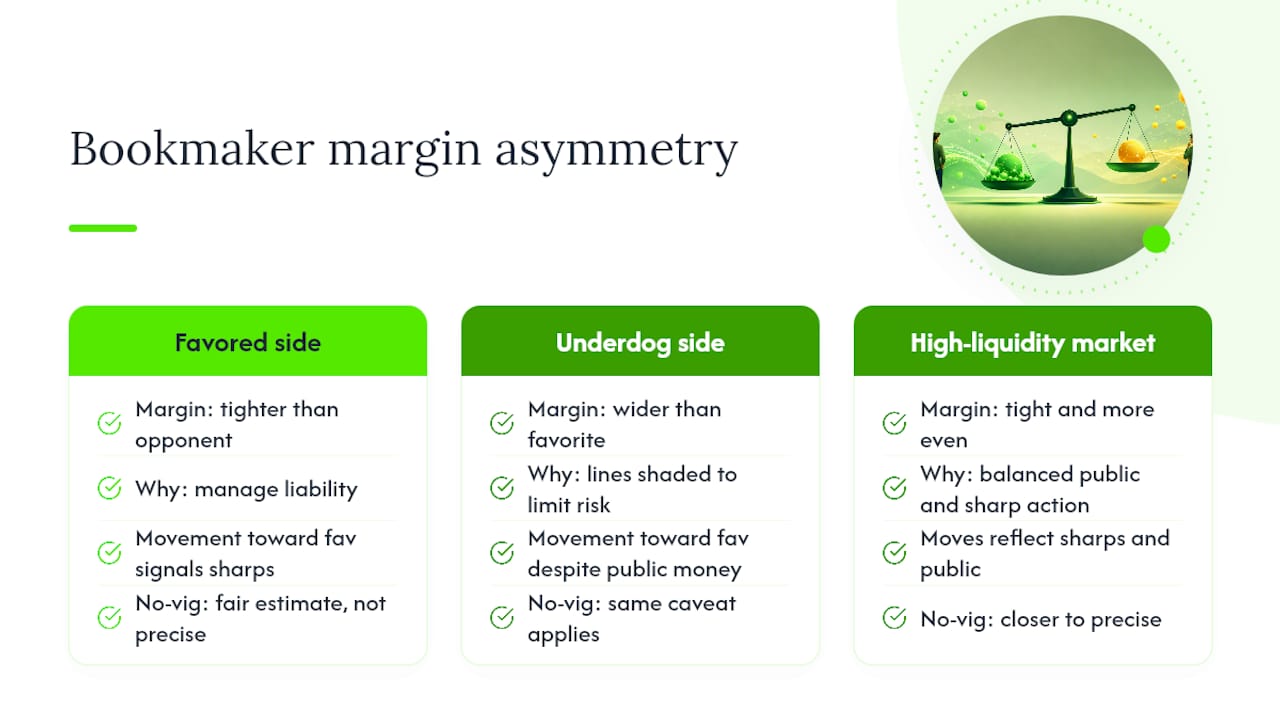
The overround isn’t uniform across a market. Books shade lines based on public betting patterns, liability exposure, and the sharpness of incoming action. A heavily bet favorite may carry a tighter margin than the underdog on the same game, because the book is managing exposure rather than applying a flat percentage.
This means the no-vig normalization method gives you a fair-probability estimate, not a precise one. The actual margin distribution between sides is rarely 50/50. Sharp bettors track line movement as a signal: when a line moves toward a favorite despite heavy public money on the underdog, it usually indicates sharp (professional) money on the favorite. That movement changes the implied probability in real time.
Markets with high liquidity, like NFL spreads and NBA totals, tend to have tighter and more evenly distributed margins. For prop-specific probability work, the NFL player props strategy guide on the Mannysvariety blog covers how margin asymmetry affects prop markets in practice.
Understanding probability basics also applies beyond sports. For readers interested in how probability principles extend to other forms of wagering, lottery probability basics offers a clear primer on the same foundational math.
When to trust implied probability and when to look deeper
The math behind implied probability is reliable. What varies is how much weight to give it in a live betting decision.
Low-overround markets with consistent line movement are the most trustworthy signals. When a line opens at −115, gets bet to −120, and holds there across multiple books, the market is telling you something coherent. That’s the environment where your own probability estimate, if it diverges from the implied number, carries the most meaning.
What I watch before acting on a probability gap:
- Market depth: Is this a high-volume market (NFL spread, NBA total) or a thin prop with limited action?
- Line movement direction: Is the line moving toward or away from my assessed probability?
- Comparables: Does the same team or player show a consistent edge across multiple recent markets, or is this a one-game anomaly?
A single implied probability calculation is a starting point. The edge comes from knowing when the market’s number is wrong and why.
Recommended calculators and resources
Online odds converters and conversion tables:
- Implied Probability Calculator — OmniCalculator: covers all three formats with step-by-step outputs.
- Oddsconv: decimal-first workflow with payout display.
- AceOdds Odds Converter: clean UI for decimal, fractional, and American conversions with implied probability output.
- OddsJam: real-time odds comparison across U.S. sportsbooks, useful for spotting line discrepancies after you’ve run your probability calculations.
- Bitodds Conversion Table: large static reference table for common market lines.
- Betiton Odds Converter: straightforward tool demonstrating the 1/decimal rule with live examples.
Analytics platform:
- Mannysvariety — How It Works: AI-driven pick generation that applies implied probability comparisons across NBA, NFL, MLB, NHL, and more, with a verified public track record.
Responsible gambling:
- GambleAware: free resources on safer gambling, self-exclusion tools, and support for anyone who needs help managing their betting.
Sources
- Implied Probability Calculator
- Oddsconv
- How to calculate implied probability in betting – Smarkets Help Centre
- Free Odds Converter: American, Decimal & Fractional to …
- Odds Conversion Table With Decimal, Fractional, US Odds & Probability