

NFL Weather Betting: Wind Thresholds and Line Timing
Wind is the single most actionable weather signal in NFL betting. Treat sustained wind above 20 mph as a strong under indicator, and use 15 mph and 25 mph as your secondary checkpoints. Before you place a wager on a game with weather in the forecast, check the roof status, compare the current market total against the season average for that stadium, and lean toward the under when totals were set before a wind forecast solidified.
- Check whether the stadium roof is open, closed, or retractable, 90 minutes before kickoff.
- Compare the market total to what it looked like Wednesday. If it hasn’t moved and wind is climbing, that’s your window.
- Treat 15 mph as a caution line, 20 mph as an action line, and 25+ mph as a strong under signal, per wind-based NFL weather betting models.
- Cross-reference forecasts with the National Weather Service before trusting a single app’s number.
Manny’s Variety builds these same thresholds into its NFL prediction engine, which is worth knowing before you dig into the mechanics below.
Key Takeaways
Wind above 20 mph sustained is the most reliable weather signal in NFL betting, and it should be checked hourly on Sunday, not just once midweek.
| Point | Details |
|---|---|
| Wind is the primary signal | Sustained wind above 20 mph reliably compresses scoring more than rain, snow, or cold alone. |
| Sustained beats gusts | Base your read on sustained wind speed; treat gusts only as a modifier when they exceed sustained speed significantly. |
| Check forecasts at four points | Review Wednesday, Friday, Sunday morning, and 90 minutes before kickoff for the most accurate read. |
| Heavy rain matters, light rain doesn’t | Only rain rates near an inch or more during the game meaningfully reduce scoring, roughly 2 to 4 points. |
| Manny’s Variety automates the model | Its NFL engine folds weather into daily picks with a public 63.5% win rate across 1,600-plus graded picks. |
Table of Contents
- Reading Game-Day Forecasts for NFL Weather Betting
- How Weather Moves Totals, Spreads, and Player Props
- A Simple Weather Adjustment Model for Totals
- When the Market Prices Weather, and When It Doesn’t
- What the Historical Numbers Say About Weather and Scoring
- How Manny’s Variety Builds Weather Into Its NFL Picks
- Applying Wind, Rain, and Timing Rules When You Bet
- Get Weather-Aware NFL Picks Without Building Your Own Model
- Sources
Reading Game-Day Forecasts for NFL Weather Betting
A forecast app tells you it’s “windy.” That’s useless for betting. You need five specific fields, and you need them at the right moments, not just once on Tuesday.
Here’s what actually matters when you pull up a game-day forecast:
- Sustained wind speed — the number that predicts scoring impact, not the flashy gust figure.
- Wind direction relative to the field’s long axis — a 20 mph crosswind barely touches field goals; a 20 mph headwind on deep throws wrecks them.
- Gust speed — only relevant as a modifier. If sustained wind is 15 mph but gusts hit 28 mph, treat the effective wind band as higher, not the sustained number.
- Precipitation rate and type — a light drizzle changes nothing; a half inch of rain during the game changes everything.
- Roof status — for stadiums with retractable roofs, this single data point can flip your entire read on a game.
Sustained wind and gusts get conflated constantly, and it costs bettors money. A stadium that reports “gusts to 30 mph” with sustained wind at 12 mph is a different bet than one holding steady at 22 mph sustained. The Datafield points out that markets frequently underweight wind direction and stadium-specific wind behavior, even when they react quickly to obvious rain or cold.
Build a checklist around four checkpoints:
- Wednesday: Pull the initial 7 to 10 day forecast. Note if wind or rain even shows up as a possibility.
- Friday: Forecasts firm up. This is when sharp bettors start adjusting positions if wind numbers hold steady.
- Sunday morning: Check hourly forecasts, not the daily summary. Kickoff-hour wind can differ from the noon reading by 10 mph.
- 90 minutes before kickoff: Confirm roof status and check METAR reports from the stadium’s nearest airport for the most current sustained wind and gust readings.
Pro Tip: Bookmark the stadium’s local airport METAR feed, not just a weather app. METARs update hourly with real observed conditions, including wind direction in degrees, which tells you instantly whether wind is blowing straight down the field or across it.
How Weather Moves Totals, Spreads, and Player Props
Wind doesn’t hurt scoring evenly. It’s non-linear. Up to about 15 mph, passing offenses barely notice. Cross into the 20 to 25 mph range and completion percentage, deep-ball accuracy, and field goal range all decline sharply. That’s why wind-adjusted betting models treat 20 mph as the real inflection point, not just a round number.
Totals move more than spreads in weather games. A bad crosswind hurts both offenses roughly equally, so the point spread often stays close to its original number while the total gets hammered down.
- Wind: Passing volume and kicking range shrink first. Totals and kicker props (field goal distance, made attempts) move the most.
- Rain: Light rain does almost nothing to scoring. Heavy rain, roughly an inch or more during the game, typically cuts scoring by two to four points due to ball security and footing issues.
- Snow: Snow falling during kickoff affects visibility and grip immediately. Snow that accumulated before the game but has stopped falling matters less than bettors assume, since grounds crews typically clear the field.
- Temperature: Cold alone rarely moves a line much above 20 degrees Fahrenheit. Below that, ball handling and kicking accuracy start to suffer, and the effect compounds when cold pairs with wind rather than adding to it in a simple linear way.
For player props, adjust quarterback pass attempts downward in high wind (teams lean on the run game more) and shave kicker field goal distance projections when wind exceeds 15 mph, especially on attempts from 45 yards or beyond. Our guide on adjusting player props breaks this down further.
A Simple Weather Adjustment Model for Totals
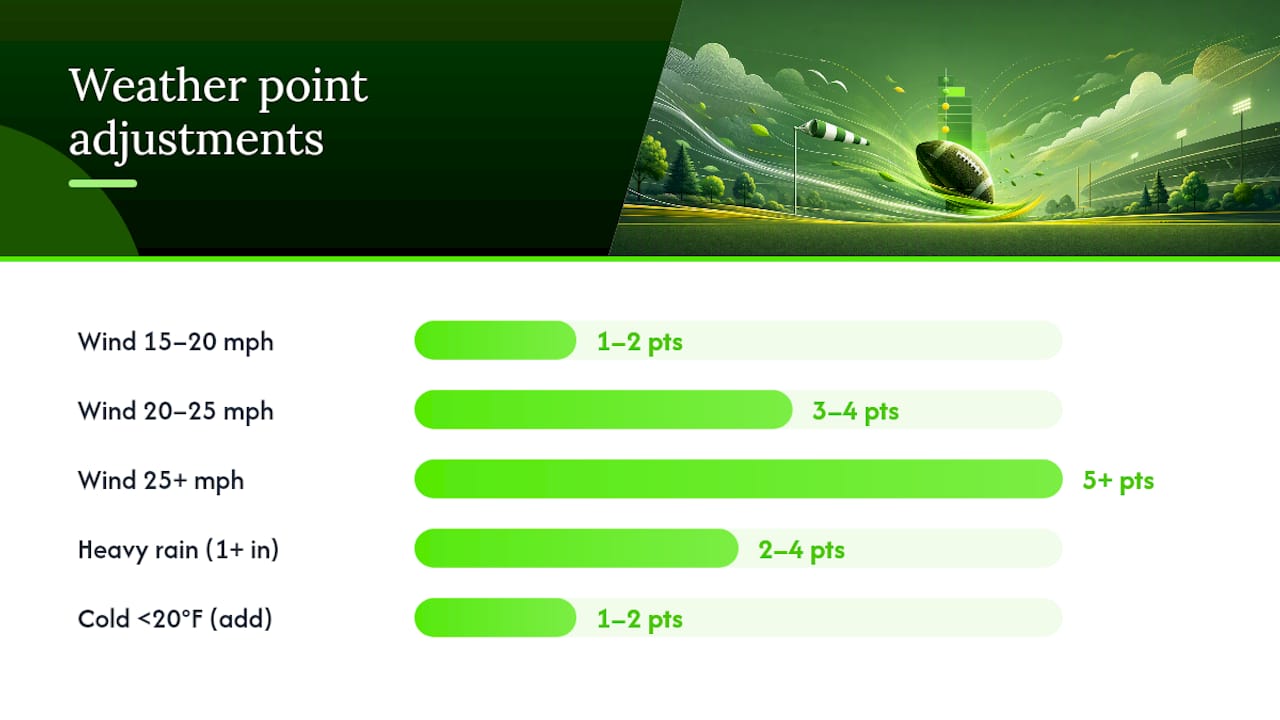
You don’t need a meteorology degree to build a usable model. You need bands and a multiplier, not addition.
Wind and cold interact multiplicatively, not additively. A 20 mph wind at 70 degrees hurts scoring less than the same 20 mph wind at 25 degrees, according to combined analysis from wind and cold betting research.
| Condition | Total Adjustment |
|---|---|
| Sustained wind 15–20 mph | Subtract 1 to 2 points |
| Sustained wind 20–25 mph | Subtract 3 to 4 points |
| Sustained wind 25+ mph | Subtract 5 or more points |
| Heavy rain (1+ inch during game) | Subtract 2 to 4 points |
| Temperature below 20°F, combined with wind | Add 1 to 2 additional points to the wind adjustment |
Apply the model in three steps:
- Start with the market total (say, 47.5).
- Apply the wind band adjustment, then layer any rain or extreme cold modifier on top rather than adding both figures separately.
- Compare your adjusted number to the market. A gap of 3 or more points is worth a second look.
Sample size is thin at the extreme bands, 25+ mph games don’t happen every week, and some stadiums (looking at you, wind tunnels built next to open water) behave worse than the raw wind number suggests. Adjust your confidence accordingly, and consider team-style modifiers, since dome-based passing offenses tend to suffer more in wind than run-heavy teams built for outdoor football.
When the Market Prices Weather, and When It Doesn’t
Sportsbooks move fast on obvious weather. A forecast showing a blizzard three days out gets baked into the total almost immediately. What moves slower, and what creates actual value, is wind direction and stadium-specific quirks.
- Early week: Totals reflect season-average expectations, not the specific forecast. This is often the worst time to bet weather.
- Midweek: If a wind or precipitation forecast holds steady for 48 hours, books start adjusting. Watch for total movement without a corresponding injury or lineup change, that’s usually weather.
- Sunday morning: The final pricing window. If the total hasn’t moved despite a strong wind forecast, that’s often where the edge lives.
- Detecting whether weather is priced in: Look at prop market shifts alongside the total. If the total dropped but kicker and passing props didn’t adjust, the market may have only partially priced the weather.
Weather rarely wins a bet by itself. It tends to work best stacked with other signals, divisional familiarity, short rest, or an offense already built around underneath throws, according to betting analysis on weather’s role in wagering. Stake weather plays modestly, and skip the ones where the wind forecast is still shifting hour to hour. For a deeper look at how to size these bets responsibly, the expected-value framework from Megasports Arena is worth reading before you commit real money to a marginal edge.
What the Historical Numbers Say About Weather and Scoring
The numbers back up the thresholds, but they come with real caveats. Games above 20 mph sustained wind show meaningfully higher under rates than the league average, and scoring drops accelerate rather than climb steadily as wind increases, consistent with the non-linear pattern documented in wind and cold impact studies. Heavy rain games show a smaller but still real scoring dip, in the two to four point range.
Extreme weather events don’t just move lines, they sometimes move entire games. Wildfire smoke and hazardous air quality have forced U.S. sports leagues to shift start times or postpone contests entirely, as seen when a Mets-Phillies game and an MLS match were both disrupted by smoke conditions in the same week.
That’s an extreme edge case, but it illustrates a broader point: weather disruptions beyond wind and rain, smoke, extreme heat advisories, even severe lightning delays, can alter kickoff timing and game conditions in ways that standard forecasts don’t fully capture. The sample size at the extreme bands (25+ mph, sub 10 degree games) stays small every season, so treat those thresholds as directional guides, not guarantees.
How Manny’s Variety Builds Weather Into Its NFL Picks
Weather is one input among many in a properly built prediction model, not a standalone bet. Manny’s Variety runs sport-specific AI engines that fold wind, precipitation, and temperature data into its NFL projections alongside team tendencies, injury data, and market movement, then run thousands of simulations to generate a probability-weighted pick.
The platform has posted a 63.5% win rate across more than 1,600 tracked picks, with a net return of 443.9 units, and every pick is archived publicly so you can check the grading yourself rather than take a marketing claim at face value.
- Daily picks factor in weather conditions automatically, so you don’t have to manually run the adjustment model yourself.
- Live updates reflect late-breaking forecast changes, including last-minute wind shifts.
- Every historical pick, weather-influenced or not, is graded and stored for public review.
Pro Tip: Use Manny’s Variety picks as a cross-check against your own wind-based math. If your manual adjustment and the platform’s pick line up, that’s added confidence before you bet.
Applying Wind, Rain, and Timing Rules When You Bet
Most weather content treats wind, rain, and cold as three separate factors to consider. That’s a mistake. The real skill is knowing they interact multiplicatively, and that wind direction relative to the field matters more than the raw speed number most bettors fixate on.
The conventional advice tells you to “check the weather” before betting a game. That’s not specific enough to act on. A bettor needs a threshold, 20 mph sustained wind, not a vague warning, and a timing rule, Sunday morning hourly forecasts, not “check before you bet.” The analysis showing markets underweight wind direction confirms there’s real value sitting in the gap between what’s obvious (rain, cold) and what takes actual modeling (crosswind at a stadium built next to open water).
Prioritize wind first, always. Then layer precipitation and temperature as modifiers, not equal factors. Data-driven platforms like Manny’s Variety operationalize exactly this kind of layered model at scale, running the same logic across every game on the slate rather than the handful you have time to check by hand.
— Manuel
Get Weather-Aware NFL Picks Without Building Your Own Model
Running the wind, rain, and temperature adjustments above for every Sunday slate takes real time, time most bettors don’t have between work and kickoff. Mannysvariety’s NFL engine runs that same weather layered analysis automatically across every game, combining it with team tendencies, injury reports, and market movement through thousands of simulations per matchup.

That transparency is rare in an industry where most services hide their misses. If you’d rather skip the manual math and get a weather-adjusted number delivered before kickoff, see how Manny’s Variety works and check today’s NFL slate.