

Golf Matchup Betting: Clear Rules and Examples for Bettors
Golf matchup betting is a wager where you pick which named player finishes with a lower score over a specified timeframe, either a single round or the full tournament. According to the PGA TOUR’s odds FAQ, matchup markets compare two or more golfers directly and grade the bet based on who posts the better score for that period. The core variants you’ll encounter at U.S. sportsbooks are:
-
2-ball (head-to-head): One player vs. one player, settled on round or tournament score.
-
3-ball: Three players compared simultaneously, typically within the same tee-time group.
-
Group/field matchups: Broader comparisons across a defined subset of players.
-
Round vs. tournament: Round bets cover 18 holes; tournament bets run all 72 (or 54 at shortened events).
-
Specialty formats: Hole-by-hole matchups, birdies-or-better props, and alternate group props.
Settlement note: when two players finish with identical scores, the outcome is either a push (stake refunded) or a tie result depending on the market type. If one player misses the cut and the other doesn’t, the player who made the cut typically wins the bet, though exact grading varies by sportsbook.
Key Takeaways
Golf matchup betting rewards bettors who understand settlement rules, shop prices across books, and align player selection to course-specific strokes-gained data.
| Point | Details |
|---|---|
| Know your market type | Two-way (push on tie) carries lower vig than three-way (tie is a separate losing outcome). |
| Cut and WD grading varies | The player who makes the cut typically wins; both-miss-cut grading differs by sportsbook. |
| Dead heats split the stake | In 3-ball ties, only a proportional share of your stake is active at the original odds. |
| Shop prices before placing | A difference of -105 vs. -110 compounds into meaningful savings across a full season. |
| Mannysvariety matchup signals | AI-driven daily picks with verified track record available at mannysvariety.com/how-it-works. |
Table of Contents
- What types of golf matchup bets are available?
- How are ties, dead heats, and tie options settled?
- What happens when a golfer misses the cut or withdraws?
- How do you read matchup odds and calculate sportsbook juice?
- How to place a matchup bet and read the settlement examples
- Specialty matchup markets: hole-by-hole, birdies-or-better, and group props
- Practical matchup strategies and bankroll management
- Tools and calculators that help you find matchup value
- Responsible gambling and U.S. legal basics
- Why matchup betting rewards process over prediction
- Mannysvariety delivers daily AI-powered matchup signals
- Sources
What types of golf matchup bets are available?
The most common format is the 2-ball head-to-head, which pits one golfer against another. Sportsbooks post these before the tournament begins and refresh them round-by-round as pairings are confirmed. Because you only need one player to outperform one other, the analysis is tighter and the variance is lower than picking an outright winner from a 156-player field.
3-ball markets group three players, usually the actual tee-time pairing, and ask you to pick the lowest scorer among them. Pricing is more complex here because three outcomes exist, and sportsbooks must price each player relative to two opponents rather than one. The hold percentage on 3-ball markets tends to run higher than on 2-ball markets as a result.
Group matchups and props extend the concept further. A sportsbook might offer “Top European” or “Best American” matchups, or group a set of players by world ranking tier. These markets appear less frequently and usually only at major tournaments like The Masters or the U.S. Open.
Specialty formats include:
- Hole-by-hole matchups: Available in live betting, these settle on a single hole’s score.
- Birdies-or-better props: You bet on whether a player makes a birdie or better on a specific hole or within a round.
- Alternate group props: Books post these during tournament week, often tied to specific pairings or featured groups.
The strategic choice between round and tournament matchups comes down to how much variance you want to absorb. Round matchups isolate 18 holes, which reduces the number of variables you must analyze. This mirrors the logic behind MLB first five innings betting, where bettors focus on a shorter, more predictable window rather than a full game outcome. Tournament matchups, by contrast, reward steadier ball-strikers and players with strong course history across all four rounds.
How are ties, dead heats, and tie options settled?
Settlement rules are where most bettors get caught off guard. Two distinct market structures exist, and they pay out very differently.
Tie-option (three-way) vs. refund-on-tie (two-way)
A three-way market lists three outcomes: Player A wins, Player B wins, or Tie. You must pick one. If you back Player A and the match ends in a tie, your bet loses. The sportsbook prices all three outcomes separately, and the combined hold across all three is typically higher than a two-way market.
A two-way refund-on-tie market has no tie option. If the players finish level, your stake is returned as a push. The vig is lower because the book only needs to price two outcomes. Three-way markets with a tie option usually carry substantially higher sportsbook margin than two-way markets, which increases the long-term cost to bettors who use them repeatedly.

Payout math: step-by-step
Example 1: Two-way market, Player A wins
- Stake: $110 on Player A at -110
- Implied probability of -110: 110 ÷ (110 + 100) = 52.38%
- Player A wins: profit = $100, total return = $210
Example 2: Two-way market, tie (push)
- Stake: $110 on Player A at -110
- Players tie: stake refunded, return equals the original stake, net zero
Example 3: Three-way market, tie occurs
- Stake: $110 on Player A at -110 (tie listed separately at +350)
- Players tie: bet on Player A loses, return = $0, net = -$110
Dead-heat rules for 3-ball and group bets
| Scenario | How it settles |
|---|---|
| Two of three players tie for best score | Stake split proportionally; each tied player’s portion paid at original odds |
| All three players tie | Stake split three ways; each portion paid at original odds |
| One clear winner in 3-ball | Full stake paid at original odds for the winning player |
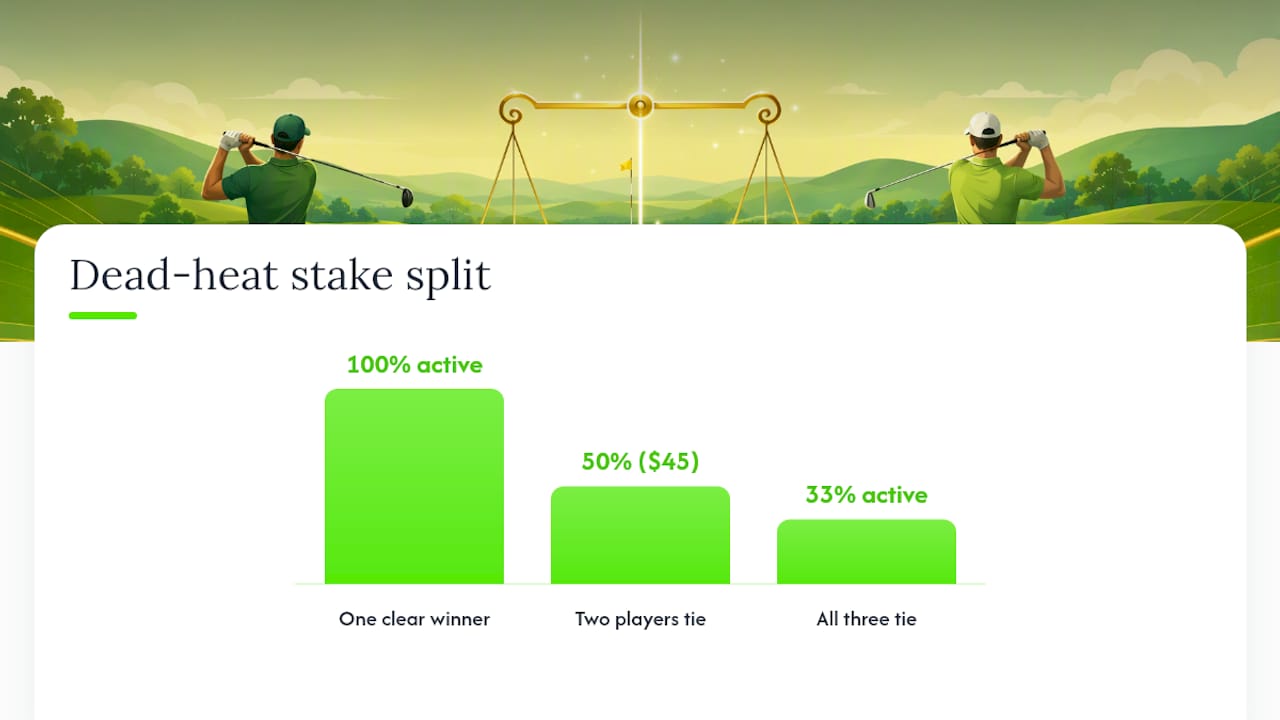
Concrete example: You bet $90 on Player B in a 3-ball at +150. Players B and C tie for the lowest score. The dead-heat rule splits your stake in half: $45 is active. Your return on that $45 at +150 is $67.50 plus the $45 stake, totaling $112.50. The remaining $45 is lost.
Pro Tip: Always check whether a market is two-way or three-way before placing. Refund-on-tie markets protect your stake in a push and carry lower vig, making them the better long-term structure for most bettors.
What happens when a golfer misses the cut or withdraws?
Cut and withdrawal grading is one of the most sportsbook-specific areas of golf betting. Standard rules exist, but exceptions are common enough that reading the terms before placing is non-negotiable.
Full-tournament matchups, one player misses the cut: The player who advances to the weekend typically wins the bet. This is the most common grading rule across major U.S. sportsbooks. If one player makes the cut and the other doesn’t, the player who made the cut typically wins the matchup, though books vary on the exact language.
Both players miss the cut: Grading splits here. Some books compare the 36-hole scores and grade the player with the lower score as the winner. Others void the bet and refund stakes. Check the specific sportsbook’s T&Cs before placing a full-tournament matchup on players who are borderline cut candidates.
Withdrawals and disqualifications: If a player withdraws before the round begins, most books void the bet and refund the stake. Mid-round withdrawals are treated differently: many sportsbooks grade the withdrawn player as a loss if the opponent completes the round. A disqualification is typically graded the same way as a withdrawal, with the opponent winning the bet.
A short callout worth repeating: sportsbook grading policies on cuts and WDs are not uniform. DraftKings, FanDuel, BetMGM, and Caesars each publish their own golf betting rules pages. Read them before a major tournament, not after you’ve placed your bets.
How do you read matchup odds and calculate sportsbook juice?
Converting American odds to implied probability
American odds tell you how much you win relative to your stake. The conversion to implied probability is straightforward:
- Negative odds (favorite): Implied probability = |odds| ÷ (|odds| + 100)
- Example: -110 → 110 ÷ 210 = 52.38%
- Positive odds (underdog): Implied probability = 100 ÷ (odds + 100)
- Example: +120 → 100 ÷ 220 = 45.45%
Calculating the hold (juice)
That’s the built-in edge the book keeps over time.
That’s a materially higher hold than the two-way equivalent, which is why two-way refund-on-tie markets are structurally cheaper for bettors.
Why price shopping matters
- A half-point difference in juice (-105 vs. -110) saves you roughly 2.4% per bet over time.
- Matchup lines can open soft early in the week before sharp money moves them.
- Closing-line value (CLV) is the practical measure of whether your process is adding value. Consistently beating the closing price correlates with long-term profitability.
- Use odds aggregators to compare prices across multiple licensed U.S. sportsbooks before placing.
Pro Tip: Book the best available price, not just the first one you see. On a -110 market, getting -105 at a competing book adds up to meaningful savings across a full season of matchup bets.
How to place a matchup bet and read the settlement examples
Step-by-step checklist
- Navigate to the golf section of your licensed U.S. sportsbook and find “Matchups” or “Head-to-Head” markets.
- Select the timeframe: round-by-round (18-hole) or full-tournament (72-hole).
- Confirm whether the market is two-way (push on tie) or three-way (tie is a separate outcome).
- Read the grading rules for cuts and withdrawals in the sportsbook’s T&Cs.
- Enter your stake and verify the potential payout on the bet slip.
- Screenshot the bet slip showing player names, odds, market type, and stake before confirming.
Worked settlement examples
Example A: Favorite wins a round matchup
- Market: 2-ball, Round 1, Player A (-130) vs. Player B (+110), two-way
- Stake: $130 on Player A
- Player A shoots 67, Player B shoots 70. Player A wins.
- Profit: $100. Total return: $230.
Example B: Underdog wins a tournament matchup
- Market: 2-ball, tournament, Player C (-115) vs. Player D (+105), two-way
- Stake: $100 on Player D at +105
- Player D finishes T22, Player C misses the cut.
- Player D wins. Profit: $105. Total return: $205.
Example C: Dead heat in a 3-ball
- Market: 3-ball, Round 2, Players E / F / G
- Stake: $60 on Player F at +200
- Players F and G both shoot 68; Player E shoots 70. Dead heat between F and G.
- Dead-heat rule: $30 active stake at +200 = $60 profit on that portion, plus $30 returned. Total return: $90. Net: +$30.
Screenshot the bet slip fields that matter most: market type (two-way vs. three-way), tie/push language, and the grading note for cuts. These fields are your reference point when a settlement dispute arises.
Specialty matchup markets: hole-by-hole, birdies-or-better, and group props
Specialty markets use the matchup concept but settle under different rules. Knowing those differences prevents surprises.
Hole-by-hole matchups are live-betting products. You pick which player wins a specific hole outright. Settlement is immediate: lower score on that hole wins, and a tie typically voids the bet (stake refunded). These markets move fast and require you to act before the players tee off on that hole.
Birdies-or-better props ask whether a player makes a birdie or better on a named hole or within a round. These are not head-to-head comparisons but use similar pricing logic. Settlement is binary: the player either makes the score or doesn’t.
3-ball and group prop dead heats in specialty markets:
- Dead-heat rules apply the same stake-splitting logic as standard 3-ball markets.
- In live 3-ball markets, the pairing is the actual tee-time group, so weather and tee-time advantages are baked into the pricing.
- If a player withdraws mid-round in a live 3-ball, most books grade the remaining two players as the active market and settle accordingly.
Live-market quirks to watch:
- Tee-time gaps of more than two hours can create meaningful course-condition differences (morning softness vs. afternoon wind).
- Books adjust 3-ball prices based on the pairing, so a strong player grouped with two weak opponents will be priced shorter than their world ranking alone would suggest.
- Pairings and tee times matter for in-play matchups. Always check the official pairing sheet before placing a round-based 3-ball bet.
Practical matchup strategies and bankroll management
Matchup markets reduce variance compared with outright tournament betting because you only need to beat one or two other players rather than a full field. That lower variance makes them a practical starting point for bettors building a process.
Five practical tips:
- Match strokes-gained profile to course demands. A course that rewards approach play (SG: Approach) favors iron-heavy ball-strikers. A course with wide fairways and premium on distance rewards SG: Off-the-Tee leaders. Align your matchup pick to the specific skill the course tests.
- Prefer refund-on-tie markets when the edge is close. When two players are nearly equal in your model, the push protection in a two-way market is worth more than the slightly better odds on a three-way tie option.
- Exploit soft opening lines. Early opening lines for matchups can be softer and therefore exploitable. Sharps often bet early to capture value before the market corrects. If you have a strong opinion, act before Wednesday afternoon.
- Float between round and tournament markets based on variance tolerance. Round matchups increase variance because a single bad hole can flip the result. Tournament matchups favor steadier players and process indicators like ball-striking and SG: Approach. Use round markets when you want a quick result; use tournament markets when your model shows a clear multi-round edge.
- Monitor pairings and tee times for weather exposure. A player paired in the morning wave during a calm day has a structural advantage over an afternoon player facing wind. This is especially relevant at links-style courses.
Because matchups carry lower variance than outrights, you can sustain a higher bet frequency without the same drawdown risk. Still, flat-betting a consistent unit size is more defensible than chasing losses with larger stakes.
Tools and calculators that help you find matchup value
The right tools cut analysis time and surface edges that manual research misses.
Multi-book odds comparison tools show you the best available price across licensed U.S. sportsbooks simultaneously. A price difference of even five cents on the dollar (-105 vs. -110) compounds meaningfully across a full season. Bookmark at least one aggregator and check it before every bet.
Implied-probability calculators convert American odds to percentages instantly. The math is simple enough to do manually (shown in the odds section above), but a calculator removes arithmetic errors when you’re comparing multiple lines quickly.
Strokes-gained data feeds are the analytical backbone of serious matchup handicapping. Strokes-gained splits and course-fit history are strong predictors for matchup value; books price heavily on world ranking and recent results, which can create exploitable edges when a player’s SG profile fits the course better than their ranking suggests. Look specifically at SG: Approach, SG: Around-the-Green, and SG: Putting splits filtered by course type (parkland, links, bermuda greens).

Course-history filters let you isolate how a player has performed at a specific venue across multiple years. A player who consistently outperforms their ranking at a particular course is a recurring matchup value target.
Bet-tracking and closing-line value tools are the long-term performance measure. Tracking CLV tells you whether your process is genuinely adding value or whether you’re winning on variance. Tools like a simple spreadsheet logging your opening price, closing price, and result are sufficient to start. More advanced platforms offer automated CLV tracking and ROI dashboards.
For a broader look at data-driven sports analytics resources, the FiveThirtyEight alternatives page at Mannysvariety covers additional modeling approaches worth bookmarking.
Responsible gambling and U.S. legal basics
Golf matchup betting is legal in states that have passed sports wagering legislation, and bettors must be of legal age to wager, which is 21 in most states. State laws govern both the minimum age and which sportsbooks are licensed to operate. Always verify your state’s current rules before placing a bet.
Key resources:
- National Council on Problem Gambling (NCPG): The NCPG operates the national helpline at 1-800-522-4700 and provides state-by-state resources for bettors who need support.
- State gaming commissions: Each licensed state publishes its own rules for sportsbook operators. Check your state’s gaming commission website for the current list of approved books.
- Sportsbook responsible-gambling tools: Most licensed U.S. sportsbooks offer deposit limits, session time limits, and self-exclusion options. Use them proactively, not reactively.
- Gambling Help Online: Available 24/7 for chat-based support in addition to phone helplines.
A short reminder: sportsbook-specific betting terms for golf markets, including cut rules, withdrawal grading, and dead-heat policies, vary by operator. Read the terms for each book you use, not just once but before each major tournament where the rules might affect your open bets.
This article provides general information about golf matchup betting and is not a substitute for professional legal or financial advice. Confirm current rules with your state’s gaming authority or a qualified professional.
Why matchup betting rewards process over prediction
Most bettors approach golf by trying to pick the outright winner, which means competing against a 156-player field and absorbing four rounds of variance. Matchup betting reframes the question entirely: you only need to be right about one player relative to one or two others.
That narrower frame is where data-driven bettors have a genuine edge. Sportsbooks price matchups primarily on world rankings and recent form, which are visible and widely tracked. Strokes-gained splits by course type, historical performance at specific venues, and pairing-based weather exposure are less efficiently priced, especially in early-week markets before sharp money arrives.
The analogy to first five innings betting in baseball is instructive. Isolating a shorter timeframe, whether it’s five innings or 18 holes, reduces the variables you must model and sharpens the signal-to-noise ratio. Round matchups work the same way: you’re not predicting four days of golf, just one.
The bettors who consistently profit from matchups are not the ones with the best gut instincts. They’re the ones who track closing-line value, shop prices across multiple books, and match their player selection to the specific skills a course rewards. That’s a repeatable process, not a lucky streak.
Mannysvariety delivers daily AI-powered matchup signals
Picking the right player in a 2-ball or 3-ball matchup requires more than a quick glance at world rankings. Mannysvariety’s AI-powered platform runs thousands of simulations per event, generating daily picks and wager-sizing guidance across PGA Tour matchup markets. The platform covers 2-ball and 3-ball formats, tracks strokes-gained splits by course type, and flags early-week lines where the model identifies value before the market corrects.

The platform’s verified track record, including win rate and historical unit returns, is publicly available on the how-it-works page. Short-term day passes and weekly access are available alongside monthly subscriptions, so you can evaluate the signals before committing to a full plan. Check the pricing page for current options and start with a trial to see the matchup picks in action.