

What Is a Verified Betting Record and How Do You Check One?
A verified betting record is a betting history that’s timestamped before each game starts, graded automatically against final scores, and published as a full, unedited ledger, including every loss. The bottom line: never trust a track record without a permanent, third-party link, and always check that the timestamps predate kickoff. Open the ledger yourself and confirm one sample pick was locked before the game went live.
Quick checklist:
- Locked before the game (not after)
- Graded automatically, not by hand
- Full history shown, wins and losses alike
| Check | What It Confirms |
|---|---|
| Timestamp | Pick was posted before the event started |
| Auto-grading | Result wasn’t edited after the fact |
| Full ledger | Losses are included, not hidden |
Key Takeaways
A verified betting record is only trustworthy when it’s timestamped before the event, graded independently, and published in full, including every loss.
| Point | Details |
|---|---|
| Definition matters | A verified record requires pre-event timestamps, independent grading, and a full public ledger. |
| Run the three tests | Confirm the pick was locked early, graded automatically, and shows losses alongside wins. |
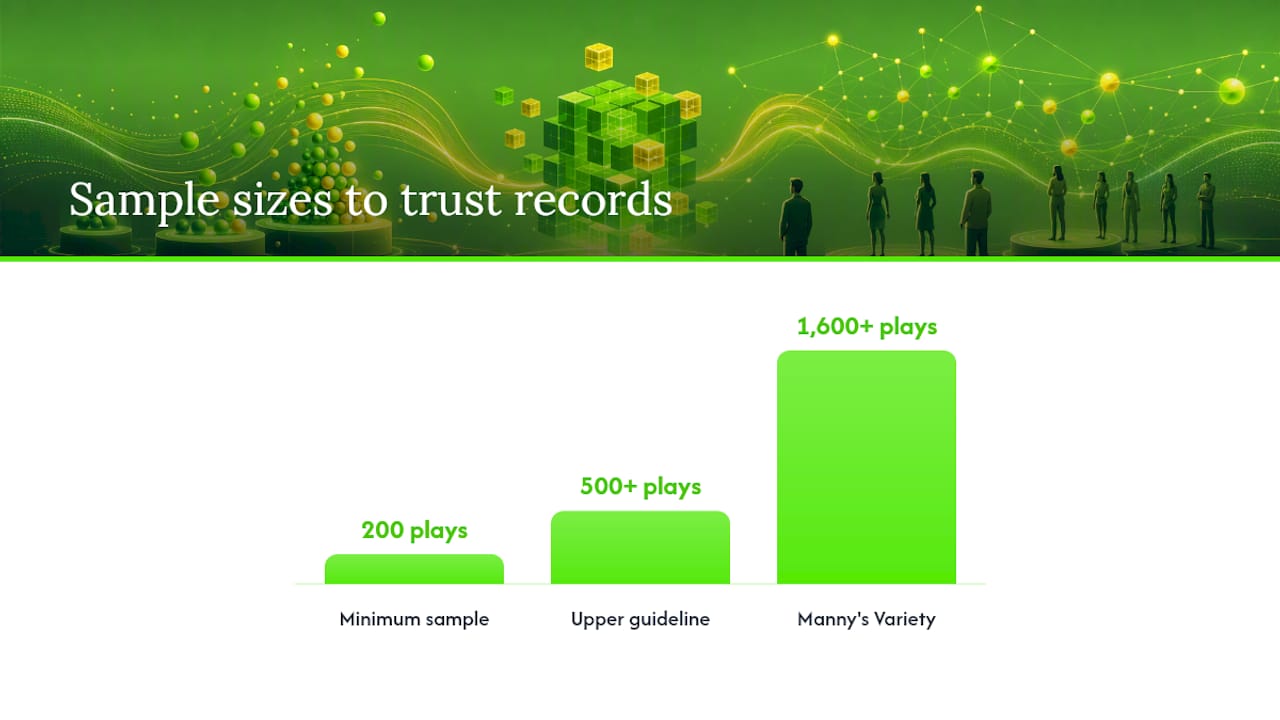
| Sample size counts | Look for 200 to 500+ graded plays before trusting a win rate or ROI figure. |
| Watch for retroactive edits | Unit sizes that change after the fact are one of the most common ways records get inflated. |
| Manny’s Variety sets the standard | Its public ledger shows 1,600+ graded picks, a 63.5% win rate, and 443.9 net units, all auto-graded and archived. |
Table of Contents
- What “Verified” Actually Means for a Betting Record
- The Three Tests That Prove a Record Is Genuinely Verified
- How to Inspect and Audit Someone Else’s Public Record
- Platforms and Tools That Provide Third-Party Verification
- How to Set Up Your Own Tamper-Evident Verified Betting Record
- Red Flags That Signal a Fake or Misleading Record
- What a Genuine Verified Ledger Looks Like in Practice
- Why Transparency Is the Real Product
- See the Verification Standard for Yourself
- Sources
What “Verified” Actually Means for a Betting Record
Verification isn’t a vibe. It’s three specific things: a timestamp that locks in before the event, grading that happens independently of the person who made the pick, and a public ledger nobody can quietly edit later. A real record also shows its math: units won or lost, ROI calculated with the juice included, a win-loss column, total plays graded, and the grading method itself.

Here’s the difference in practice. A screenshot of a “12-2 week” tells you nothing, because you can’t see what happened before it or after it. A ledger entry tells you the exact date, the odds at that moment, the stake in units, and the final grade, all sitting in a record you can scroll back through for months. One is marketing. The other is proof.
Pro Tip: If a handicapper can’t show you a losing week, that’s not luck. That’s a filtered feed.
The Three Tests That Prove a Record Is Genuinely Verified
Every legitimate track record passes three tests. Fail one, and the whole thing is suspect, regardless of how good the win rate looks.
- Locked before the game. The pick needs a timestamp that predates the event, ideally through a platform that stamps posts automatically rather than letting the handicapper type in a date.
- Independently graded. Results should come from final scores fed into an automated grading system, not from the handicapper marking their own homework after the fact.
- Full, uneditable history. Every play shows up, wins and losses, with consistent unit sizing from the first entry to the last.
Sample size matters just as much as the mechanics. A 15-play hot streak proves nothing. Independent guides on verifying handicapper records point to 200 to 500 plays as the range where win rate and ROI start meaning something statistically. Below that, you’re looking at noise dressed up as skill.
How to Inspect and Audit Someone Else’s Public Record
Auditing a claimed track record takes about ten minutes if you know where to look.
- Open the public ledger. Confirm it lives at a permanent URL, not a page that resets or disappears after a subscription ends.
- Sample a few picks. Check the timestamp, the odds posted at that moment, and compare them against the closing line for that game.
- Check unit consistency. A 1-unit play in January shouldn’t quietly become a 3-unit play in March once the streak looks good.
- Look at ROI math. Confirm the calculation accounts for the juice, not just the raw win-loss count.
- Check sample size and drawdowns. A record with zero losing streaks across 300 plays is not a record. It’s fiction.
- Search for outside chatter. Reddit threads and betting forums often surface complaints a seller’s own site will never mention.
Pro Tip: If the platform hides post metadata, cross-reference the pick’s posted odds against historical line movement data from that game day. A pick claiming odds that never existed at that price is a dead giveaway.
Platforms and Tools That Provide Third-Party Verification
Four categories dominate this space: public pick trackers, dedicated ledger services, consumer bet-tracking apps, and exportable self-tracking spreadsheets or tools. Each solves the trust problem a little differently.
What to look for in any of them:
- Automatic timestamping, not a manual date field the handicapper controls
- Grading pulled from final scores, not entered by hand
- A permanent, shareable URL that survives even if a subscription lapses
- Clear display of units, ROI, win rate, and total plays graded
- Export or API access so you can pull the raw data yourself
Notable names bettors run into: TrustMyRecord and Veri.bet function as public ledger sites built specifically around locked, auto-graded picks. FeedMe.bet and Pikkit lean toward bet-tracking with import and dashboard features. Action Network and BetStamp are consumer apps offering bet history, notifications, and grading, and BetStamp’s own listing highlights automatic grading and complete history as core features. Manny’s Variety fits the same standard, publishing a permanent, third-party graded ledger rather than a self-reported spreadsheet.
Before trusting any of them with your data, check the platform’s privacy policy. A service that’s vague about data handling is a service you should be cautious about linking your betting history to.
How to Set Up Your Own Tamper-Evident Verified Betting Record
Building a record worth trusting starts with structure, not spreadsheets you can quietly edit at 2 a.m. after a bad beat.
- Pick a timestamp-capable platform. Choose a ledger service or tracking app that stamps entries automatically the moment you post.
- Set a flat unit size. Decide it once, in writing, and never adjust it retroactively.
- Log the full entry before the game. Date, market, stake, and posted odds, all recorded before kickoff, not after.
- Publish a permanent link. Share it publicly so anyone can scroll the full history, not a curated highlight reel.
Sample ledger entry template:
Keep original evidence, screenshots with visible timestamps, API exports, or CSV downloads, so nothing in your history can be quietly rewritten later. That archive is your backup if a platform ever goes down or a dispute comes up.
Red Flags That Signal a Fake or Misleading Record
Some warning signs show up again and again, and they’re easy to spot once you know what to look for.
- Screenshots instead of a live link. Ask for the actual ledger, not a curated image.
- Absurd win rates. Anything claiming 80% or higher over a real sample is almost certainly cherry-picked.
- Hidden “VIP” picks excluded from the public record. If the best picks aren’t in the ledger, the ledger is meaningless.
- Unit sizes that change after the fact. This is one of the most common manipulations in the industry, quietly reweighting old picks to inflate a streak.
- Losses missing entirely. No bettor wins every week. A record without losses isn’t a record.
Instead of taking any claim at face value, ask for the permanent ledger link and a full CSV export. A legitimate service hands both over without hesitation.
What a Genuine Verified Ledger Looks Like in Practice
Manny’s Variety publishes picks against a public, auto-graded ledger rather than a self-reported tally, which is the standard worth measuring any service against.
Proof points to check on a real ledger: permanent URL, automated grading against final scores, units won, and ROI across the full sample.
Manny’s Variety has tracked a large number of graded picks for a significant net return and a win rate above average across its history.
Auditing one entry takes three steps:
- Pull a single graded pick and confirm its timestamp predates the game’s start time.
- Compare the posted odds on that entry against the market’s closing line for context.
- Check the unit impact shown against the running total to confirm the math holds up across the ledger.
Why Transparency Is the Real Product
The betting industry has a trust problem, and it’s mostly self-inflicted. Too many services treat “track record” as a marketing asset instead of an audit trail, which is exactly backwards. A record you can’t scrutinize isn’t a record. It’s a pitch.
We built Manny’s Variety around the opposite premise: every pick gets timestamped, graded automatically, and archived permanently, whether it wins or loses. That matters most for amateur bettors, who rarely have the time to cross-check a handicapper’s claims against forum chatter and closing-line data. Long-term verification only works if losses stay visible as long as wins do.
See the Verification Standard for Yourself
Most pick services ask you to trust a highlight reel. Manny’s Variety asks you to check the receipts instead, every graded pick sits in a permanent public ledger with automated grading pulled straight from final scores, not hand-typed results.

The platform’s sport-specific AI engines cover NBA, MLB, NFL, and more, and every pick logged carries the same timestamped, auto-graded treatment described throughout this guide. If you want to see exactly how the verification process works before committing to anything, that page walks through the full methodology alongside the public track record. Short-term day and week passes are available if you’d rather test the ledger yourself before subscribing, and pricing details for ongoing access are listed on the Manny’s Variety pricing page.
Sources
- How to Verify a Sports Handicapper’s Track Record in 2026: The Bettor’s Complete Guide - XCLSV