

American Odds Explained: Read Any Line in Seconds
American (moneyline) odds tell you one of two things: how much profit a $100 bet returns, or how much you must risk to win $100. A line of +200 means a $100 stake wins $200 in profit. A line of −150 means you risk $150 to collect $100 in profit. Either way, a winning bet returns your original stake on top of that profit.
Key Takeaways
American odds use a $100 reference point: positive odds show profit on a $100 bet, negative odds show the amount you must risk to win $100, and implied probability reveals the break-even win rate the market has priced in.
| Point | Details |
|---|---|
| Positive odds (+) | Show profit on a $100 stake; +200 returns $200 profit plus your $100 back. |
| Negative odds (−) | Show the amount to risk for $100 profit; −110 requires a $110 stake. |
| Implied probability | Use 100 ÷ (odds + 100) for positive and |
| Vig adds up | Both sides of a −110/−110 line sum to 104.76%, not 100%; that gap is the sportsbook’s margin. |
| Decimal for parlays | Convert each leg to decimal, multiply, then convert back to American to avoid sign errors. |
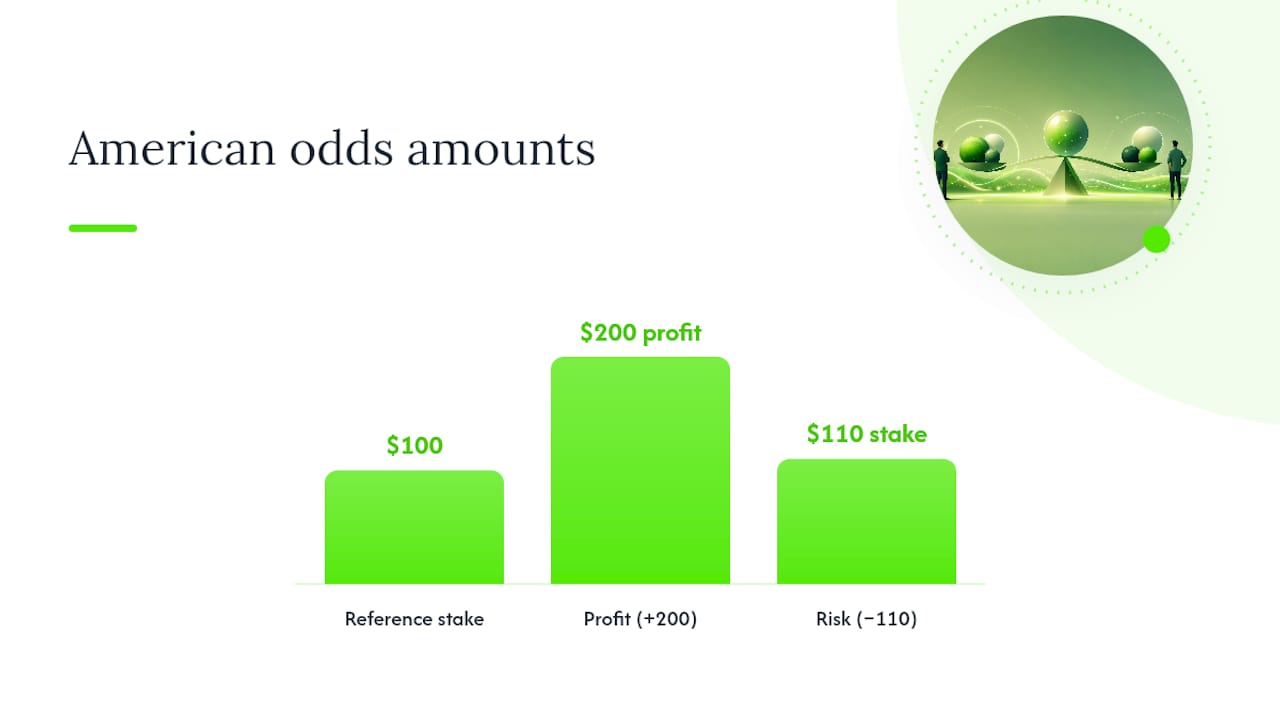
Table of Contents
- What are American (moneyline) odds and where do you see them?
- How do you read plus and minus American odds?
- How do you calculate profit and total return for any stake?
- How do you convert American odds to implied probability?
- How do you convert American odds to decimal and fractional formats?
- What mental-math shortcuts help you estimate odds quickly?
- When should you use American odds vs. decimal odds?
- The part beginners underestimate about learning odds
- Sources
What are American (moneyline) odds and where do you see them?
American odds, also called moneyline odds or U.S. odds, are built around a $100 reference point. Every number on a U.S. sportsbook screen is either positive or negative relative to that baseline. The format is the default across American sports betting, from NFL spreads to NBA totals to MLB moneylines, and it appears on every major U.S. sportsbook app and broadcast graphic.
You’ll encounter this format under several names:
- Moneyline odds — the most common term on U.S. sportsbook apps
- American odds — used in educational and international contexts
- U.S. odds — shorthand when comparing to decimal or fractional formats
The plus/minus notation is what makes this format distinctive. Positive numbers mark underdogs; negative numbers mark favorites. That single rule covers every line you’ll see, whether you’re betting a point spread, a game total, or a straight moneyline.
How do you read plus and minus American odds?
The sign in front of the number is the whole story. Here’s how each works, according to Investopedia:
Positive odds (+): The number shows your profit on a $100 bet.
- +150 means a $100 bet wins $150 in profit. Total return: $250.
- +200 means a $100 bet wins a significant profit. Total return includes the stake plus profit.
Negative odds (−): The number shows how much you must risk to win $100.
- −200 means you risk $200 to win $100 in profit. Total return: $300.
- −110 means you risk $110 to win $100 in profit. Total return: $210.
Scaling to any stake: You don’t have to bet exactly $100. Use the ratio.
- Identify the odds: say +150.
- Set your stake: say $25.
- Divide your stake by 100: $25 ÷ 100 = 0.25.
- Multiply by the odds number: 0.25 × 150 = $37.50 profit.
- Add your stake back for total return: $25 + $37.50 = $62.50.
For negative odds at −200 with a $50 stake: $50 ÷ 200 = 0.25 × 100 = $25 profit, total return $75.
How do you calculate profit and total return for any stake?
Two formulas handle every American odds calculation. Apply whichever matches the sign.
For positive odds:
Profit = Stake × (Odds ÷ 100) Total Return = Stake + Profit
For negative odds:
Profit = Stake × (100 ÷ |Odds|) Total Return = Stake + Profit
Pro Tip: To scale quickly from the $100 baseline, treat your stake as a fraction of $100. A $25 bet is 0.25 of $100, so multiply the odds number by 0.25. This works for any stake and keeps the math clean without a calculator.
How do you convert American odds to implied probability?
Implied probability is the break-even win rate baked into a given line. The formulas differ by sign:
Positive odds:
Implied probability = 100 ÷ (Odds + 100)
Negative odds:
Implied probability = |Odds| ÷ (|Odds| + 100)
Three worked examples:
- +200: 100 ÷ (200 + 100) = 100 ÷ 300 = 33.33%
- −150: 150 ÷ (150 + 100) = 150 ÷ 250 = 60.00%
- −110: 110 ÷ (110 + 100) = 110 ÷ 210 = 52.38%
The vig (sportsbook margin): Add the implied probabilities for both sides of a typical game. On a standard −110/−110 spread, each side implies 52.38%, which sums to 104.76%. That extra 4.76% is the sportsbook’s built-in margin, commonly called the vig or juice. You need to win more than 52.38% of your −110 bets just to break even, which is why accounting for vig matters before comparing your model’s edge to market prices.
- Implied probabilities always sum to more than 100% across a full market.
- The gap above 100% represents the sportsbook’s profit margin.
- Comparing your own probability estimate to the implied probability reveals whether a line has value.
How do you convert American odds to decimal and fractional formats?
Different markets use different formats. Knowing how to convert keeps you from misreading a line when you shop across books. Converting American to decimal first reduces sign errors and keeps the math consistent.
American → Decimal:
- Positive odds: Decimal = (Odds ÷ 100) + 1. Example: +150 → (150 ÷ 100) + 1 = 2.50
- Negative odds: Decimal = (100 ÷ |Odds|) + 1. Example: −200 → (100 ÷ 200) + 1 = 1.50
Decimal → American:
- Decimal ≥ 2.00: American = (Decimal − 1) × 100. Example: 2.50 → +150
- Decimal < 2.00: American = −100 ÷ (Decimal − 1). Example: 1.50 → −200
Fractional ↔ Decimal: Divide the fraction. 5/2 = 2.50 decimal. 1/2 = 1.50 decimal. “EVS” (evens) = 2.00 decimal = +100 American.
What mental-math shortcuts help you estimate odds quickly?
You won’t always have a calculator handy. These three shortcuts cover the most common sportsbook prices, drawing on common translations bettors use to estimate quickly:
- +200 ≈ 33% implied chance. Divide 100 by 300 (odds + 100). On a $10 bet: profit = $10 × 2 = $20. Fast check: double your stake.
- −150 ≈ 60% implied chance. Divide 150 by 250. On a $25 bet: profit = $25 × (100/150) = $16.67. Fast check: multiply stake by two-thirds.
- −110 ≈ 52%. The standard spread price. On a $25 bet: profit ≈ $22.73. Fast check: your profit is just under your stake.
Parlay quick-check tip: American odds make parlay math awkward because you can’t simply add the numbers. Convert each leg to decimal first, multiply all the decimals together, then convert the result back to American. For two legs at +150 (2.50) and −110 (1.91): 2.50 × 1.91 = 4.775 decimal, which equals roughly +378 American. Use the best parlay picks resource to see how combined payouts work in practice before committing real money.
When should you use American odds vs. decimal odds?
Decimal odds are the easiest format for arithmetic: stake × decimal = total return, no sign to track. American is the U.S. default and what every domestic sportsbook displays. Fractional odds remain common in UK horse racing but are rarely seen on U.S. apps.
American odds work best when:
- You’re betting on U.S. sportsbooks (DraftKings, FanDuel, BetMGM, and similar apps all default to this format).
- You want to quickly spot favorites vs. underdogs by sign.
- You’re reading a broadcast graphic or a sports media line.
Decimal odds work better when:
- You’re comparing lines across multiple books or international markets.
- You’re calculating parlay payouts (multiply decimals; no sign confusion).
- You want a faster mental check on total return.
Pro Tip: Learn American odds first since that’s what you’ll see on every U.S. app. Once the +/− logic feels automatic, switch your display to decimal for any multi-book line shopping or parlay math. Most sportsbook apps let you toggle the format in settings.
Horse-racing bettors in the U.S. occasionally see fractional odds on track programs, but moneyline format has largely replaced them on digital platforms.
The part beginners underestimate about learning odds
Most beginners spend too long trying to memorize formulas and not enough time just reading live lines. The fastest way to get comfortable with American odds is to pull up a real sportsbook screen, pick three games, and convert each line to implied probability by hand. Do that for a week and the +/− logic becomes automatic.

The other thing worth saying plainly: implied probability is more useful than raw odds. Knowing that −150 implies 60% tells you something about the market’s confidence. Knowing that your own analysis puts the team at 55% tells you the line has no value for you. That gap between your estimate and the market’s implied probability is where betting decisions actually live. Tools like AI sports betting models exist precisely to quantify that gap with more data than any individual bettor can process manually.
Start small. Convert lines. Check your math against a calculator. The arithmetic gets fast quickly.
Sources
- Oddsconv
- Sports Betting Odds: How They Work and How to Read Them · Investopedia
- Odds to Implied Probability Calculator | Break-Even Chance
- American Odds to Probability Odds Converter | Betting Calculators and Odds Tools
- American vs Decimal vs Fractional Odds Explained · BetToolkit