

Expected Value Betting: How to Calculate and Find +EV Bets
Expected value (EV) is the probability-weighted average profit or loss a bet produces if you placed it thousands of times. The formula is simple: EV = (win probability × profit) − (loss probability × stake). When that number lands above zero, the bet is +EV, meaning it should profit over the long run. When it’s negative, the sportsbook has the edge, and you should pass.
A few reference points anchor everything that follows:
- The law of large numbers means EV only proves itself over hundreds or thousands of bets, not a single Sunday slate.
- Fractional Kelly criterion staking helps you size bets to your actual edge instead of guessing.
- Closing-line value (CLV) is the closest thing to real-world proof that your process finds genuine value.
Take +EV bets consistently, size them sensibly, and let the sample size do its job.
Key Takeaways
Expected value works because it measures long-run edge mathematically, letting bettors separate genuinely profitable bets from lucky short-term outcomes.
| Point | Details |
|---|---|
| EV formula | EV = (win probability × profit) − (loss probability × stake); positive means long-term profit. |
| De-vig before trusting a line | Strip the bookmaker’s margin from a sharp reference price to get a fair probability baseline. |
| CLV confirms your edge | Consistently beating the closing line is the strongest real-world signal your model works. |
| Size bets to your edge | Use fractional Kelly or flat units; avoid overstaking small edges under 2% EV. |
| Mannysvariety applies this daily | AI simulations generate model-backed picks with a public 63.5% win rate across 1,600+ tracked selections. |
Table of Contents
- What Is Expected Value in Sports Betting?
- How Do You Convert Odds to Implied Probability?
- How Does EV Change Across Bet Types?
- How Do You Actually Find +EV Bets?
- What Staking Approach Works Best With EV?
- What Can Go Wrong With EV Calculations?
- Why We Teach EV First
- Put EV Into Practice With Model-Backed Picks
- Frequently Asked Questions
- Sources
What Is Expected Value in Sports Betting?
Expected value in sports betting measures whether the price you’re getting exceeds the true risk of the outcome. It’s the mechanism behind everything sharp bettors call “finding value.” A sportsbook sets odds based on its own implied probability of an outcome. When your estimate of the true probability is higher than what the odds imply, you’ve found an edge, and the math will eventually pay you for it, according to Covers.
Here’s the step-by-step process for calculating it yourself:
- Estimate the true probability of the outcome, using a model, historical data, or a sharp market reference.
- Convert the sportsbook’s odds to a decimal payout and implied probability.
- Strip the vig if you’re using a sharp line as your fair-probability baseline (more on this below).
- Apply the EV formula using your true probability and the offered payout.
- Interpret the result as either a dollar amount or a percentage of your stake.
Worked example: Say a sportsbook offers +150 on an underdog (decimal odds of 2.50), but your model says the true win probability is 45%, not the implied 40% the odds suggest. On a $100 stake:
EV = (0.45 × $150) − (0.55 × $100) = $67.50 − $55.00 = $12.50
That’s a positive EV on this bet. If you ran this exact scenario a thousand times, you’d expect to net roughly $12,500 in profit, even though you’d lose more often than you’d win.
If you’re using an EV calculator, the inputs that matter are your stake, the offered American or decimal odds, and your estimated true probability (or a de-vigged fair line). Most calculators output both a dollar EV and an EV percentage, per Market Math.
Pro Tip: Always compare bets using EV percentage, not dollar EV. A $5 bet with 10% EV is a better long-term play than a $50 bet with 2% EV, even though the dollar figures look smaller.
How Do You Convert Odds to Implied Probability?
American and decimal odds each convert to implied probability with their own formula:
- American odds (favorite, negative): implied probability = odds / (odds + 100). Example: −150 → 150 / 250 = 60%.
- American odds (underdog, positive): implied probability = 100 / (odds + 100). Example: +150 → 100 / 250 = 40%.
- Decimal odds: implied probability = 1 / decimal odds. Example: 2.50 → 1 / 2.50 = 40%.
To de-vig, add both implied probabilities and divide each one by that total. If a moneyline shows 52% and 50% (102% total), the fair probabilities become 51% and 49%. SharpAPI recommends de-vigging a sharp book’s closing line, since that market tends to reflect the truest available probability before using it as your EV baseline.
How Does EV Change Across Bet Types?
EV math doesn’t shift, but the reliability of your inputs does, depending on the market:
- Moneylines are the cleanest application: straightforward arithmetic, and you size the bet directly to your calculated edge.
- Spreads require watching line width and vig differences between books, since a half-point can swing implied probability more than bettors expect.
- Totals and props run on thinner data, so use wider EV thresholds; model variance is higher when fewer historical samples exist for a given market. Prop-specific analysis, like NFL prop betting, shows how much single-player variance affects these numbers.
- Parlays and teasers compound vig across every leg, which is why parlay EV frequently turns negative even when each individual leg is +EV on its own. Only combine legs you’ve already confirmed are positive.
- Thin markets can offer bigger edges, but estimation error rises with them. Act conservatively until you’ve verified the model.
How Do You Actually Find +EV Bets?
Finding value isn’t about predicting winners. It’s about spotting when a sportsbook’s number is mathematically wrong relative to the true probability, according to Covers. That happens through a repeatable process, not luck:
- Build or use a probability model for the sport and market you’re targeting, rather than relying on gut feel.
- De-vig a market-consensus line or a sharp reference like Pinnacle’s closing number to establish your fair-probability baseline.
- Line shop across multiple sportsbooks to find whichever offers the best price relative to that fair number.
- Check closing-line value on every bet you place. If your price consistently beats the closing line, your process is likely calibrated correctly.
- Use scanners or odds-matching tools to surface discrepancies across books faster than manual comparison allows.
Three broad paths lead to value: building your own statistical models, leaning on market consensus across several sportsbooks, or catching stale lines before they move, according to Krok Odds. Arbitrage is a related but distinct strategy. It locks in guaranteed profit by betting both sides across books at mismatched prices, whereas value betting accepts variance in exchange for a mathematical edge over time.
Pro Tip: Log every bet with its estimated EV, the odds you took, and the closing line. After 200 to 500 bets, compare your cumulative expected profit to your actual results. If CLV doesn’t confirm your claimed edge, your model needs revision.
What Staking Approach Works Best With EV?
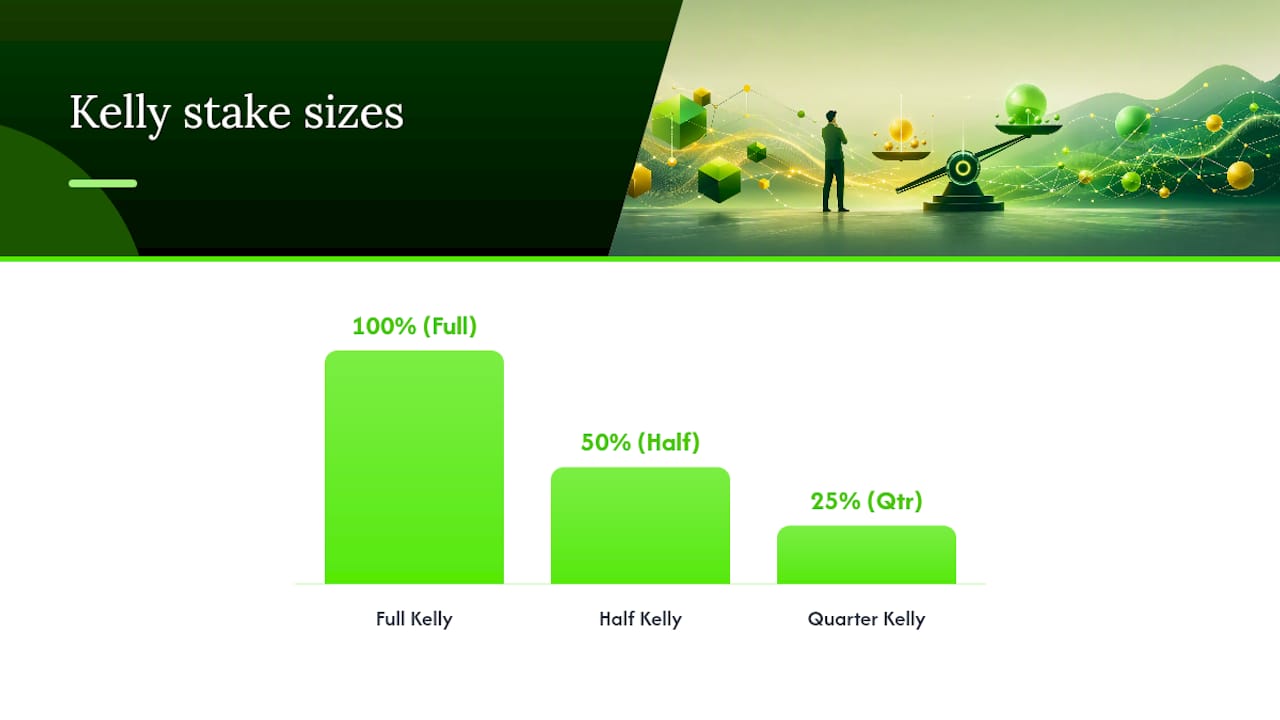
The Kelly criterion calculates the mathematically optimal bet size as a percentage of your bankroll, scaled to the size of your edge and the odds offered. Full Kelly is aggressive and produces sharp bankroll swings, so most bettors use fractional Kelly, typically a quarter or half of the full recommendation, to smooth out variance.
Simpler alternatives work too:
- Flat unit betting, where every bet risks the same fixed percentage of your bankroll.
- Percentage-of-bankroll staking, adjusting stake size as your bankroll grows or shrinks.
- Quarter or half Kelly, a conservative default for bettors without a fully tested model.
For edges under 2%, sample sizes need to be very large before you can trust the number is real. Stake conservatively until volume confirms it.
What Can Go Wrong With EV Calculations?
The math is only as good as the inputs behind it. The most common mistakes:
- Ignoring the vig and treating raw sportsbook odds as fair probability.
- Estimating probabilities from gut instinct instead of a tested model or de-vigged market line.
- Forgetting fees or commissions on betting exchanges, which reduce your effective edge even when the raw EV looks positive.
- Drawing conclusions from small samples, then abandoning a genuinely +EV strategy after a losing week.
- Running into bookmaker limits once a book notices consistent winning patterns.
Track CLV on every bet, and if it doesn’t confirm your claimed edge over time, revisit the model. Positive EV never guarantees short-term wins. Variance will hand you losing streaks even when your process is sound.
Why We Teach EV First
I built Mannysvariety’s editorial approach around EV because it’s the only honest way to evaluate a betting strategy. Win rate alone lies to you; EV doesn’t. Our predictive engines run thousands of simulations per matchup specifically to produce probability estimates worth trusting. Test the math yourself, track your results, and let the sample size speak.
Put EV Into Practice With Model-Backed Picks
Calculating EV by hand works, but it takes real modeling discipline to do it consistently across NBA, MLB, and NFL slates every single day.

Every pick is archived permanently, so you can check the math against results instead of taking anyone’s word for it. That transparency matters more than any single win, since one good week doesn’t prove an edge exists. If you want to see how the predictive models generate picks and track closing-line value over time, start with a day pass and compare a week of picks against your own EV calculations before committing to a subscription.
Frequently Asked Questions
Is value betting profitable? Value betting is profitable over large samples when your probability estimates are more accurate than the sportsbook’s implied odds. Profitability requires hundreds to thousands of bets to confirm, since short-term variance can mask or mimic a real edge.
How do I calculate expected value for a bet quickly? Convert the offered odds to a decimal payout, estimate your true win probability, then apply EV = (win probability × profit) − (loss probability × stake). Most EV calculators need just your stake, the odds, and your probability estimate.
What does closing-line value actually prove? CLV shows whether the market agreed with your assessment by the time betting closed. Consistently beating the closing number suggests your probability estimates, not just luck, are driving your results.
Why do parlays usually have negative EV even with +EV legs? Vig compounds across every leg in a parlay, shrinking your combined edge with each addition. Even strong individual legs can produce a parlay with lower total EV than betting each leg separately.
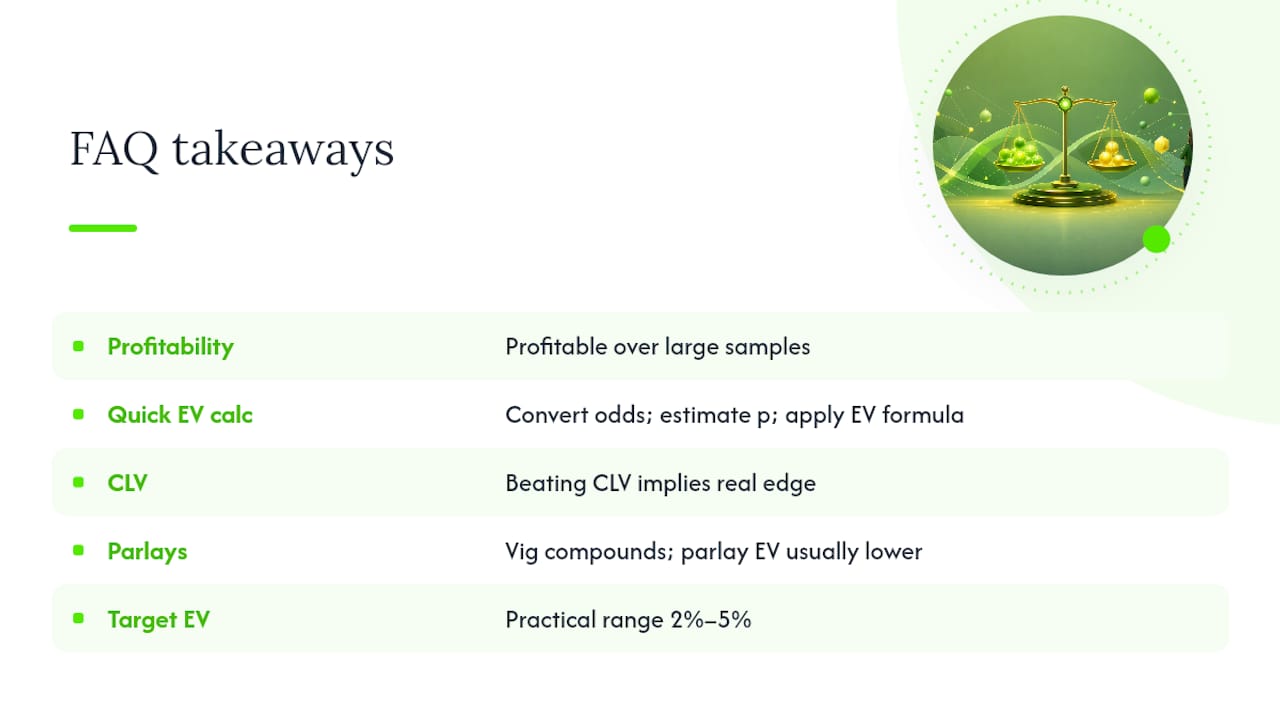
What’s a reasonable EV percentage to target? Many advantage bettors treat 2% to 5% EV as a practical, sustainable range, since edges below 2% require very large samples to verify with confidence.
Sources
- How to Calculate Expected Value (EV) in Betting: Formula, Examples & Free Calculator | Market Math
- What is Expected Value in Sports Betting? Learn How to Harness +EV for Your Wagering
- How to calculate expected value in betting
- Expected Value in Betting: The Complete EV Guide