

Legal Sports Betting States 2026: Where You Can Bet Online & in Person
Last updated: June 2026
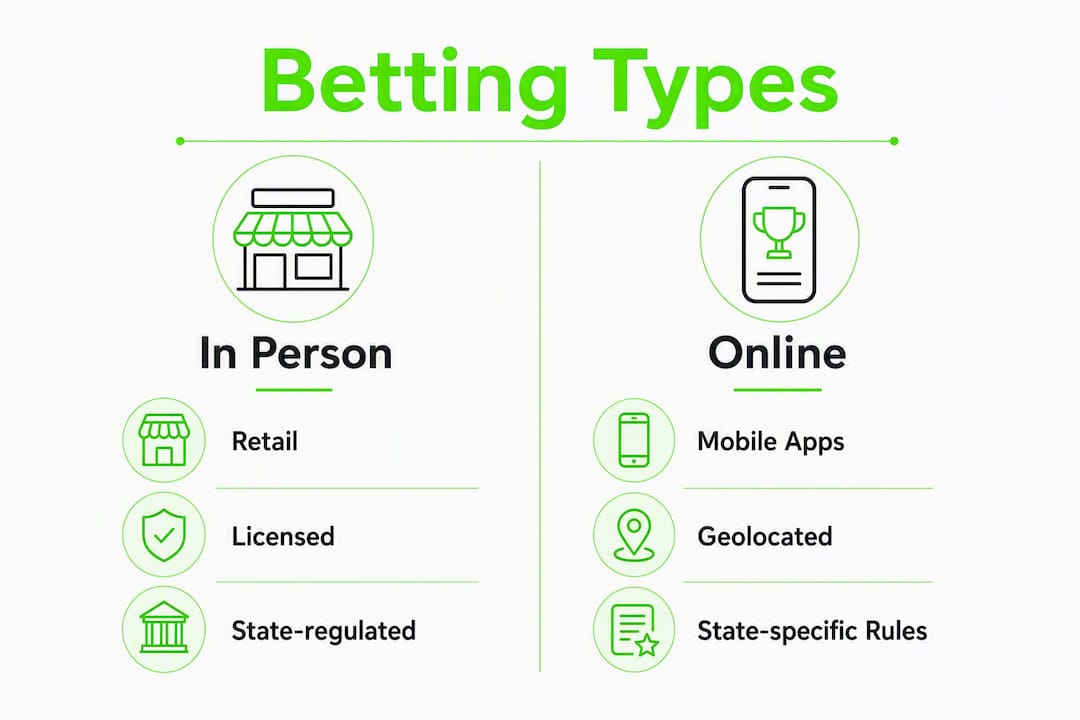
As of mid-2026, 39 states plus Washington, D.C., have legalized sports betting in some form, and roughly 30 of those jurisdictions permit online or mobile wagering. That means more than half the country can place a legal bet from a phone or computer, while several others are limited to retail sportsbooks or tribal facilities.
Quick snapshot for 2026:
- Online/mobile legal: many states plus D.C.
- Retail-only or tribal-only: several additional states
- Prohibited or no active law: a smaller number of states
- Notable 2026 change: Wisconsin legalized online sports betting on April 9, 2026 (launch pending as of this writing)
These counts come from state regulator websites, statutes, and industry trackers including CBS Sports, Legal Sports Report, and the Foley & Lardner Online Sports Betting Tracker. The table below reflects the most current publicly available data; always confirm binding rules with the linked state regulator before placing a wager.
Table of Contents
- Legal sports betting states 2026: the full state-by-state table
- How to read the status labels in the table
- What changed in 2026 and what’s still moving
- How state laws differ in ways that actually affect your bets
- How to place a legal sports bet, step by step
- Consumer protections you should know about in regulated markets
- If your state still prohibits sports betting
- How we compiled and verified the state status table
- How federal law shapes state sports betting frameworks
- What legal sports betting generates in state revenue
- Legal challenges states face when implementing sports betting laws
- Which states could legalize next, and what to watch in late 2026
- Key Takeaways
- The fragmentation problem no one talks about enough
- Mannysvariety gives legal-state bettors a verified edge
- Useful sources for verifying state law and operational status
Legal sports betting states 2026: the full state-by-state table
The table below covers all 50 states, Washington, D.C., and Puerto Rico. “Online allowed” means a licensed, commercially available mobile or online platform is either operational or legally authorized. “Retail allowed” means licensed in-person sportsbooks are open. “Tribal-only” means wagering is confined to tribal gaming facilities. “Launch pending” means a law has passed but no operator has gone live yet.
Note: “Online allowed” reflects licensed and launched markets unless marked “pending.” A state where the legislature passed a bill but no operator has launched is listed as “Legal, pending.” Lottery-run or in-casino-only mobile apps are noted in the status column.
| State | Online allowed? | Retail allowed? | Tribal-only? | Status / Launch date | Regulator or statute |
|---|---|---|---|---|---|
| Alabama | No | No | No | Prohibited | No active law |
| Alaska | No | No | No | Prohibited | HB (proposed) |
| Arizona | Yes | Yes | No | Operational | AZ Dept. of Gaming |
| Arkansas | Yes | Yes | No | Operational (2022 online) | AR Racing Commission |
| California | No | No | No | Prohibited | No active law |
| Colorado | Yes | Yes | No | Operational | CO Division of Gaming |
| Connecticut | Yes | Yes | No | Operational | CT DOSR |
| Delaware | No | Yes | No | Retail operational (2018) | DE Lottery |
| Florida | No | Yes | Yes | Tribal-only (Hard Rock app) | Compact dispute ongoing |
| Georgia | No | No | No | Prohibited | No active law |
| Hawaii | No | No | No | Prohibited | No active law |
| Idaho | No | No | No | Prohibited | No active law |
| Illinois | Yes | Yes | No | Operational | IL Gaming Board |
| Indiana | Yes | Yes | No | Operational | IN Gaming Commission |
| Iowa | Yes | Yes | No | Operational | IA Racing & Gaming |
| Kansas | Yes | Yes | No | Operational (Sep 2022) | KS Racing & Gaming Commission |
| Kentucky | Yes | Yes | No | Operational | KY Horse Racing Commission |
| Louisiana | Yes | Yes | No | Operational (Jan 2022) | LA Gaming Control Board |
| Maine | Yes | No | No | Operational | ME Gambling Control Unit |
| Maryland | Yes | Yes | No | Operational (Nov 2022) | MD Lottery & Gaming |
| Massachusetts | Yes | Yes | No | Operational | MA Gaming Commission |
| Michigan | Yes | Yes | No | Operational | MI Gaming Control Board |
| Minnesota | No | No | No | Prohibited | No active law |
| Mississippi | No | Yes | No | Retail-only (Aug 2018) | MS Gaming Commission |
| Missouri | Yes | No | No | Legal, pending launch | MO Gaming Commission |
| Montana | No | Yes | No | Lottery-run retail only | MT Lottery |
| Nebraska | No | Yes | No | Retail-only | NE Racing & Gaming Commission |
| Nevada | Yes | Yes | No | Operational (long-standing) | NV Gaming Control Board |
| New Hampshire | Yes | No | No | Lottery-run online | NH Lottery |
| New Jersey | Yes | Yes | No | Operational (Jun 2018) | NJ Division of Gaming |
| New Mexico | No | No | Yes | Tribal-only | NM Gaming Control Board |
| New York | Yes | Yes | No | Operational (Jan 2022) | NY Gaming Commission |
| North Carolina | Yes | Yes | No | Operational | NC Lottery Commission |
| North Dakota | No | No | Yes | Tribal-only | ND Gaming Division |
| Ohio | Yes | Yes | No | Operational | OH Casino Control Commission |
| Oklahoma | No | No | Yes | Tribal-only (limited) | OK Horse Racing Commission |
| Oregon | Yes | No | No | Lottery-run online | OR Lottery |
| Pennsylvania | Yes | Yes | No | Operational (Nov 2018) | PA Gaming Control Board |
| Rhode Island | Yes | Yes | No | Operational | RI Lottery |
| South Carolina | No | No | No | Prohibited | No active law |
| South Dakota | No | Yes | No | Retail-only | SD Commission on Gaming |
| Tennessee | Yes | No | No | Online-only | TN Sports Wagering Council |
| Texas | No | No | No | Prohibited | No active law |
| Utah | No | No | No | Prohibited (constitutional ban) | No active law |
| Vermont | Yes | No | No | Operational | VT Dept. of Liquor & Lottery |
| Virginia | Yes | Yes | No | Operational (Jan 2021) | VA Lottery |
| Washington | No | No | Yes | Tribal-only | WA Gambling Commission |
| Washington, D.C. | Yes | Yes | No | Operational (2020) | DC Office of Lottery & Gaming |
| West Virginia | Yes | Yes | No | Operational (Aug 2018) | WV Lottery |
| Wisconsin | Yes (pending) | No | No | Legal Apr 9, 2026; launch pending | WI Gaming Commission |
| Wyoming | Yes | No | No | Online-only (Sep 2021) | WY Gaming Commission |
| Puerto Rico | No | No | No | No active commercial law | PR Treasury |
Edge cases to know: Florida’s Hard Rock Bet app operates under a tribal compact that has faced federal court challenges. Montana and Oregon run state-lottery-controlled platforms, not open commercial markets. Tennessee is online-only with no retail sportsbooks. New Hampshire’s market is lottery-run with a single operator. Missouri passed a law but has not yet launched a commercial market.
How to read the status labels in the table
The table uses five status labels. Each one means something specific, and confusing them is the most common mistake bettors make when checking whether they can legally wager in a state.
- Online allowed / Operational: A licensed commercial or lottery-run platform is live and accepting wagers from adults physically located in that state. You can download an app or visit a website and bet today.
- Retail allowed / Operational: Licensed in-person sportsbooks are open at casinos, racetracks, or dedicated facilities. You must travel to the physical location to place a wager.
- Tribal-only: Wagering is legally confined to tribal gaming facilities or tribal-compact apps. Commercial operators are not licensed. Access depends on whether you are on tribal land or using a tribally operated app.
- Legal, pending launch: The legislature passed a law and the governor signed it, but no operator has received a license and gone live. Wisconsin is the clearest 2026 example: the law took effect April 9, 2026, but no platform had launched at the time this article was updated.
- Prohibited: No law authorizes sports betting. Placing a wager through any channel is unlawful under state law.
How we verify each status:
- Primary source: the state regulator’s official website or published statute
- Secondary confirmation: operator launch press releases and licensing announcements
- Tertiary check: Legal Sports Report’s state tracker and the Foley & Lardner Online Sports Betting Tracker
When a regulator page and an industry tracker conflict, the regulator’s published rule controls. If a state’s law is under active litigation (as in Florida), the table reflects the current operational reality, not the theoretical legal outcome.
What changed in 2026 and what’s still moving
The biggest single development of 2026 is Wisconsin. Governor Tony Evers signed the online sports betting bill into law on April 9, 2026, making Wisconsin the latest state to legalize online wagering. The market had not launched commercially as of this update, so Wisconsin bettors cannot yet place a legal online wager, but the regulatory framework is in place.
Here is a concise timeline of the major 2026 developments:
- April 9, 2026 — Wisconsin: — Governor signs online sports betting legislation. Launch timeline to be set by the Wisconsin Gaming Commission. Market expected to open later in 2026 or early 2027.
The Legal Sports Report state tracker is the most reliable source for bill-by-bill updates as these states move through their legislative sessions.
How state laws differ in ways that actually affect your bets
The 2018 Supreme Court decision in Murphy v. NCAA struck down the Professional and Amateur Sports Protection Act (PASPA), which had effectively banned most states from legalizing sports betting. That ruling did not create a uniform national framework. It handed authority to each state individually, which is why the rules vary so widely.

Minimum age:
Most states set the minimum age at 21, aligning with casino gambling. A smaller number, including New Hampshire, Iowa, and Wyoming, permit wagering at 18. Always check the specific state rule before registering an account.
College-sports restrictions:
Several states restrict or prohibit betting on in-state college teams or college player props. Illinois, for example, prohibits wagering on Illinois college teams. New Jersey and Tennessee restrict certain college player props. If you want to bet on NFL player props or college-level lines, confirm your state’s specific rules before placing those wagers.
Operator tax rates and market structure:
Operator tax rates range widely, from roughly 6.75% in Nevada to over 50% in New York. Higher tax rates tend to produce less competitive odds and fewer promotional offers because operators have less margin to work with. New York’s high-tax environment, for instance, has led to tighter lines compared to lower-tax states. The Foley & Lardner tracker documents per-state tax structures and market models for anyone who wants the full breakdown.
Bettor tax reporting:
Winnings from sports betting are taxable income at the federal level. The IRS requires operators to issue a W-2G form for net winnings of $600 or more at odds of 300-to-1 or greater. Regardless of whether you receive a W-2G, all gambling winnings are reportable. State income tax treatment varies: some states have no income tax, others tax gambling winnings at the standard income rate.
Geolocation and physical presence:
You do not need to be a resident of a state to place a legal bet there. You must be physically located within that state’s borders when the wager is placed. Operators enforce this through geolocation software. A traveler visiting Nevada can legally bet on a Nevada-licensed app; a Nevada resident sitting in California cannot.
How to place a legal sports bet, step by step
Whether you are betting online or walking into a retail sportsbook for the first time, the process is straightforward once you know what to expect.
Online betting
- Confirm your state is operational. Check the table above. If your state shows “legal, pending” or “prohibited,” you cannot place a legal online wager from that location.
- Find a licensed operator. Only use operators licensed by your state’s gaming regulator. Licensed operators are listed on the regulator’s website. Avoid any platform that does not display a state license.
- Verify your physical location. When you open the app, geolocation software checks that you are inside the state’s borders. If you are near a state line, move away from the border and try again.
- Create and verify your account. You will need a valid government-issued ID, a Social Security number (last four digits in most states), and proof of age. This is a regulatory requirement, not optional.
- Fund your account. Approved methods typically include debit cards, bank transfers (ACH), PayPal, and in some states, cash deposits at a retail cage. Credit card deposits are restricted or blocked in several states.
- Place your wager. Select your sport, market (spread, moneyline, total, player prop, parlay), and stake. Review the bet slip before confirming.
- Keep records. Save confirmation emails and screenshots of settled bets. You will need this documentation at tax time.
Retail betting
Walk-in sportsbooks require a valid government-issued photo ID proving you meet the state’s minimum age. Most retail windows accept cash and debit cards. Bring your ID, know the bet type you want (spread, moneyline, total, or parlay), and ask the teller to confirm the current lines before submitting your ticket.
Pro Tip: Geolocation failures are the most common reason a legal bet gets blocked. Turn off VPNs entirely before opening a betting app, allow location services for the app, and if you are near a state border, move at least a few miles into the legal state before trying again.
Consumer protections you should know about in regulated markets
Regulated sports betting markets include consumer safeguards that unlicensed offshore sites do not offer. Knowing what tools exist is the first step to using them.
- Advertising restrictions: — 2026 legislative activity in multiple states has focused on restricting sports betting advertising near schools, prohibiting promotional offers targeted at self-excluded players, and capping daily deposit bonuses. These rules are state-specific and evolving.
If you need to file a complaint against a licensed operator, the state gaming regulator listed in the table is the correct contact. Regulators have enforcement authority over licensed operators; they cannot act against unlicensed offshore sites.
If your state still prohibits sports betting
Roughly 11 states have no active legal framework for sports betting. If you live in one of them, your options are limited but not zero.
- Do not use offshore or unlicensed operators. These platforms operate outside U.S. law, offer no consumer protections, and expose you to financial and legal risk. Winning payouts from offshore sites are not legally enforceable.
- Travel to a legal state. You can legally place a bet in any state where sports betting is operational, as long as you are physically present in that state when the wager is placed. Residency is not required. A Georgia resident driving to Tennessee can legally bet on a Tennessee-licensed app while in Tennessee.
- Use legal fantasy contests. Daily fantasy sports platforms operate under a separate legal framework in most states. Check your state’s specific rules, as a handful of states restrict DFS as well.
- Use free-to-play markets. Several platforms offer no-money prediction contests that are legal in all 50 states.
- Check the regulator link before acting. When in doubt about what is permitted in your state, the state regulator link in the table above is the authoritative source. This article provides general information, not legal advice; consult a qualified attorney or your state’s gaming authority for binding guidance.
How we compiled and verified the state status table
Transparency about sourcing matters for a table like this, where a single outdated entry could send a reader to an illegal platform or cause them to miss a newly legal market.
- Secondary sources: Legal Sports Report’s state tracker, the Foley & Lardner Online Sports Betting Tracker, and the American Gaming Association’s policy resources.
- Tertiary confirmation: Operator launch press releases, licensing announcements, and CBS Sports’ state-by-state tracker.
- Update cadence: — The table is reviewed when a state passes new legislation, a major operator launches, or a court ruling changes operational status. The “last updated” date at the top of this article reflects the most recent review.
Readers should treat the regulator link in the table as the definitive source for binding legal detail. Industry trackers are useful for quick status checks but may lag behind regulatory changes by days or weeks.
How federal law shapes state sports betting frameworks
The federal legal picture for sports betting is simpler than most people expect, but it still shapes what states can and cannot do.
The key event was the Supreme Court’s 2018 ruling in Murphy v. NCAA, which struck down PASPA. That law had prohibited most states from authorizing sports wagering since 1992. The Court held that PASPA violated the anti-commandeering doctrine of the Tenth Amendment, meaning Congress cannot force states to maintain a particular regulatory regime. The ruling did not legalize sports betting nationally. It simply removed the federal prohibition, leaving each state free to act or not act on its own.
Two other federal laws remain relevant. The Wire Act of 1961 restricts interstate wire communications for sports betting purposes. The Department of Justice has issued conflicting opinions on whether the Wire Act applies only to sports betting or to all forms of online gambling, creating ongoing legal uncertainty for operators that handle transactions across state lines. The Unlawful Internet Gambling Enforcement Act (UIGEA) of 2006 restricts financial institutions from processing payments to unlicensed gambling operators, which is why some payment methods are blocked on offshore sites but work fine on licensed state platforms.
Congress has not passed a federal sports betting framework since PASPA’s repeal. Several bills have been introduced proposing federal minimum standards for integrity monitoring, problem gambling funding, and advertising restrictions, but none have advanced to a floor vote. The result is the fragmented state-by-state patchwork visible in the table above, where tax rates, age limits, bet restrictions, and operator counts differ in every jurisdiction.
What legal sports betting generates in state revenue
The economic case for legalization is straightforward, and the numbers bear it out. In the roughly five years following PASPA’s repeal, approximately $220 billion in U.S. sports bets were placed through licensed channels. That volume generates tax revenue for states, funds for problem gambling programs, and licensing fees that support regulatory infrastructure.
New York is the clearest example of high-volume revenue generation. The state’s online market, which launched in January 2022, quickly became the largest single-state online sports betting market in the country by handle. The tradeoff is a tax rate that exceeds 50% on gross gaming revenue, which compresses operator margins and limits the competitiveness of odds available to bettors.
States with lower tax rates, like Colorado (10%) and Indiana (9.5%), tend to attract more operators and produce more competitive lines, which drives higher handle over time. The American Gaming Association has consistently framed legalization as a mechanism for moving consumer spending from unregulated offshore markets into taxable, regulated channels, where integrity monitoring and player protections can be applied.
Beyond direct tax revenue, legal markets generate jobs at retail sportsbooks, technology and compliance roles at operators, and indirect spending at casinos and entertainment venues that host sportsbooks. States that have legalized report these economic benefits as a primary driver of legislative support, particularly in states where casino gaming is already established.
Legal challenges states face when implementing sports betting laws
Passing a sports betting law is the beginning of the legal work, not the end. Several categories of litigation and regulatory dispute have emerged since 2018.
Tribal compact disputes are the most complex. In Florida, the Seminole Tribe’s compact with the state authorized a “hub-and-spoke” model where bets placed on mobile devices anywhere in Florida are routed through servers on tribal land, technically making them tribal wagers. Federal courts have challenged this interpretation under the Indian Gaming Regulatory Act (IGRA). The dispute has moved through multiple court rulings, creating ongoing uncertainty about the app’s legal status.
Constitutional challenges have appeared in several states where voters approved sports betting via ballot measure. Opponents have argued procedural defects in ballot language or conflicts with existing state constitutional provisions on gambling. Most of these challenges have been resolved in favor of the approved measures, but they delayed launches in some markets.
Operator licensing disputes arise when applicants denied a license challenge the regulator’s decision. These cases typically move through administrative law processes before reaching state courts. They can delay market launches and reduce operator competition in the interim.
Interstate and federal preemption questions remain unresolved. The Wire Act’s scope is still contested, and any federal legislation on sports betting would raise preemption questions about existing state frameworks. Operators and regulators monitor federal legislative activity closely for this reason.
Advertising and marketing litigation is an emerging category. As states pass stricter advertising rules, operators have challenged some restrictions as violations of commercial speech protections under the First Amendment. No definitive federal court ruling has settled this question as of mid-2026.
Which states could legalize next, and what to watch in late 2026
The states most likely to move toward legalization in the next 12–18 months share a common profile: neighboring states have already legalized, creating visible revenue leakage; there is an existing commercial gaming industry (casinos, racetracks) that provides a regulatory foundation; and there is bipartisan legislative interest, even if a bill has not yet passed.
Georgia has come closest among the large holdout states. Bills have passed committee in both chambers in recent sessions. The primary obstacle has been disagreement over the tax rate and the number of licenses. A special session or a 2027 regular session push is plausible.
Texas is the largest state without legal sports betting by population. Legislative sessions are biennial, and the 2025 session did not produce a bill. The next regular session is in 2027, though a special session remains possible. Tribal and commercial gaming interests are both active in Austin.
Minnesota has a strong tribal gaming presence that has complicated commercial sports betting legislation. Tribal operators want exclusivity; commercial operators want open licensing. That tension has blocked bills in recent sessions, but the financial pressure from neighboring Wisconsin’s new law may accelerate compromise.
California remains the most complex case. Two competing ballot measures failed in 2022. A new effort would require another ballot campaign, which is expensive and uncertain. No credible 2026 ballot initiative was on track as of this update.
The Legal Sports Report tracker and Covers both monitor active bills in real time. For anyone tracking the future of sports betting in 2026 and beyond, those two sources provide the most current bill-by-bill status.
Key Takeaways
As of mid-2026, many states plus Washington, D.C., have legalized sports betting in some form, with numerous jurisdictions offering legal online or mobile wagering, and Wisconsin representing the latest addition to the map.
| Point | Details |
|---|---|
| Online markets now cover ~30 states | About 30 states plus Washington, D.C., and Puerto Rico offer licensed online or mobile wagering, while several others allow only retail or tribal-only access. |
| Wisconsin is the key 2026 change | Wisconsin legalized online sports betting on April 9, 2026; a commercial launch is pending as of this update. |
| Physical presence, not residency, is required | You must be physically inside a legal state’s borders when placing a wager; geolocation enforces this rule. |
| State rules vary significantly | Age limits, college-sports restrictions, tax rates, and operator counts differ by state; always check the state regulator link. |
| Mannysvariety provides AI-driven picks for legal markets | Bettors in operational states can use Mannysvariety’s data-driven picks, props, and parlays to inform their legal wagers. |
The fragmentation problem no one talks about enough
The state-by-state patchwork created by the PASPA repeal is often celebrated as a win for states’ rights, and in many ways it is. States can tailor rules to their populations, tax structures, and existing gaming industries. But the fragmentation also creates a real problem for bettors who move between states, travel frequently, or live near state lines.
A bettor who uses a platform in New Jersey faces different age verification rules, different college-sports restrictions, and different odds (because of different tax rates) than the same bettor would encounter in Pennsylvania, which shares a border. The platform itself may be the same operator, but the product is legally different in each state. That complexity is not going away. Congress has shown no appetite for a federal framework, and the states that have already built regulatory infrastructure have little incentive to cede control.
What this means practically: the most important skill a bettor can develop right now is understanding their own state’s specific rules, not just whether betting is “legal.” Legal is a starting point. The details of what you can bet on, at what age, through which operators, and at what tax cost are what actually determine your experience. The table and regulator links in this article are the right tools for that research.
The responsible-gambling trend in 2026 legislation is also worth watching closely. Deposit caps and advertising restrictions are not just consumer-protection measures; they reshape market economics. A state that caps daily deposits limits operator revenue, which affects promotional budgets and, eventually, the odds and offers available to bettors. That is a market dynamic most bettors do not factor in when choosing where to wager.
Mannysvariety gives legal-state bettors a verified edge
Knowing where you can legally bet is step one. Knowing what to bet is where most bettors lose their edge. Mannysvariety’s AI-powered picks platform runs thousands of Monte Carlo simulations per game, covering spreads, moneylines, totals, and player props across the NFL, NBA, MLB, NHL, PGA, MMA, and more. Every pick is publicly graded and archived, so the track record is verifiable, not claimed.
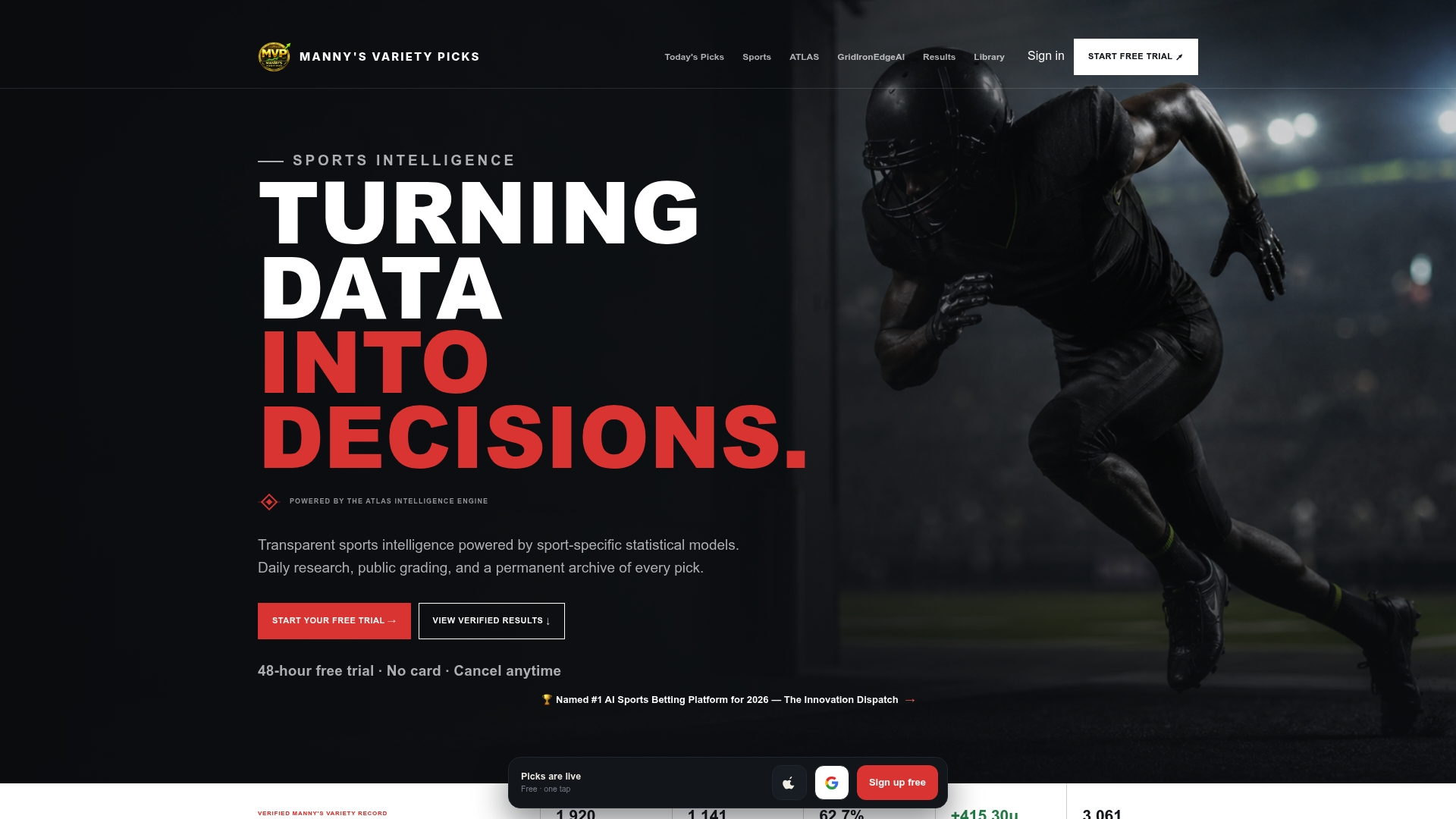
The platform’s sport-specific predictive engines deliver daily reports with clear, data-driven recommendations. Bettors in legal states can use these picks to inform wagers on licensed platforms without relying on gut feel or generic advice. A free trial gives you access to limited features before committing to a Core or Elite subscription.
Important: Mannysvariety’s picks and tools are intended for use only in jurisdictions where sports betting is lawful. Before placing any wager, confirm your state’s status using the regulator links in the table above. If your state is listed as “prohibited” or “legal, pending,” do not place a bet until the market is operational and you are physically located in a legal jurisdiction.
Ready to see how AI sports betting analysis works in practice? Visit the how-it-works page and start your free trial.
Useful sources for verifying state law and operational status
These are the primary sources used to compile and verify the state table above. Each is updated more frequently than any single article can be.
- Legal Sports Report — State Tracker: The most comprehensive bill-by-bill and law-by-law tracker for all 50 states. Updated when legislation moves. Best for tracking pending bills and newly signed laws.
- Foley & Lardner Online Sports Betting Tracker: A law firm tracker that compiles per-state regulatory details, tax rates, license structures, and launch dates. Authoritative for regulatory specifics.
- CBS Sports — State-by-State Tracker: Consumer-facing tracker with clear operational status for each state. Updated regularly and accessible to non-legal readers.
- American Gaming Association: The trade association for the U.S. commercial gaming industry. Publishes policy analysis, revenue data, and responsible-gambling resources.
- Covers: Industry reporting on betting regulations, legislative trends, and market developments. Useful for tracking 2026 advertising and consumer-protection bill activity.
- FOX Sports — Legal Sports Betting States: Accessible state-by-state overview with operational status and links to state-specific information.
- State gaming regulator websites: Listed individually in the state table above. These are the binding legal authority for each jurisdiction and should be the final check before placing any wager.