

Round Robin Betting Strategy: Control Risk, Cash Partial Wins
A round robin betting strategy breaks a set of picks into multiple smaller parlays so you can earn a return even when one or more legs fail. Instead of betting everything on a single parlay that dies the moment one team loses, you spread your action across every possible combination of your selections. The Action Network’s guide to round robins puts it plainly: the structure automatically generates smaller parlays from a larger list of picks, preserving your ability to profit even when the full slate doesn’t hold.
The tactical verdict: round robins work best with 3–4 high-value selections, emphasized “by 2s” to keep costs manageable and partial payouts meaningful.
When to use a round robin:
- You have 3–4 strong picks but aren’t confident every single one wins
- You want more paths to profit than a single parlay allows
- Your selections include moneyline underdogs where two or three hits can return solid profit
When to avoid it:
- You have only two picks (a parlay is simpler and cheaper)
- You’re adding 6+ legs (combination count and total stake explode fast)
- Your bankroll can’t absorb stake per combo × number of combos as total outlay
That last point is the most important caveat up front: your total ticket cost is never just the per-combo stake. It’s that stake multiplied by every combination the system generates.
Key Takeaways
A round robin betting strategy gives you multiple paths to profit from a single set of picks, but only when leg count, stake sizing, and combination math are managed deliberately before you place the ticket.
| Point | Details |
|---|---|
| Core definition | A round robin splits picks into every possible smaller parlay so partial wins still return profit. |
| Optimal setup | Use 3–4 picks by 2s; this keeps combinations between 3 and 6 and total cost proportional to bankroll. |
| Cost formula | Total stake equals stake per combo × number of combos — always calculate this before confirming. |
| Best market fit | Moneyline underdogs in the +180–+400 range give each 2-team parlay enough payout to justify the structure. |
| Mannysvariety edge | AI-graded picks help identify the high-value legs that make round robins work. |
Table of Contents
- How does the round robin betting strategy work?
- Worked examples: payouts and outcomes across common setups
- Practical strategy and bankroll rules for round robins
- When does a round robin beat a parlay or straight bets?
- Common mistakes and bookmaker constraints to know
- How to place a round robin at a sportsbook
- What the research says about round robin performance
- An editorial perspective on the right default approach
- How Mannysvariety supports your round robin leg selection
- Sources
How does the round robin betting strategy work?
Notation and combination math
The notation follows a simple “n by k” format. A 4-by-2 round robin takes 4 picks and builds every possible 2-team parlay from them. A 3-by-2 produces 3 doubles. A 4-by-3 produces 4 three-team parlays.
The number of combinations comes from the standard “n choose k” formula:
C(n, k) = n! ÷ (k! × (n − k)!)
You don’t need to calculate this by hand. Sportsbooks compute it automatically, but knowing the formula helps you anticipate how fast combinations multiply as you add legs.
The table below shows how combinations scale across common round robin sizes:
Going from 4 picks to 5 picks by 2s jumps you from 6 combinations to 10. At 6 picks, you’re placing 15 two-team parlays. That growth is why Betting flags total outlay as the most underestimated risk: total cost equals stake per combination × number of combinations.
Cost formula and a quick example
Total stake = stake per combo × number of combos
Say you build a 4-by-2 round robin at $10 per combo. You have 6 two-team parlays, so your total ticket costs $60. A single 4-team parlay on the same picks would cost $10. The round robin costs six times as much for the same four selections.
Named system bets follow the same math under different labels. A Trixie (3 picks, 3 doubles + 1 treble) and a Yankee (4 picks, 6 doubles + 4 trebles + 1 four-fold) are common round-robin configurations that bettors use as shorthand to understand exactly how many bets they’re placing.
Worked examples: payouts and outcomes across common setups
Scenario 1: 3 picks by 2s (3 doubles)
Selections: Team A moneyline +200, Team B moneyline +180, Team C moneyline +150. Stake: $10 per double.

Decimal odds: A = 3.00, B = 2.80, C = 2.50
The same three picks as a single 3-team parlay at $30 would return roughly $588 if all win, but $0 if any one leg fails. The round robin trades maximum upside for partial-win protection.
Scenario 2: 4 picks by 2s and by 3s
4-by-2: 6 doubles at $5 each = $30 total. If 3 of 4 picks win, 3 of 6 doubles cash. If all 4 win, all 6 cash.
4-by-3: 4 three-team parlays at $5 each = $20 total. If 3 of 4 win, 1 of 4 trebles cashes. Higher payout per winning combo, but fewer paths to profit.
Running both simultaneously costs $50 and covers every combination size from 2-team to 3-team. That’s a common approach for bettors who want layered protection without going all the way to a full 4-team parlay.
Scenario 3: 4 underdog-focused picks
TalkSPORT’s round robin breakdown makes the case for underdogs clearly: hitting two or three moneyline underdogs in a multi-pick round robin can return a meaningful payout even when one or two picks miss. Four underdogs at +200 each (decimal 3.00) produce 2-team parlays paying 9.00 per $1 staked. If 3 of 4 hit, 3 of your 6 doubles cash. At $10 per combo, that’s roughly $270 gross on a $60 ticket, a net of +$210 despite one losing pick.
A single 4-team parlay on the same underdogs pays roughly $810 on $10 staked, but it’s all-or-nothing. The round robin sacrifices the ceiling in exchange for three separate chances to profit.
Practical strategy and bankroll rules for round robins
The most common error bettors make is treating the round robin as a “safer parlay” without accounting for how quickly total stake grows. Betting.net’s analysis frames the real constraint correctly: manage stake per combo, not just the number of legs.
Core rules of thumb:
- Keep selections to 3–4. At 5+ picks, the combination count grows faster than most bankrolls can absorb comfortably.
- Favor “by 2s” as your base. Two-team parlays give you the most paths to cash and the lowest variance per combination. Topendsports confirms that the by-2s approach is the lower-variance option and the most common starting point for new round robin bettors.
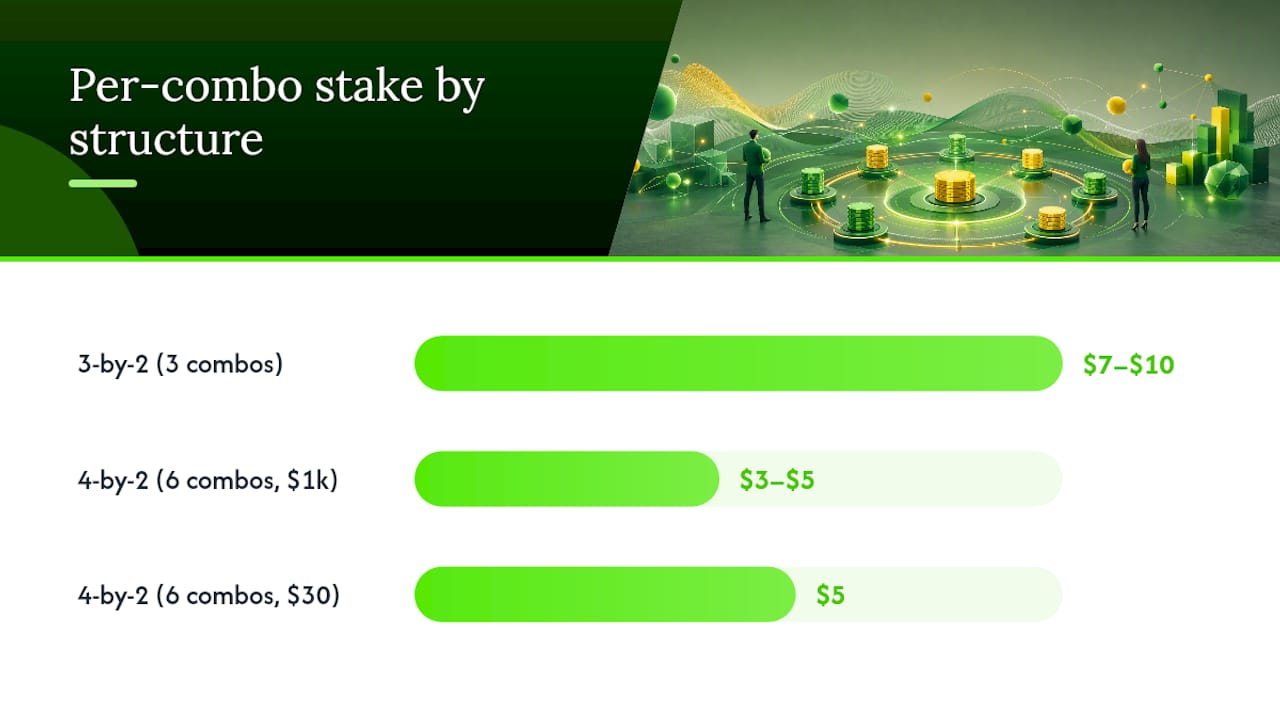
- Set a maximum ticket budget first. Decide your total round robin budget before choosing stake per combo. If your budget is $30 and you’re running a 4-by-2 (6 combos), your stake per combo is $5.
- Target moneyline underdogs in the +180–+400 range. Favorites at −150 or shorter compress returns so much that even a full-win scenario barely covers the total ticket cost. Underdogs give each 2-team parlay enough payout to justify the structure.
Stake-sizing framework:
On a $1,000 bankroll, that’s $20–$30 per ticket. With a 3-by-2 (3 combos), that means $7–$10 per combo. With a 4-by-2 (6 combos), it means $3–$5 per combo.
Pro Tip: You don’t have to stake the same amount on every combination. If you’re more confident in two of your four picks, you can weight those specific doubles higher and reduce the stake on combinations involving your weakest selection. Most sportsbooks allow per-combo stake entry when you build the ticket manually.
Responsible bankroll management matters here as much as anywhere in sports betting. BeGambleAware provides practical guidance on setting deposit limits and staking boundaries that apply directly to structured bets like round robins.
When does a round robin beat a parlay or straight bets?
The answer depends entirely on what you’re optimizing for.
Round robin advantages over a single parlay:
- Survives one or more losing legs and still returns profit
- Generates multiple independent payout events from the same set of picks
- Reduces the all-or-nothing variance that makes parlays feel like lottery tickets
Round robin disadvantages versus a single parlay:
- Total stake is significantly higher for the same selections
- Maximum payout when all legs win is lower than a single parlay on all picks
- More complex to track and settle across multiple simultaneous bets
Round robin versus straight bets:
- Straight bets carry lower total risk and simpler math
- Round robins offer higher upside when multiple picks hit, without requiring a perfect sweep
- Straight bets are better when you have one or two high-confidence picks rather than a spread of value plays
The one-sentence decision flow: use a round robin when you have 3–4 picks you believe in but can’t justify betting all-or-nothing; use a single parlay when you want maximum upside and accept that one miss kills the ticket; use straight bets when you want the lowest-variance, most bankroll-efficient approach.
Topendsports’ complete guide reinforces this framing: round robins change the risk-to-reward profile rather than making bets inherently more profitable. They reduce catastrophic single-loss risk but typically lower the maximum payout compared to a full parlay on the same picks.
For a deeper look at how best parlay picks compare to round robin structures in practice, that resource covers selection criteria that apply to both formats.
Common mistakes and bookmaker constraints to know
Mistakes that cost bettors money
- Adding too many legs. Five picks by 2s means 10 combinations. At $10 each, that’s $100 on one ticket. Most bettors underestimate this until they see the total.
- Ignoring total stake. Focusing on stake per combo while forgetting to multiply by the number of combos is the single most common staking error in round robins.
- Stacking correlated legs. Betting the same team’s moneyline and spread in the same round robin doesn’t add diversification. Sportsbooks often restrict or void correlated parlay combinations, and the legs move together anyway.
- Using stakes so small the payouts are meaningless. A $1-per-combo round robin on 6 combinations costs $6 and, even with two winners, might return $18. That’s not worth the complexity.
Bookmaker constraints
- Max payout caps. Most sportsbooks cap parlay payouts at $100,000–$250,000. If your round robin combinations would theoretically exceed that, the cap applies per combo.
- Push/tie rules. When one leg in a parlay pushes, most books reduce the parlay by that leg (a 3-team parlay becomes a 2-team parlay). Confirm your book’s policy before building a ticket where a push could change your payout significantly.
- Prop combination restrictions. Many sportsbooks prohibit combining same-game props or certain correlated player props in parlays. Round robin combinations built from restricted markets may be rejected at confirmation.
- Ticket limits. Some books limit the number of simultaneous open parlay tickets. A large round robin that generates 20+ combinations may hit that ceiling.
Red-flag checklist before confirming any round robin ticket:
- Total stake confirmed (not just per-combo stake)
- No correlated legs from the same game
- All markets eligible for parlay combination at your book
- Push/tie settlement policy reviewed
- Max payout cap checked against your expected returns
How to place a round robin at a sportsbook
- Add your selections to the bet slip. Choose 3 or more picks from eligible markets. Moneylines, spreads, and totals are typically allowed; same-game props may be restricted.
- Open the parlay or multiples section. Look for a “Round Robin,” “System Bet,” or “Multiples” tab on your bet slip. Different books label this differently.
- Choose your “by-k” setting. Select “by 2s,” “by 3s,” or both. The slip will display the number of combinations generated.
- Enter your stake per combination. The sportsbook will show total stake automatically. Verify it matches your budget before proceeding.
- Confirm the total stake. This is the number that leaves your account. Double-check it against your bankroll limit.
- Submit and track settlement. Each combination settles independently as games conclude. Most books show individual parlay results in your bet history, not just the round robin summary.
Pro Tip: Some sportsbooks display “total stake” as the default entry field rather than “stake per combo.” Enter a small test amount first, check the per-combo breakdown, then adjust. Entering $50 when the book interprets it as total stake across 6 combos gives you $8.33 per combo, not $50.
Understanding line movement betting can also sharpen your timing when placing round robin tickets, since odds on individual legs shift before game time and affect each combination’s payout.
What the research says about round robin performance
The core finding from topendsports’ round robin guide is worth stating plainly: round robins restructure risk, they don’t eliminate it or improve expected value. The strategy reduces the all-or-nothing exposure of a single parlay, but when all legs win, the total payout is lower than a single parlay on the same picks would have been.
Statistic callout: Limiting round robin selections to 3–4 picks keeps the number of 2-team combinations between 3 and 6, a range where total ticket cost stays proportional to a reasonable bankroll percentage and each combination carries enough individual payout to justify the structure.
The underdog case is where round robins show their clearest practical advantage. TalkSPORT’s worked examples demonstrate that hitting two or three moneyline underdogs in a multi-pick round robin can produce meaningful profit even when one or two picks miss, a scenario where a single parlay would return nothing.
The practical constraint, as betting.net’s strategy guide identifies, is bankroll exposure. Bettors who focus only on the number of legs and ignore how stake per combo scales into total ticket cost consistently over-expose their bankroll on round robin tickets.
Pro Tip: Track your round robin results by combination, not just by ticket. Knowing which specific 2-team or 3-team parlays within your round robins are hitting tells you whether your leg selection process is working, independent of whether the full ticket was profitable.
An editorial perspective on the right default approach
Most bettors who struggle with round robins aren’t making bad picks. They’re using the wrong structure for their bankroll size. A 5-pick by-2s round robin at $10 per combo costs $100 per ticket. Run that three times a week and you’ve committed $300 weekly to a single bet type, which is a significant exposure for anyone operating on a sub-$2,000 bankroll.
The default that makes the most sense for most bettors: 3 picks, moneyline underdogs in the +180–+350 range, by 2s only, with a per-combo stake that keeps total ticket cost under 2% of bankroll. That structure gives you three separate chances to profit, meaningful payouts on each winning double, and a total cost you can absorb if all three picks lose. It’s not the most exciting version of the strategy, but it’s the one that survives long enough to show whether your selection process has real edge.
The round robin’s value isn’t in the math. It’s in the discipline it forces: you have to commit to specific combinations, specific stakes, and a specific total budget before the games start. That structure alone separates it from the impulsive parlay-building that drains most bettors’ accounts.
How Mannysvariety supports your round robin leg selection
Choosing the right legs is where most round robin tickets succeed or fail, and that’s exactly where Mannysvariety’s AI-powered pick engine earns its place. The platform’s sport-specific predictive models cover NBA, MLB, NFL, NHL, and more, running thousands of simulations per game to surface the picks with the strongest probability-adjusted value, the kind of selections that belong in a structured round robin rather than a gut-feel parlay.

Every pick comes with a documented track record. The platform’s parlay and prop tools also let you cross-reference selections across sports, so building a 3- or 4-pick round robin from high-value moneyline underdogs takes minutes rather than hours of research.
See exactly how the pick process works and what’s included at each subscription tier on the Mannysvariety how-it-works page.
Sources
- Round Robin Bets Explained: Complete Guide
- Round robin bet 101: Guide to the math, mechanics, and payouts (2026)
- Round Robin Betting Strategy Explanation: Complete ‘How-to’ guide
- BeGambleAware