

Sports Betting Legality USA: 2026 State-by-State Guide
As of May 2026, 39 states plus Washington, D.C. allow sports betting in some form, whether online, retail, or through tribal operators, and roughly 30 of those jurisdictions offer full mobile wagering through licensed apps. The short legal context: the Supreme Court’s 2018 decision in Murphy v. National Collegiate Athletic Association struck down the Professional and Amateur Sports Protection Act (PASPA), returning authority to legalize sports betting to each individual state. The federal government no longer imposes a blanket ban. Each state writes its own rules on permitted bet types, age requirements, and operator licensing, which is why the map looks the way it does.
Last updated: May 2026. Status can change mid-session when a state legislature acts. Always confirm current status with your state’s gaming commission before placing a wager.
Table of Contents
- What is the current sports betting legal status in every state?
- State-by-state breakdown: what bettors actually need to know
- Why does federal law not decide sports betting legality?
- How do you verify a sportsbook is legal before you deposit?
- How are sports betting winnings taxed in the U.S.?
- What consumer protections do licensed sportsbooks provide?
- How do you monitor ongoing sports betting legislation?
- How this guide was compiled and verified
- Key Takeaways
What is the current sports betting legal status in every state?
The table below reflects the status of all 50 states plus D.C. as of May 2026. Use it as a starting point, then verify with the state regulator link in the notes column before funding an account.
Status labels:
- Legal — full commercial licensing in place (online and/or retail)
- Limited — legal but restricted (single operator, lottery-only, or partial launch)
- Tribal-only — wagering permitted only through tribal compact operators
- Not legal — no authorized wagering at this time
“Online available” means statewide mobile apps are live and accessible to any adult physically present in the state. “Tribal-only” in that column means mobile access exists but only through tribal-licensed platforms.
| State | Legal status | Online available | Retail available | Launch year | Age limit | College betting | Notes |
|---|---|---|---|---|---|---|---|
| Alabama | Not legal | No | No | — | — | — | Bills introduced; no law passed |
| Alaska | Not legal | No | No | — | — | — | No active legislation |
| Arizona | Legal | Yes | Yes | 2021 | 21 | Restricted (in-state college props banned) | AZ Dept. of Gaming regulates |
| Arkansas | Legal | Yes | Yes | 2022 | 21 | Permitted | Retail launched 2019; mobile 2022 |
| California | Not legal | No | No | — | — | — | Two 2022 ballot measures failed; tribal opposition remains |
| Colorado | Legal | Yes | Yes | 2020 | 21 | Permitted | CO Division of Gaming |
| Connecticut | Legal | Yes | Yes | 2021 | 21 | Restricted (in-state college props banned) | Tribal + commercial licenses |
| Delaware | Limited | No | Yes | 2018 | 21 | Restricted | Lottery-run retail only |
| Florida | Tribal-only | Tribal-only | Yes | 2021 | 21 | Permitted | Seminole Tribe compact; legal disputes ongoing |
| Georgia | Not legal | No | No | — | — | — | Active bills in 2026 session |
| Hawaii | Not legal | No | No | — | — | — | No legal framework |
| Idaho | Not legal | No | No | — | — | — | No active legislation |
| Illinois | Legal | Yes | Yes | 2020 | 21 | Restricted (in-state college teams banned) | IL Gaming Board |
| Indiana | Legal | Yes | Yes | 2019 | 21 | Permitted | IN Gaming Commission |
| Iowa | Legal | Yes | Yes | 2019 | 21 | Permitted | IA Racing & Gaming Commission |
| Kansas | Legal | Yes | Yes | 2022 | 21 | Permitted | KS Racing & Gaming Commission |
| Kentucky | Legal | Yes | Yes | 2023 | 18 | Restricted (in-state college props banned) | KY Horse Racing Commission |
| Louisiana | Legal | Yes | Yes | 2021 | 21 | Restricted (in-state college props banned) | LA Gaming Control Board |
| Maine | Legal | Yes | Yes | 2023 | 21 | Permitted | ME Gambling Control Unit |
| Maryland | Legal | Yes | Yes | 2022 | 21 | Permitted | MD Lottery & Gaming |
| Massachusetts | Legal | Yes | Yes | 2023 | 21 | Restricted (in-state college props banned) | MA Gaming Commission |
| Michigan | Legal | Yes | Yes | 2020 | 21 | Permitted | MI Gaming Board |
| Minnesota | Not legal | No | No | — | — | — | Active tribal negotiations in 2026 |
| Mississippi | Limited | No | Yes | 2018 | 21 | Permitted | Retail-only; no statewide mobile |
| Missouri | Legal | Yes | Yes | 2025 | 21 | Restricted | Launched December 1, 2025 |
| Montana | Limited | Yes | Yes | 2019 | 18 | Permitted | Lottery-operated; limited operators |
| Nebraska | Limited | No | Yes | 2023 | 21 | Permitted | Retail only at licensed racetracks |
| Nevada | Legal | Yes | Yes | Pre-2018 | 21 | Permitted | NV Gaming Control Board |
| New Hampshire | Legal | Yes | Yes | 2019 | 18 | Permitted | Single-operator model (lottery) |
| New Jersey | Legal | Yes | Yes | 2018 | 21 | Restricted (in-state college teams banned) | NJ Division of Gaming Enforcement |
| New Mexico | Tribal-only | Tribal-only | Yes | 2018 | 21 | Permitted | Tribal compacts only |
| New York | Legal | Yes | Yes | 2022 | 21 | Restricted (in-state college props banned) | NY Gaming Commission |
| North Carolina | Legal | Yes | Yes | 2024 | 21 | Restricted | NC Lottery Commission |
| North Dakota | Not legal | No | No | — | — | — | No active legislation |
| Ohio | Legal | Yes | Yes | 2023 | 21 | Restricted (in-state college props banned) | OH Casino Control Commission |
| Oklahoma | Tribal-only | Tribal-only | Yes | — | 21 | Permitted | Tribal compacts; no commercial license |
| Oregon | Legal | Yes | Yes | 2019 | 21 | Permitted | Lottery-operated online; tribal retail |
| Pennsylvania | Legal | Yes | Yes | 2019 | 21 | Restricted (in-state college props banned) | PA Gaming Control Board |
| Rhode Island | Legal | Yes | Yes | 2018 | 18 | Permitted | Lottery-run; limited operators |
| South Carolina | Not legal | No | No | — | — | — | No active legislation |
| South Dakota | Limited | No | Yes | 2021 | 21 | Permitted | Retail only in Deadwood |
| Tennessee | Legal | Yes | No | 2020 | 21 | Restricted | Online-only; no retail sportsbooks |
| Texas | Not legal | No | No | — | — | — | Bills introduced; no law passed |
| Utah | Not legal | No | No | — | — | — | Constitutional prohibition |
| Vermont | Legal | Yes | No | 2024 | 21 | Permitted | Online-only |
| Virginia | Legal | Yes | Yes | 2021 | 21 | Restricted (in-state college props banned) | VA Lottery |
| Washington | Tribal-only | Tribal-only | Yes | 2020 | 18 | Permitted | Tribal-only; no commercial mobile |
| Washington, D.C. | Legal | Yes | Yes | 2020 | 18 | Permitted | DC Lottery; GambetDC app |
| West Virginia | Legal | Yes | Yes | 2018 | 21 | Permitted | WV Lottery Commission |
| Wisconsin | Limited | Pending | Yes | 2026 | 21 | Permitted | Online legalized April 9, 2026; launch pending |
| Wyoming | Legal | Yes | No | 2021 | 21 | Permitted | Online-only |
Key notes on the table:
- Age limits of 18 apply in Kentucky, Montana, New Hampshire, Rhode Island, Washington, and D.C. All other legal states require bettors to be 21.
- Several states ban wagering on in-state college team games or player props for college athletes. Arizona, Connecticut, Illinois, Louisiana, Massachusetts, New Jersey, New York, Ohio, Pennsylvania, and Virginia all carry some form of college-betting restriction.
- Tennessee is the only state with legal sports betting that has no retail sportsbooks at all.
- Wisconsin’s online market was authorized in April 2026 but had not launched as of this update.
State-by-state breakdown: what bettors actually need to know
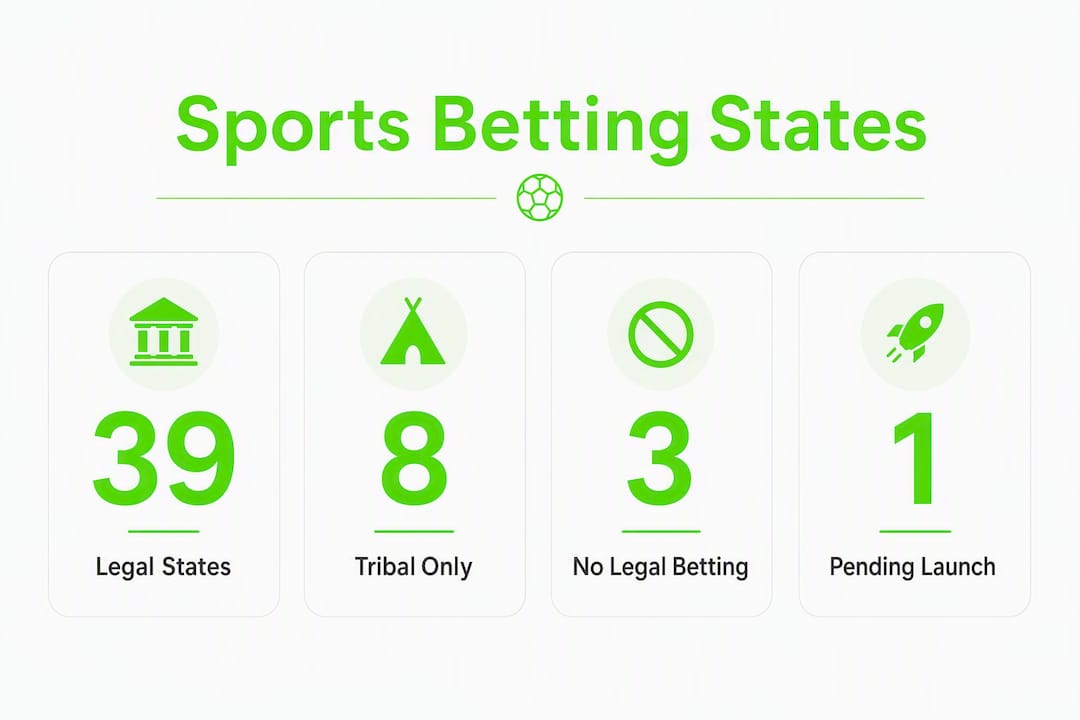
The quick-reference table gives you the headline status. This section covers the details that actually matter when you’re deciding whether and how to bet in a specific state.
States with full commercial markets
New Jersey was the first state to launch after Murphy v. NCAA, going live in June 2018. The NJ Division of Gaming Enforcement licenses operators and publishes a public roster at its official site. Betting on in-state college teams (Rutgers, Seton Hall, etc.) is prohibited. Age minimum is 21.

Pennsylvania launched retail in 2019 and mobile shortly after. The PA Gaming Control Board maintains a licensed-operator list. College player props for in-state schools are off the menu. At 21+, Pennsylvania also taxes gambling winnings at the state level.
New York launched mobile in January 2022 and quickly became one of the highest-revenue markets in the country. The NY Gaming Commission licenses operators. College prop restrictions apply to in-state schools. Age minimum is 21.
Colorado went live in May 2020 following a 2019 ballot measure. The Colorado Division of Gaming oversees licensing. No college-betting restrictions beyond standard federal rules. Age minimum is 21.
Michigan launched online in January 2021. The Michigan Gaming Control Board licenses both commercial and tribal operators for online play. No college-team betting ban, though operators may impose their own limits. Age minimum is 21.
Illinois launched in 2020 but banned in-person registration requirements in 2022, opening full mobile access. The Illinois Gaming Board regulates. Betting on in-state college teams is prohibited. Age minimum is 21.
Ohio launched January 1, 2023. The Ohio Casino Control Commission regulates. College player props for in-state schools are restricted. Age minimum is 21.
Massachusetts launched retail in January 2023 and mobile in March 2023. The Massachusetts Gaming Commission regulates. College prop restrictions apply to in-state schools. Age minimum is 21.
Missouri launched December 1, 2025, following a November 2024 ballot vote. Both retail and online are live. College-betting restrictions apply. Age minimum is 21.
North Carolina launched online in March 2024. The NC Lottery Commission regulates. Some college-betting restrictions apply. Age minimum is 21.
States with limited or tribal-only markets
Delaware was actually the first state to offer single-game sports wagering post-PASPA, launching in June 2018. However, it operates through the Delaware Lottery with retail-only access at three casinos. No mobile wagering is available statewide.
Mississippi has had retail betting since 2018 but has not authorized statewide mobile. Bets must be placed on casino property. The Mississippi Gaming Commission regulates.
Montana operates through the state lottery with a limited number of licensed retail locations and a lottery-run mobile app. The operator pool is narrow compared to full commercial markets.
Florida presents one of the more complex situations in the country. The Seminole Tribe’s compact authorizes sports betting, and the Hard Rock Bet app operates under that compact. Legal challenges have created periods of uncertainty. As of May 2026, the app is live, but bettors should monitor the Florida Division of Pari-Mutuel Wagering for updates.
Washington State permits sports betting only through tribal compacts. No commercial mobile apps are authorized. Tribal casinos offer retail wagering. Age minimum is 18.
New Mexico operates entirely through tribal compacts. No commercial sportsbook licenses exist. Retail wagering is available at tribal casinos.
Oklahoma is similar: tribal compacts govern all sports wagering. No commercial licenses have been issued.
Wisconsin legalized online sports betting on April 9, 2026, but the market had not launched as of this update. Retail wagering through tribal casinos is available. Monitor the Wisconsin Department of Administration for launch timing.
States where sports betting is not legal
California remains the largest state without legal sports betting. Two competing ballot measures in 2022 both failed. Tribal opposition to commercial online betting remains a significant barrier. No active law is in place as of May 2026.
Texas has seen repeated legislative attempts, but no bill has cleared both chambers. The political environment remains challenging.
Georgia has active bills in the 2026 legislative session. Watch the Georgia General Assembly’s official tracker for movement.
Utah has a constitutional prohibition on gambling. No legislative path exists without a constitutional amendment.
Alabama, Alaska, Hawaii, Idaho, Minnesota, North Dakota, and South Carolina have no active legal frameworks. Minnesota has ongoing tribal negotiations that could produce movement.
Recent launch timeline
| State | Launch date | Market type |
|---|---|---|
| New Jersey | June 2018 | Retail + online |
| Delaware | June 2018 | Retail only |
| West Virginia | August 2018 | Retail + online |
| Rhode Island | November 2018 | Retail + online |
| New Mexico | October 2018 | Tribal retail |
| Mississippi | August 2018 | Retail only |
| Nevada | Pre-2018 | Retail + online |
| Indiana | September 2019 | Retail + online |
| Iowa | August 2019 | Retail + online |
| New Hampshire | December 2019 | Online (lottery) |
| Oregon | October 2019 | Online (lottery) |
| Colorado | May 2020 | Retail + online |
| Illinois | March 2020 | Retail + online |
| Tennessee | November 2020 | Online only |
| Michigan | March 2021 (online) | Retail + online |
| Virginia | January 2021 | Online |
| Arizona | September 2021 | Retail + online |
| Connecticut | October 2021 | Retail + online |
| Louisiana | October 2021 | Retail + online |
| Wyoming | September 2021 | Online only |
| Maryland | December 2021 (retail) | Retail + online |
| New York | January 2022 (online) | Retail + online |
| Kansas | September 2022 | Retail + online |
| Arkansas | March 2022 (online) | Retail + online |
| Ohio | January 2023 | Retail + online |
| Massachusetts | January 2023 (retail) | Retail + online |
| Kentucky | September 2023 | Retail + online |
| Maine | November 2023 | Retail + online |
| Vermont | January 2024 | Online only |
| North Carolina | March 2024 | Online |
| Missouri | December 1, 2025 | Retail + online |
| Wisconsin | April 9, 2026 (online authorized) | Retail + pending online |
Why does federal law not decide sports betting legality?
The direct answer: federal law no longer bans single-game sports wagering. The Supreme Court’s ruling in Murphy v. National Collegiate Athletic Association (2018) struck down PASPA, the Professional and Amateur Sports Protection Act of 1992, which had effectively prohibited states from authorizing sports betting. The Court held that PASPA violated the anti-commandeering doctrine of the Tenth Amendment by forcing states to maintain laws that prohibited sports wagering. That ruling did not create a federal right to bet. It returned the decision entirely to state legislatures.
The practical result is a patchwork. Because regulation is decentralized, there is no single U.S. sports betting market. Each state sets its own rules on permitted bet types, age requirements, and operator licensing. A bettor in New Jersey operates under entirely different rules than one in Tennessee or Montana.
Federal laws that still affect bettors
Two federal statutes remain relevant even after Murphy v. NCAA:
The Wire Act (18 U.S.C. § 1084) prohibits using wire communications to transmit bets or wagering information across state lines. The Department of Justice has issued conflicting opinions on whether the Wire Act applies only to sports betting or to all forms of online gambling. The current practical effect: licensed operators are careful about interstate data transmission, and bettors cannot legally place wagers through unlicensed interstate channels.
Federal taxation applies to all gambling winnings regardless of state law. The IRS treats gambling winnings as ordinary income. Operators are required to report certain winnings to the IRS, and bettors must report all winnings on their federal return, even amounts below the W-2G threshold.
Federal excise taxes on sports wagering operators are also part of the federal code, though the primary tax burden in regulated markets falls on operators, not individual bettors.
Pro Tip: Geo-fencing is not optional for licensed apps. Every state-licensed sportsbook app uses location-verification technology to confirm you are physically inside the state before accepting a wager. If you cross a state line mid-session, the app will suspend your ability to bet. A VPN does not bypass this. Attempting to spoof your location violates the operator’s terms and potentially state law.
How do you verify a sportsbook is legal before you deposit?
Confirming that a sportsbook is licensed in your state takes about five minutes and protects you from the most common risk: depositing money with an offshore, unregulated operator that has no obligation to pay you and no U.S. legal accountability. Follow these steps before funding any account.
1. Find your state gaming commission’s licensed-operator list. Every state with legal sports betting publishes a roster of licensed operators on its gaming commission or lottery website. Search “[your state] gaming commission licensed sportsbooks” and go directly to the .gov or official state site. Do not rely on third-party lists as your primary verification.
2. Confirm the operator’s license number. Licensed sportsbook apps display their license number in the app footer, the “About” section, or the terms and conditions. Cross-reference that number against the state regulator’s public roster. If the number is absent or does not match, stop.
3. Verify the app’s geolocation behavior. A legitimate licensed app will request location permissions before allowing you to place a bet. If an app accepts wagers without any location check, that is a red flag. Confirm the app is available in your state’s official app store listing, not just a side-loaded APK.
4. Check payout procedures and complaint processes. Licensed operators must publish their payout timelines and dispute-resolution procedures. Your state gaming commission also maintains a complaint process for unresolved disputes. Locate that complaint form before you need it.
5. Avoid offshore and unlicensed sites. Offshore operators are not licensed by any U.S. state and operate outside U.S. jurisdiction. If a dispute arises, you have no meaningful legal recourse. The Congressional Research Service has specifically flagged offshore operators as a consumer-protection risk.
6. Read the promotional terms carefully. Bonus offers and promotional bets are subject to state-specific rules. Some states restrict the types of promotions operators can offer. Confirm that any bonus you claim is disclosed in the operator’s official terms, not just in a marketing email.
Pro Tip: Screenshot and save three things before you place your first bet: (1) the state regulator’s page showing the operator’s active license, (2) the in-app location confirmation screen, and (3) your deposit transaction receipt. If a dispute arises, these three documents are your starting evidence.
How are sports betting winnings taxed in the U.S.?
Gambling winnings are taxable income at the federal level. You must report them whether or not the operator issued a W-2G form. That point trips up a lot of bettors who assume small wins don’t count. They do.
Federal W-2G thresholds
Operators are required to issue a W-2G form when a single win meets specific thresholds. For sports betting, the threshold is $600 or more when the payout is at least 300 times the wager. The operator may also withhold 24% federal income tax on winnings above $5,000 from a single bet. Winnings below these thresholds are still taxable; the operator simply is not required to report them automatically.
The IRS requires bettors to report all gambling winnings on Form 1040, Schedule 1. Gambling losses can be deducted, but only up to the amount of winnings, and only if you itemize deductions. You cannot deduct losses against other income.
State-level variation
State income tax treatment of gambling winnings varies considerably. Some states with legal sports betting, such as Nevada, do not have a state income tax, so winnings face no state-level tax. Others, like Pennsylvania and New York, tax gambling winnings as ordinary income at the state rate. Tennessee has no state income tax on wages but does have specific rules worth confirming with a tax professional.
The general rule: you owe state income tax where you are a resident, not necessarily where you placed the bet. If you live in a state with income tax and bet legally in a state without one, your home state’s tax rules still apply.
Pro Tip: Keep a bet log throughout the year: date, sport, operator, amount wagered, and outcome. Export your transaction history from the app monthly and save it. If you receive a W-2G, attach it to your return. If you don’t, you still need records. The IRS can audit gambling income, and a documented log is your best defense.
This article provides general information, not tax advice. Confirm your specific reporting obligations with a qualified tax professional or the IRS directly.
What consumer protections do licensed sportsbooks provide?
Licensed sportsbooks must follow state rules on payouts, dispute resolution, and responsible-gambling safeguards. Offshore and unlicensed sites carry none of these obligations. That gap is the single most important reason to verify licensing before depositing.
Here is what you should expect from any state-licensed operator:
- Identity verification: Licensed operators must verify your age and identity before activating an account. This protects against underage gambling and fraud.
- Published terms and odds: Bet terms, payout rules, and odds must be disclosed. You have the right to review them before placing a wager.
- Payout timelines: State regulations typically specify maximum payout processing times. If an operator misses them, you can escalate to the state gaming commission.
- Dispute resolution: Every licensed operator must have a documented complaint process. If the operator does not resolve your complaint, the state gaming commission accepts formal complaints and can investigate.
- Self-exclusion programs: Every state with legal sports betting maintains a self-exclusion registry. Operators are required to honor it. If you or someone you know needs to step back from betting, self-exclusion is a legally enforceable option.
- Deposit limits and responsible-gambling tools: Licensed operators must offer deposit limits, session time limits, and links to problem-gambling resources. These tools are not optional features; they are regulatory requirements.
- Responsible-gambling hotlines: The National Council on Problem Gambling operates a 24/7 helpline at 1-800-522-4700. Licensed operators are required to display this or an equivalent resource.
For additional responsible-gambling guidance and tools, BetsyScore’s responsible gambling resources provide a practical reference alongside state-specific self-exclusion information.
How to escalate a complaint
If an operator fails to resolve a dispute, contact your state gaming commission directly. Collect: your account ID, the bet slip or transaction ID, screenshots of the disputed outcome, and any correspondence with the operator’s support team. File the complaint through the commission’s official online portal or by certified mail. Most commissions respond within 30–60 days.
How do you monitor ongoing sports betting legislation?
Legalization is an active, ongoing process in state legislatures. The status of sports betting in any given state can change within a single legislative session. Several states that appear in the “not legal” column today have active bills that could move to a vote before the end of 2026.
What drives legalization:
- State tax revenue projections (legal markets generate significant tax receipts that legislatures find attractive)
- Tribal compact negotiations (particularly in states like Minnesota and California where tribal gaming interests shape the debate)
- Professional sports lobbying (leagues and team owners increasingly support regulated markets)
- Responsible-gambling framework development (some states delay legalization until they have adequate consumer-protection infrastructure)
- Neighboring-state competition (when a nearby state legalizes, the pressure on holdout legislatures increases)
Reliable sources to monitor:
- American Gaming Association maintains a state-by-state tracker and publishes regular legislative updates. Their commercial gaming revenue reports are the most cited industry data source.
- State legislative portals: Every state legislature publishes bill status online. Search “[state] legislature bill tracker” and filter for gaming or wagering bills.
- State gaming commission websites: When a bill passes, the gaming commission publishes rulemaking timelines and licensing schedules. This is where you find out when a newly legal market will actually open.
- CBS Sports and Legal Sports Report publish ongoing legislative trackers with bill numbers and committee status.
- National Indian Gaming Commission (NIGC): For tribal-compact states, the NIGC publishes compact approvals and amendments. Tribal markets often move on a different timeline than commercial legislation.
Pro Tip: Set a Google Alert for “[your state] sports betting bill” and “[your state] gaming commission.” When a bill advances to a committee vote or a governor signs it, you’ll get the news within hours. For tribal-compact states, also set an alert for “[your state] tribal gaming compact” since those approvals come from the NIGC, not the state legislature.
How this guide was compiled and verified
Last updated: May 2026. “As of” means the status reflected the publicly available information from state gaming commissions, official state statutes, and major industry trackers at the time of this update. State laws change. Always confirm current status with your state’s official gaming regulator before placing a wager.
Primary sources used in this guide:
- Murphy v. National Collegiate Athletic Association, 584 U.S. 453 (2018) — the Supreme Court decision that removed PASPA and returned sports betting authority to the states
- Congressional Research Service brief on sports gambling and consumer finance (Congress.gov)
- State gaming commission websites for licensing rosters and statute references
- American Gaming Association state tracker for market-status counts
- National Indian Gaming Commission for tribal compact data
- State legislative portals for pending-bill status
- FOX Sports and Legal Sports Report for launch-date verification and state-by-state legislative tracking
A note on methodology: State entries in this guide were cross-referenced against official state gaming commission pages and state statutes where available. Launch dates were verified against multiple industry trackers. College-betting restriction notes reflect the most commonly cited state rules; individual operators may impose additional restrictions beyond the state minimum. Age limits reflect the statutory minimum for sports wagering specifically, which may differ from the minimum for other forms of gambling in the same state.
For bettors who want to go beyond knowing the law and start making data-driven decisions within legal markets, Mannysvariety’s AI-powered picks platform provides sport-specific predictive engines, transparent pick archives, and daily betting intelligence across NFL, NBA, MLB, NHL, and more. The platform’s track record is publicly graded, which is the standard any serious bettor should demand from a picks service.

Key Takeaways
Sports betting is legal in many U.S. states and D.C. as of May 2026, but the rules governing age limits, online access, college betting, and operator licensing vary significantly by state, and bettors must verify current status with their state gaming commission before placing any wager.
| Point | Details |
|---|---|
| Many states plus D.C. allow betting | As of May 2026, 39 states and Washington, D.C. allow sports betting in some form, and about 30 states have online or mobile wagering through licensed apps. |
| Murphy v. NCAA (2018) is the foundation | The Supreme Court struck down PASPA, returning sports betting authority to each state individually. |
| Age limits vary by state | Most legal states require bettors to be 21; Kentucky, Montana, New Hampshire, Rhode Island, Washington, and D.C. allow betting at 18. |
| College betting restrictions are common | Arizona, Connecticut, Illinois, New Jersey, New York, Ohio, Pennsylvania, and others ban wagering on in-state college teams or player props. |
| Always verify licensing before depositing | Check your state gaming commission’s licensed-operator roster and confirm the app’s license number before funding any account. |