

3 Conditions That Make Paid Picks Worth It for Casual Bettors
Paid picks are worth it only when three conditions line up: the service publishes a verified, timestamped track record, you bet enough volume that the subscription cost stays under roughly 10 to 15 percent of your expected monthly profit, and the picks come with real closing-line value. Without verification, a subscription is a bet on the seller’s honesty, not a bet on sports. A legitimate service tracks a large number of graded picks with a strong win rate and positive net return, the kind of public record that separates it from a marketing page.
TL;DR:
- Verified record and transparent closure line data are essential to distinguish legitimate paid picks from marketing scams.
- Subscription costs are only justified if your betting volume makes the fee a small percentage of expected profit, especially at higher stake levels.
- Proper vetting requires full historical results, disclosed stake sizes, and a focus on closing-line value rather than win percentage alone.
- Paid picks are more valuable in niche markets or with specialized tools, but generally less effective for low-volume or casual bettors.
- Building skills, using odds comparison tools, and tracking personal results provide better value than unverified paid picks for most recreational bettors.
Table of Contents
- How Paid Picks Services Actually Work
- Does the Math Actually Work Out?
- How Do You Vet a Paid Picks Service Before You Pay?
- When Do Paid Picks Make Sense to Buy?
- Are There Better Options Than Buying Picks?
- What Do Real Outcomes Look Like With Paid Picks?
- How Do Paid Picks Affect Your Betting Discipline?
- What Does a Paid Picks Subscription Really Cost?
- Do Paid Picks Work Better in Some Sports Than Others?
- Manuel’s Take: When I’d Actually Recommend Paying for Picks
- Try Manny’s Variety Without Betting on Faith
- Sources
- FAQ
How Paid Picks Services Actually Work
Most paid picks operate on a subscription model: a flat weekly or monthly fee gets you a daily slate of selections, sometimes tiered into a basic package and a “VIP” upgrade with more picks or higher confidence ratings. Some services sell single-day passes for bettors who only want access before a big slate, and a handful offer a free trial so you can sample the product before paying. Others skip the trial entirely and push a large upfront fee, which is worth treating with suspicion on its own.
What separates a legitimate operation from a marketing funnel is what gets published. A real service posts picks with a timestamp before the game starts, discloses recommended stake sizes, and keeps a complete history, including the losing stretches. Sports Command’s auditor framework for vetting tipster sites puts verified historical records and disclosed methodology at the center of that standard.
Some services bundle in tools like odds comparators or CLV calculators rather than just handing you picks. Action Network built its business around comparing odds across sportsbooks and layering in prediction-market pricing, and that kind of tool changes the math: you’re not just buying a guess, you’re buying a way to check the guess against the market.
- Daily pick subscriptions: lowest commitment, easiest to cancel
- VIP or premium tiers: higher price, often more picks or added confidence grading
- Day passes: useful for one-off high-volume slates like NFL Sundays
- Tool bundles: odds comparison and CLV tracking layered on top of picks
It’s also worth knowing that subscription-based selling isn’t automatically a red flag. Sharp bettors frequently hit betting limits at sportsbooks once they win consistently, so selling analysis instead of placing bets can be a rational business model for someone with real edge, not just a way to dodge accountability.
Does the Math Actually Work Out?
Run the numbers before you run your bankroll through anything. A legitimate handicapper hitting 55% at standard -110 odds generates roughly a 3.5% return on investment. That’s a real edge, but it’s a thin one, and a subscription fee eats into it fast if your bet size is small.
Here’s how that plays out at different stake levels betting $50 a game, five games a week:
- $50 average bet: roughly $8.75 profit per bet at 3.5% ROI, or about $175 a month across 20 bets. A $50 monthly subscription eats nearly 30% of that profit.
- $250 average bet: about $43.75 profit per bet, roughly $875 a month. The same $50 fee now costs under 6% of profit.
- $500 average bet: about $87.50 per bet, or $1,750 monthly. The subscription barely registers.
Two things matter more than the win-rate headline. First, closing-line value, meaning whether the pick would have gotten a better price than the line at kickoff, is often a stronger signal of real skill than win percentage alone, since it shows the pick moved the market rather than just getting lucky. Second, sample size matters enormously. Bettors need several hundred graded picks before a win rate means much of anything, and even strong professional services tend to run in the single digits to low double digits for long-term ROI. A 15 pick heater tells you nothing. A 500 pick archive tells you almost everything.
How Do You Vet a Paid Picks Service Before You Pay?
Treat this like due diligence, not a leap of faith. The framework that matters most here comes down to four checks, and skipping any one of them is how bettors end up funding someone else’s marketing budget.
- Demand a public, timestamped history. Picks posted after the fact, or a record you can’t independently confirm, tell you nothing.
- Check for CLV data, not just win percentage. A service that tracks and publishes closing-line performance is showing its work, not just its highlights.
- Look for disclosed stake sizing. A credible service tells you how much to bet on each pick relative to your bankroll, not just what to bet on.
- Do the ROI math yourself. If a service claims a return, the losing stretches should be visible in the same log as the wins.
Red flags show up fast once you know where to look. Watch for cherry-picked highlight reels instead of full histories, “guaranteed” winners (nothing in sports betting is guaranteed), quietly deleted losing picks, and large nonrefundable upfront packages sold with urgency. Fabricated records and impossibly high sustained win rates are common tells of a scam, not signs of a hot streak.
Pro Tip: Before subscribing to anything, ask the service for its full graded history, including losses, from at least 90 days ago. A legitimate operation will hand it over without hesitation. One that stalls, deflects, or only shows “recent” results is telling you something.
Once you’ve verified the record, compare the subscription cost to your expected monthly betting profit.
When Do Paid Picks Make Sense to Buy?
Paid picks fit a specific profile better than a general one. If you’re betting casually with a small bankroll and no plan to scale up, the subscription fee will likely outrun any edge a service provides, no matter how good the picks actually are.
Paying makes more sense when:
- You bet enough volume that a subscription fee stays a small slice of expected profit, not a large one
- You want exposure to markets you can’t easily analyze yourself, like player props, niche futures, or international leagues
- The service includes tools or education that teach you to spot value, not just a list of picks to copy blindly
- The provider shows verified CLV performance and offers a trial or reasonable entry price before you commit long term
That last point matters most. A service willing to prove itself before asking for your money is behaving like a business with a real product. One that pressures you into a large upfront package, with no trial and no visible track record, is behaving like something else entirely.
Are There Better Options Than Buying Picks?
For most recreational bettors, the highest-leverage purchase isn’t a pick, it’s a tool or a skill. Line shopping alone can add meaningful value over time, since Action Network’s odds comparison tools let you check a line across multiple sportsbooks before you bet, and getting -108 instead of -115 on a regular basis compounds significantly over a season.
- Odds and line aggregator tools: compare prices across books in seconds, often free or low cost
- Prediction-market pricing checks: weighing market-implied probabilities against sportsbook lines exposes mispriced numbers
- Betting education and bankroll management resources: learning proper stake sizing prevents the kind of variance swings that wipe out a season
- Tracking your own bets: a simple spreadsheet logging every bet, price, and outcome often reveals more about your actual edge than any subscription will
None of this requires trusting a stranger’s claimed win rate. It requires discipline and a few free or low-cost tools, which for a lot of bettors is a better return than a $100 a month pick subscription with no verifiable history behind it.
What Do Real Outcomes Look Like With Paid Picks?
The success stories and the horror stories both tend to follow a pattern once you strip away the noise. Bettors who came out ahead almost always describe the same setup: they started with a small stake or a trial, checked the service’s picks against its published history in real time, and only scaled up their bet size after weeks of watching the numbers hold up. They treated the subscription as a research cost, not a guaranteed payday.
The failure pattern looks different. It usually starts with a service that shows a hot streak, sometimes real, sometimes staged through selective posting, and a bettor who commits a large bankroll on the strength of a few weeks of wins. When the inevitable losing stretch hits, and every legitimate service has one, the bettor either quits with a loss or chases harder, increasing stakes to recover faster. That’s not a picks problem. That’s a bankroll management problem that paid picks can amplify if you’re not careful.
The common thread across both outcomes isn’t the quality of the picks. It’s whether the bettor treated the service as one input into a disciplined process, or as a shortcut that removes the need for one. A 63.5% win rate over 1,600 picks means very little to a bettor who bets his entire bankroll on a single Thursday night parlay because a text alert felt urgent.
How Do Paid Picks Affect Your Betting Discipline?
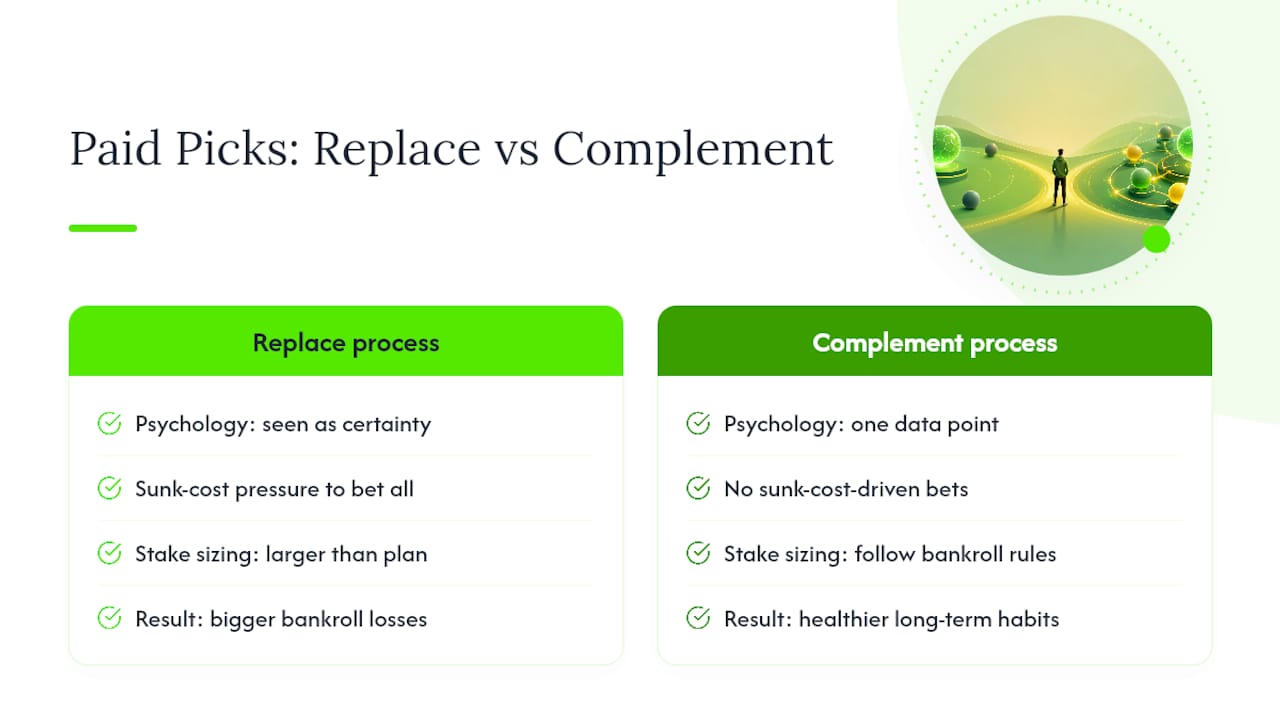
Buying picks changes how people bet, and not always for the better. The psychological shift is subtle: once you’re paying someone else to think for you, it’s easy to treat their pick as certainty rather than probability, which pushes bettors toward larger stakes than their bankroll plan actually allows.
There’s also a sunk-cost effect that shows up constantly. A bettor who just paid $75 for a week of VIP picks feels pressure to bet every single one to “get their money’s worth,” even when a pick doesn’t match their own risk tolerance or bankroll rules. That’s backwards. The subscription fee is already spent whether you bet the pick or not, and letting it dictate stake size is how a $75 subscription turns into a $400 loss.
The flip side matters too. Bettors who use paid picks alongside their own tracking, rather than instead of it, tend to develop better habits over time. Watching how a service handles CLV, stake sizing, and losing runs is itself an education, provided the service is transparent enough to show that information in the first place. A service that bundles predictive tools with its picks often produces this effect naturally, since it teaches pattern recognition instead of just delivering conclusions.
The healthiest relationship with paid picks treats them as one data point, weighed against your own bankroll rules, not as an instruction to follow blindly. That’s a harder discipline to maintain than it sounds, especially after a losing week when doubt creeps in and the temptation to bet bigger to “catch up” gets loud.
What Does a Paid Picks Subscription Really Cost?
The advertised price is rarely the full cost. A basic daily picks subscription might run $30 to $100 a month, but plenty of services layer in extras: a “premium” tier for their highest confidence plays, add-on fees for player props or parlays, and seasonal price bumps during marquee stretches like the NFL playoffs or March Madness.
Some of the biggest costs hide in structure rather than price tags. Auto-renewing subscriptions that bill weekly instead of monthly can add up faster than bettors expect if they forget to cancel. Nonrefundable “VIP” packages sold as one-time purchases, often priced at several hundred dollars for a season, carry real risk if the service turns out to be unreliable, since there’s no trial period to test the product first.
The other hidden cost is behavioral, not financial. A subscription that pressures bigger bets to “cover the fee,” discussed above, functions as a real cost even though it never appears on a receipt. Add it up over a season, and a bettor chasing losses to justify a subscription can lose far more than the subscription itself ever charged.
Compare the full annual cost, including any premium add-ons, against your realistic expected profit at your typical bet size before committing to anything longer than a month at a time.
Do Paid Picks Work Better in Some Sports Than Others?
Not every sport rewards a paid picks subscription equally, and that’s worth knowing before you pick a service. NFL and NBA markets are the most heavily bet and most efficiently priced, since sportsbooks pour enormous resources into setting those lines, which makes a genuine edge harder to find and easier to spot when a service claims an unrealistic win rate.
MLB and NHL, with their higher game volume and moneyline-heavy structure, tend to have softer lines in spots, especially on smaller market games that get less betting action and less line-setting attention. That’s part of why sport-specific analysis, built around a dedicated engine for each league, tends to outperform a generalist approach that applies the same model to every sport.
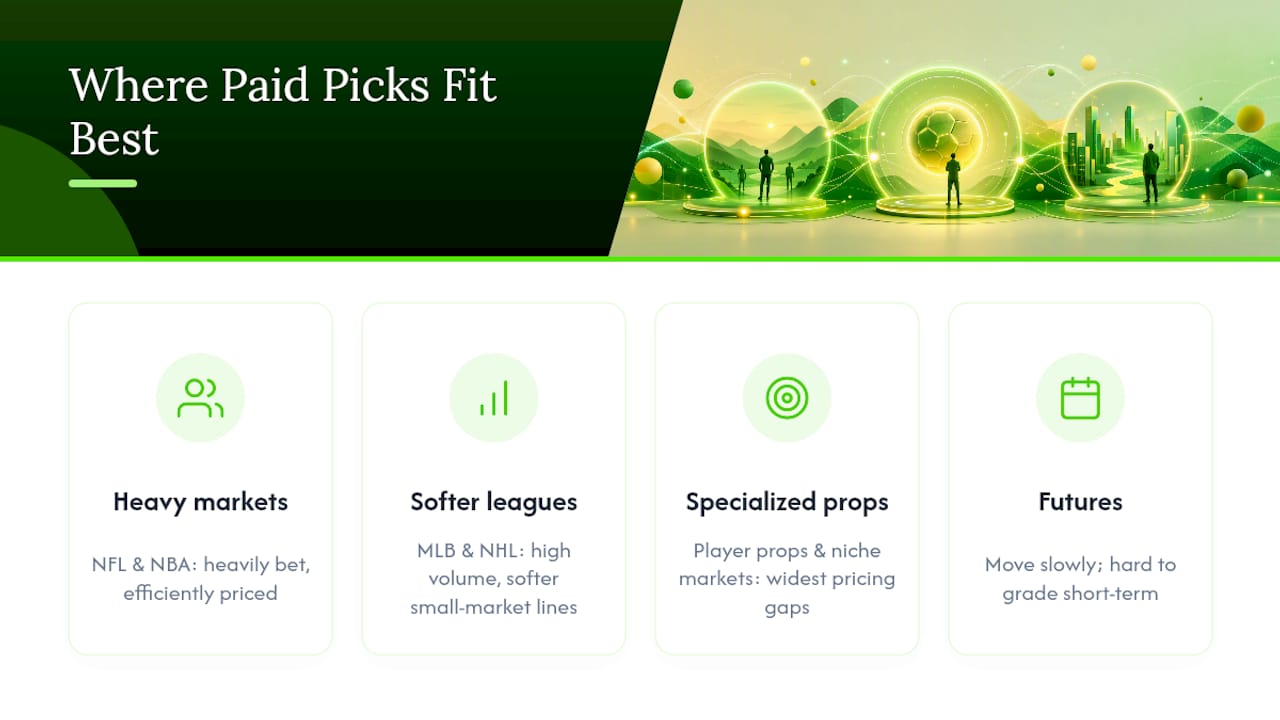
Player props and niche markets, think second-half totals, specific statistical props, or lower-profile international soccer leagues, often carry the widest gap between sharp pricing and public pricing, simply because fewer people are betting them and books spend less time perfecting the number. That’s exactly where paid picks with real specialization can add the most value, since replicating that kind of research yourself takes real time.
Futures markets sit at the other extreme. They move slowly, settle over months, and are hard to grade fairly in a short subscription window, which makes them a poor fit for judging any service’s short-term track record.
Manuel’s Take: When I’d Actually Recommend Paying for Picks
I work with Manny’s Variety, so take this as an informed opinion, not a neutral one. That’s the bar I hold any service to, ours included.
My honest read: paid picks make sense for bettors with real volume and the discipline to verify before they scale up. They don’t make sense for someone hoping a subscription replaces bankroll management they haven’t built yet. No pick fixes that.
— Manuel
Try Manny’s Variety Without Betting on Faith
Manny’s Variety gives you a public track record instead of a promise. Every pick gets logged before it’s graded, wins and losses both stay visible, and the sport-specific AI engines behind daily AI-powered picks cover MLB, NBA, NFL, and beyond without collapsing everything into one generic model.
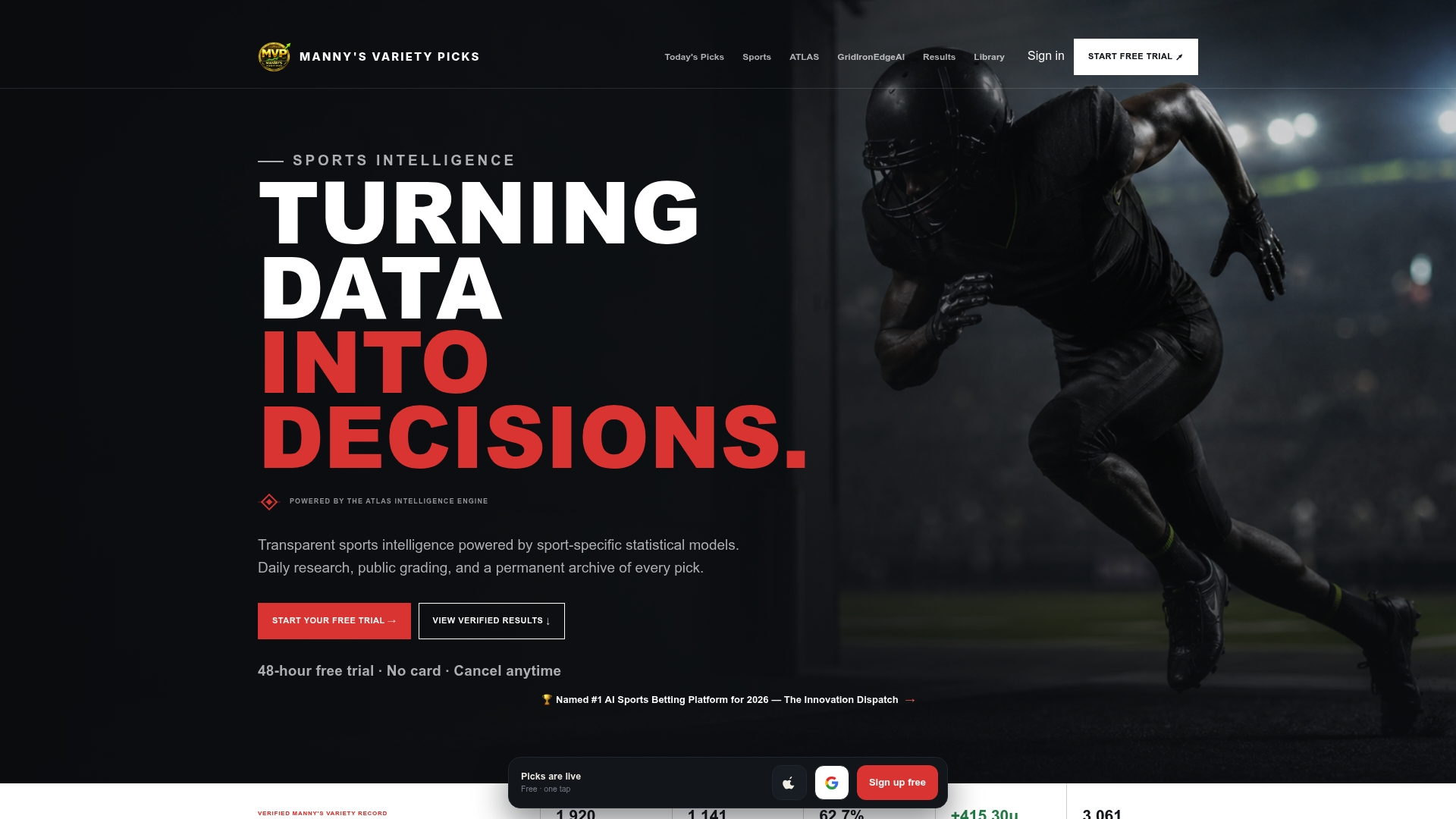
That structure checks the boxes this guide walks through: timestamped archives instead of highlight reels, published win rate and net units instead of vague claims, and stake guidance instead of guesswork. If you want picks during the action itself, the live in-game picks run on the same transparent grading. Start with a small stake, compare a few weeks of picks against the published pricing tiers, and track your own closing-line value before deciding how far to scale up.
Sources
- Is Paying for Handicapper Picks Worth It in 2026? The Honest Answer - XCLSV
- Betting Tips Sites: How to Vet Them (2026) — Sports Command
- Action Network: Sports Betting Odds, News & Analysis
FAQ
Are Paid Picks Worth It for a Casual Bettor?
Only if the service verifies its track record and your bet size is large enough that the subscription fee stays a small share of expected profit. For low-volume bettors, fees often erase most of a legitimate 3 to 4% edge.
How Do I Know If a Picks Service Is Legitimate?
Look for a timestamped public archive that includes losing streaks, disclosed stake sizing, and evidence of positive closing-line value.
Should I Trust a Service That Offers a Money-Back Guarantee?
A guarantee doesn’t replace verification. Focus on whether the service shows a complete, timestamped history instead of relying on refund promises to earn trust.
Is It Better to Buy Picks or Learn to Bet Myself?
For most recreational bettors, tools like odds comparison, bankroll management, and tracking your own results produce a better return than an unverified subscription. Paid picks add the most value when they’re verified, include education or tools, and match your betting volume.