

$20–$40 Plans: When a Sports Picks Subscription Actually Pays for Bettors
Most sports picks subscriptions commonly range from about $20 to $40 per month for entry to mid-tier access, with seasonal or six-month passes and annual plans that convert to lower effective monthly rates, and some vendors offering day or week passes as well. Casual bettors placing $50 or less per game should start with a low-cost monthly plan or free trial; high-volume bettors staking $200 or more per game can justify premium annual pricing if the math checks out. The value math section below shows exactly how to run that calculation before you pay.
TL;DR:
- Monthly subscription costs typically range from $15 to $50, with higher tiers including live in-game picks and multiple sports; annual plans often reduce the effective monthly rate to $17–$42.
- Genuine price drivers include in-game picks, unlimited daily picks, sport-specific AI models, and cross-book odds scanning, while vague marketing claims like “AI technology” lack verifiable performance data.
- To determine if a subscription is worthwhile, estimate your conservative expected profit, compare it to the monthly cost, and ensure the expense is no more than a third of your estimated monthly gains.
- Be cautious of billing terms such as price-lock guarantees, seasonal billing pauses, free trial lengths, refund policies, auto-renewal rates, and cancellation procedures before subscribing.
- Transparent archives with verified, graded pick histories are a crucial sign of a credible service, and starting with a short trial allows testing results against your own analysis before full commitment.
Table of Contents
- Typical Sports Picks Subscription Cost Ranges by Plan Type
- What Actually Drives the Price Up (and What’s Just Marketing)
- How Do You Know if a Subscription Is Worth the Price?
- Billing Terms That Quietly Change Your Long-Term Cost
- How to Compare Promo Pricing Without Getting Fooled
- Red Flags That Mean You Should Walk Away
- How Manny’s Variety Pricing Maps to These Value Criteria
- A Straight Answer on What’s Fair to Pay
- Ready to See the Numbers for Yourself?
- Sources
- FAQ
Typical Sports Picks Subscription Cost Ranges by Plan Type
Pricing for sports picks subscriptions clusters into a few predictable bands, and once you know them, spotting an overpriced or underpriced offer takes seconds.
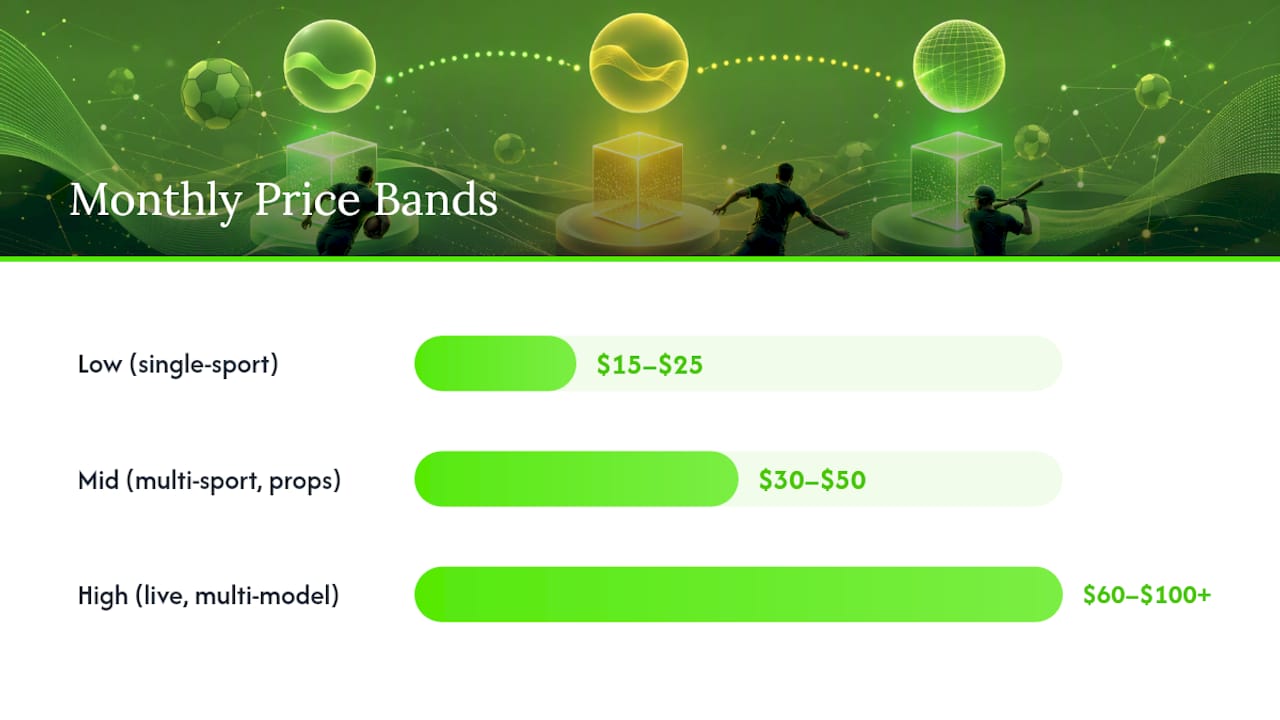
Monthly-only plans are the entry point for most services. Low-end plans start around $15 to $25 per month and typically cover a single sport with a limited number of daily picks. Mid-tier monthly plans, priced between $30 and $50, usually add multiple sports, player props, and some form of performance tracking. High-end monthly plans can run $60 to $100 or more, often bundling live in-game picks, parlays, and access to multiple predictive models at once.
Seasonal and six-month plans typically offer a discount compared to monthly plans, allowing access for a full season or half-year. However, they require a commitment that may not be beneficial if the picks do not perform well early on.
Annual plans typically offer further discounts when converted to a monthly equivalent rate, often making them cheaper than paying month-to-month. This requires prepayment for a full year, which increases the risk if the service’s performance declines or it ceases operation.
Day passes and week passes provide short-term access for single or limited events without requiring a subscription. They typically cost from about $5 to $20 and suit bettors who focus only on specific high-interest events and prefer not to pay for year-round coverage.
Here’s how the common price points break down:
- Entry monthly plans: generally around $20 to $40, usually single-sport, limited daily picks
- Mid-tier monthly plans: roughly $20 to $40, multi-sport with props and basic tracking
- Premium monthly plans: often priced toward the higher end of the $20 to $40 range, including live picks, parlays, multiple AI models
- Seasonal/6-month passes typically cost in a range that converts to roughly $25 to $50 per month
- Annual plans often convert to a monthly equivalent rate in the $17 to $42 range
- Day/week passes generally cost from about $5 to $20, allowing single-event or short-window access
One pattern worth watching: seasonal billing and price-lock guarantees show up most often at the mid-to-premium tier, where vendors compete on retention rather than just headline price. A cheap monthly plan with no seasonal option isn’t necessarily a worse deal, but it does mean you’re exposed to price increases every renewal cycle.
What Actually Drives the Price Up (and What’s Just Marketing)
Not every dollar you pay for a picks subscription buys you something real. Some features genuinely change the quality of what you’re getting; others are dressed-up versions of the same basic product.
Features that legitimately justify a higher price tag include:
- Live and in-game picks, which require real-time data processing and faster turnaround than pre-game analysis
- Unlimited daily picks across multiple sports instead of a capped number per day
- Access to sport-specific AI models, since building and maintaining a separate predictive engine for MLB, NBA, and NFL costs more than running one generic model across all three
- Cross-book odds scanning, which flags the best available line across sportsbooks instead of quoting a single number
- Per-model performance metrics, showing win rate and unit return broken out by sport or bet type rather than one blended figure
Compare that against claims that sound impressive but don’t tell you much. “Powered by advanced algorithms” is a phrase that describes almost every service on the market and none of them specifically. A vague mention of “AI technology” without a visible track record is marketing language, not a feature. The real differentiator is whether the service shows its work: can you see how the underlying models actually perform, sport by sport, pick by pick?
Transparent archives are the single best signal separating a legitimate service from a marketing shell. If a subscription costs $50 a month and the provider can’t show you a dated, graded history of past picks, you’re paying for a promise, not a product.
Pro Tip: During a free trial, don’t just read the picks. Check whether the service publishes results for picks made before you signed up. A provider with nothing to hide will show you last month’s grades, not just this week’s.
How Do You Know if a Subscription Is Worth the Price?
The only honest answer is math, not vibes. Whether a subscription pays for itself depends on your betting volume, your stake size, and a conservative estimate of the edge the picks actually provide.
Here’s the repeatable process:
- Estimate your expected edge conservatively. Don’t assume a 63% win rate translates directly to your results. Assume something modest, like a small edge over breakeven on standard odds, since subscription economics depend heavily on betting volume and overconfidence in your own execution will wreck the calculation.
- Calculate expected monthly profit at your stake level. Multiply your average bet size by your estimated edge and by how many picks you actually place per month.
- Convert the subscription cost to a monthly equivalent. If you’re paying for a six-month pass, divide the total by six. If it’s annual, divide by twelve.
- Compare the two figures and decide. If the subscription eats more than a third of your expected monthly profit, the math is working against you.
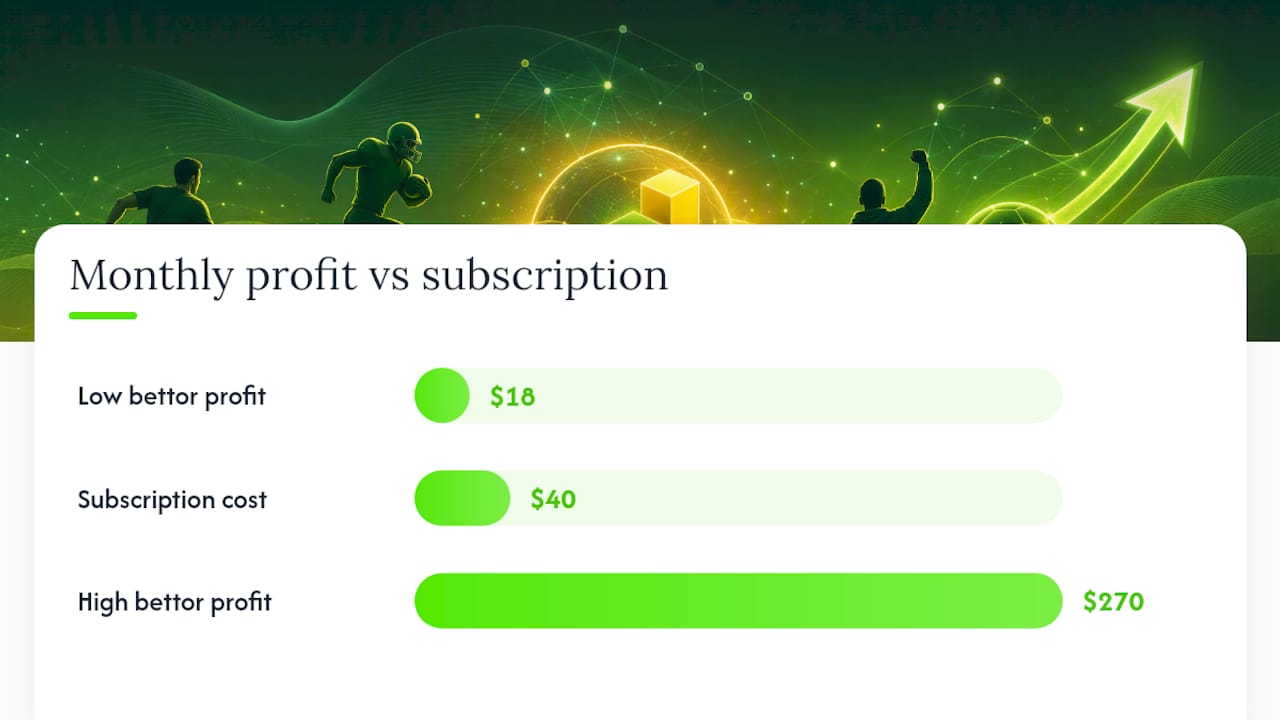
Consider two hypothetical bettors. That’s about $18 in expected monthly profit, before subscription costs. A $40 monthly subscription would consume more than double that expected profit, meaning the picks would need to dramatically outperform the conservative estimate just to break even on cost.
That works out to roughly $270 in expected monthly profit. A $40 subscription is a small fraction of that, leaving real room for profit even if actual performance lands below the advertised win rate.
This exercise has real limits. Variance means any given month can look nothing like the average, and sportsbook limits often reduce your ability to bet at scale once you’re winning consistently. Treat the math as a floor for decision-making, not a guarantee, and test any new service with smaller stakes before committing your full bankroll.
Billing Terms That Quietly Change Your Long-Term Cost
The sticker price on a subscription page rarely tells the whole story. Billing terms, renewal clauses, and trial structure often matter more than the headline number.
Price-locks guarantee your rate stays fixed for as long as you remain subscribed, even if the service raises prices for new customers later. This protects long-term subscribers from the common pattern where a $30 plan quietly becomes $45 a year later for existing users.
Seasonal billing pauses are specific to sports with clear offseasons. A service that pauses NFL-focused billing from February through August, rather than charging you year-round for a product you’re not using, meaningfully lowers your effective annual cost. Vendor pricing pages increasingly build this in as a retention feature rather than an afterthought.
Before paying anything, check these:
- Trial length: a 5 to 7 day trial is common and lets you sample picks before committing; be cautious of services offering no trial at all
- Refund policy: look for a clear, written refund window rather than a vague “contact support” promise
- Auto-renewal terms: confirm whether the plan renews at the same price or a different introductory rate
- Cancellation process: a legitimate service lets you cancel from your account settings, not just by emailing support and hoping for a reply
A short 5 to 7 day trial period helps users quickly decide whether to commit, reducing potential exposure if picks do not meet expectations. A 30-day trial can be a bigger commitment if it requires a card on file that auto-charges at day 31 without a clear reminder.
How to Compare Promo Pricing Without Getting Fooled
Promotional pricing is where a lot of buyers get burned, not because the discount is fake, but because they compare the promo price to a competitor’s full price instead of its own renewal rate.
The trick is annualizing everything before you compare. A service advertising “$19 your first month” that renews at $49 monthly is not a $19 service, it’s a $49 service with a one-time discount. To find the real cost, calculate the blended rate: add the discounted month to eleven months at full price, then divide by twelve.
For example, $19 for month one plus $49 for the next 11 months equals $558 total, or about $46.50 per month averaged across the year. That’s a meaningfully different number than the $19 headline, and it’s the number that matters if you’re planning to stay subscribed past the intro period.
Watch specifically for:
- “First-year” pricing that reverts to a much higher rate at the twelve-month mark
- Promo windows shorter than a full billing cycle, which can expire before you’ve even seen a full month of picks
- Bundled discounts that require annual commitment, since the discount often isn’t available month-to-month
Run the annualized math before comparing any two services on promo price alone. The provider with the flashier discount isn’t always the cheaper one over a full year.
Red Flags That Mean You Should Walk Away
Some warning signs are obvious once you know to look for them, and they show up across the industry regardless of sport or price point.
Treat these as immediate red flags:
- Guaranteed win rates, especially anything claiming 80% or higher with no variance acknowledged; sports betting doesn’t work that way, and any service claiming otherwise is either lying or cherry-picking
- No archived picks, meaning you can’t verify a single graded result from before you paid
- Large upfront fees with no trial, particularly four-figure “lifetime access” pricing sold through cold outreach or social media ads
- Opaque refund policies, where the terms of service are vague about cancellation or refunds are handled case-by-case with no written standard
Before subscribing anywhere, run a short due-diligence pass: request or search for archived picks going back at least a few weeks, check independent betting forums or Reddit threads for real user experiences rather than testimonials on the vendor’s own site, and start with the shortest available pass or trial instead of jumping straight to an annual plan.
Small-stake testing is the cheapest insurance you’ll ever buy in this space. Track results from a trial period against your own spreadsheet, not the vendor’s self-reported numbers, and only scale up once you’ve confirmed the picks hold up under your own scrutiny. If you’re budgeting for any subscription like this, responsible-spending guidance is worth a look before you commit real money.
How Manny’s Variety Pricing Maps to These Value Criteria
Manny’s Variety structures its subscription around two tiers, Core and Elite, alongside short-term day and week passes for bettors who want single-event access without a recurring charge. That structure lines up directly with the pricing bands covered above: a lower-cost tier for bettors testing the waters, a higher tier for those who want full access across sports, and short passes for one-off events like a marquee NFL Sunday or a UFC card.
What separates the pricing conversation here from a generic vendor page is the track record behind it. Manny’s Variety uses sport-specific AI engines, one model built for MLB, another for NBA, another for NFL, rather than a single generic algorithm applied across every sport. That distinction matters because it’s exactly the kind of feature this guide flags as a legitimate price driver, not marketing filler.
The numbers behind the tiers: Manny’s Variety has tracked over 1,600 graded picks with a 63.5% win rate and a net return of 443.9 units, all backed by permanent, publicly viewable archives rather than cherry-picked highlights.
That combination, transparent grading plus sport-specific models, is the same criteria this article recommends checking for before paying anyone for picks. Bettor profiles best matched to this structure:
- Casual, first-time bettors testing whether data-driven picks outperform gut instinct, best served by starting with a trial or the Core tier
- Multi-sport bettors who want MLB, NBA, and NFL coverage without subscribing to three separate single-sport services
- Fantasy football players who want custom league settings and player prop breakdowns alongside straight betting picks
- Higher-volume bettors for whom the Elite tier’s daily reports and market analysis justify the added cost under the value math from earlier in this guide
Before upgrading from Core to Elite, or before subscribing at all, run the same evaluation math covered earlier: estimate your conservative edge, calculate expected monthly profit at your stake level, and confirm the subscription cost represents a modest share of that projected return. The how it works page breaks down which tier includes which features in more detail.
A Straight Answer on What’s Fair to Pay
Fair pricing in this industry isn’t about finding the cheapest option. It’s about finding the price where the math still works in your favor after the subscription cost comes out. Most bettors overcorrect in one of two directions: they chase the cheapest plan available and get generic, unverifiable picks, or they pay premium prices without ever checking whether their own betting volume can support that cost.
My advice is unglamorous but reliable. Start with a trial. Test small. Track your results against your own numbers, not the vendor’s marketing page, for at least a full month before deciding whether to renew. If a service doesn’t show you graded history from before you paid, that alone should end the conversation regardless of how confident the sales page sounds.
The bettors who do well with subscriptions treat them like any other tool: useful when the numbers support it, disposable when they don’t.
— Manuel
Ready to See the Numbers for Yourself?
Most sports picks services ask you to trust a win rate you can’t verify. Manny’s Variety is built around the opposite approach: every pick, graded and archived, sits in a permanent public record you can check before you ever pay for anything.

That transparency is the real advantage here. Instead of guessing whether a service’s advertised numbers hold up, you can review the actual track record, sport by sport, and decide for yourself whether the Core or Elite tier fits your betting volume. Apply the value math from earlier in this guide: estimate your expected edge, compare it against the subscription cost, and see where the numbers land for your stake size.
If the math checks out, the how it works page walks through exactly what each tier includes, and the live picks page shows in-game access for bettors who want real-time coverage during games. Start with a trial, track your own results for a few weeks, and scale up only once you’ve confirmed the picks hold up under your own scrutiny.
Sources
FAQ
How Much Do Sports Picks Subscriptions Typically Cost?
Monthly plans generally run $15 to $50 depending on tier, while six-month and annual plans convert to an effective monthly cost between roughly $17 and $50, often cheaper than paying month-to-month.
What Is the Best Way to Get Free Sports Picks Before Paying?
Free trials of 5 to 7 days are the most reliable option, since most reputable services offer a trial period that lets you review real picks before any charge hits your card.
Is a Sports Picks Subscription Worth It for a Casual Bettor?
It depends on your stake size and volume; a bettor placing small, infrequent bets often finds the subscription fee consumes most of their expected edge, while higher-volume bettors have more room for the math to work in their favor.
What Should I Look For in a Subscription’s Track Record?
Look for permanent, dated archives of graded picks rather than curated highlights. Manny’s Variety, for example, publishes over 1,600 graded picks with a documented 63.5% win rate and 443.9 units of net return.
Are There Cheaper Alternatives to Monthly Subscriptions?
Day and week passes, typically $5 to $20, let you pay for single-event access instead of a recurring monthly charge, which works well if you only bet on specific high-interest matchups.