

Best Ball Draft Strategy: Build for Ceiling, Not Floor
Build for ceiling and roster depth, not weekly floor. Draft high-upside players over “safe” ones, prioritize wide receiver volume in the middle rounds, and add a third quarterback only when the ADP-to-value gap makes it free value. Target roughly enough roster spots for your platform, and let your first four picks dictate how you allocate the rest.
TL;DR:
- Prioritize high-ceiling players and late-round wide receivers with volume upside, especially those with favorable playoff schedules in weeks 15 to 17.
- Adapt your strategy to your draft slot, focusing on value comparisons and avoiding positional runs rather than sticking to a fixed plan.
- Use projections and gap analysis tools to identify players whose ADP exceeds their true value, enabling smarter late-round selections.
- Incorporate stacking strategies that add correlation without overpaying, pairing quarterbacks with pass-catchers at fair value and avoiding forced connections.
- Build rosters specific to your platform’s size, adjusting the number of quarterbacks, running backs, and receivers based on the total available slots.
Table of Contents
- What Makes Best Ball Draft Strategy Different From Redraft?
- Should You Play Upside-First, Zero-RB, or Robust-RB?
- How Should You Draft Each Position for Best Ball?
- What Roster Construction Actually Works by Platform?
- How Do You Use Stacking Without Wasting Roster Spots?
- How Should Your Draft Slot Change Your Approach?
- Why Do Playoff Schedules and Bye Weeks Matter So Much?
- What Are the Biggest Best Ball Drafting Mistakes?
- How Do Projections and Track Records Sharpen Best Ball Picks?
- What Should You Actually Do Differently This Draft Season?
- Check Your Pick-Level Value Before You Draft
- Where to Go Deeper on Best Ball Strategy
- Sources
What Makes Best Ball Draft Strategy Different From Redraft?
Best ball formats auto-start each week’s highest-scoring lineup automatically, with no waiver wire, no lineup decisions, and no way to correct a bad draft mid-season. That single rule change flips almost every valuation you learned playing redraft. A running back who scores 8 points in six games and 30 in four is more valuable here than one who scores a steady 14 every week, because best ball construction rewards ceiling and depth over weekly consistency.
Redraft punishes boom-bust players because you have to bench them on bust weeks. Best ball never benches anyone. Your algorithm does that automatically, picking your top scorers at each position every single week. That means your job at the draft table isn’t to build the most “complete” roster. It’s to stack as many boom weeks as possible across 18 to 20 players.
This changes how you should think about three things:
- Ceiling over floor. A wide receiver with a 35-point upside week beats one who caps out around 16, even if the low-ceiling guy is more consistent.
- Playoff-week weighting. Weeks 15 through 17 typically decide tournament payouts, so players with favorable late-season schedules carry extra value beyond their season-long average.
- Depth as insurance. Since you can’t replace an injured starter, roster depth is your only hedge, which is why best ball drafts run 18 to 20 rounds instead of the 12 to 15 you’re used to.
Understanding this shift is the foundation for every decision that follows, from how you rank quarterbacks to when you reach for a rookie wide receiver in round 9.
Should You Play Upside-First, Zero-RB, or Robust-RB?
Three frameworks dominate best ball drafts, and the right one depends on your seat, not a fixed rulebook.
Upside-first is the baseline mindset every strategy should share: in the back half of your draft, chase players with real weekly ceilings instead of proven-but-capped veterans. A rookie wide receiver with a clear path to targets is usually a better dart throw in round 14 than a 30-year-old possession receiver locked into a low-ceiling role.
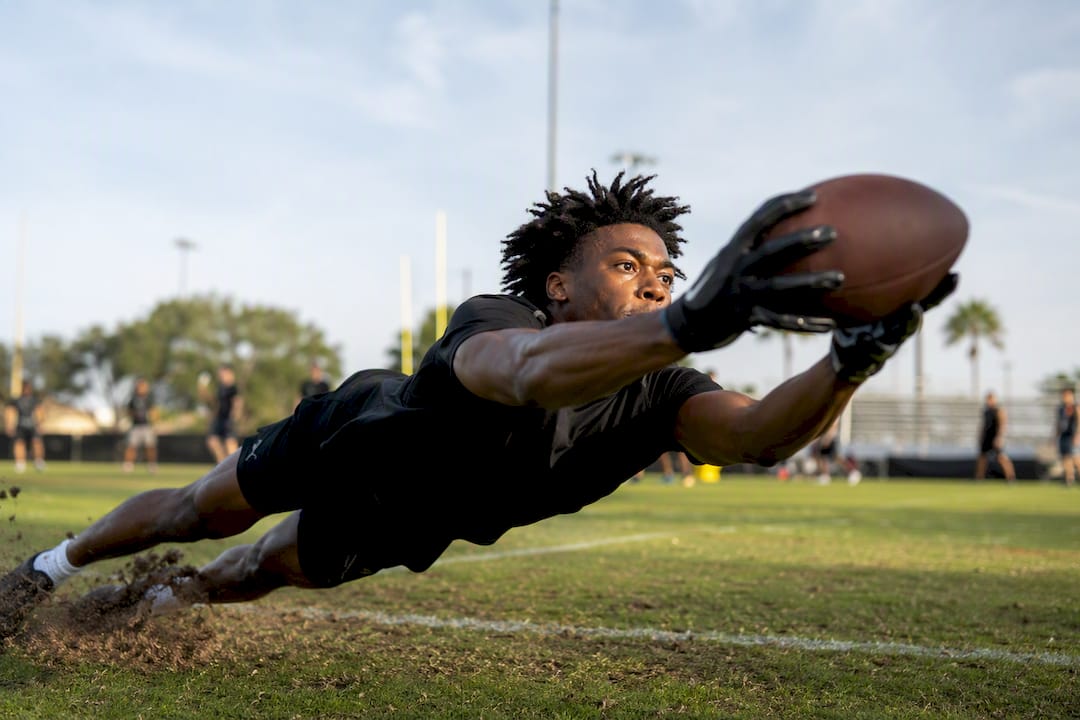
Zero-RB means punting running back in the first four or five rounds, loading up on elite wide receivers and a top tight end, then hammering the running back position from rounds 6 through 12 hoping volume shakes out. It works because running backs get hurt more than any other position, and the format’s depth requirement means you can absorb several running back swings if your receiver corps is stacked.
Robust-RB does the opposite: it takes two or three running backs in the first five rounds to lock in touch-heavy roles before wide receiver runs start, then pivots hard to receiver depth afterward. This fits best when your draft slot lands you next to two or three legitimate first-round backs.
Neither framework is universally correct. The decision rule that actually matters is simpler:
- Compare the player available at your pick to the next-best player at a different position.
- If the gap in projected value exceeds what ADP suggests it should be, take the value, not the position your strategy “requires.”
- If two players grade similarly, default to the scarcer position, usually running back in the middle rounds.
Pro Tip: Don’t marry a strategy before the draft starts. Decide your framework in the first two rounds based on who actually falls to you, then build the rest of the roster around that reality instead of a plan you wrote the night before.
This is also where a third quarterback earns its roster spot. Rostering a third QB makes sense once the value at that ADP outpaces the next available running back or wide receiver, which raises your floor in bye weeks and captures upside from backup quarterbacks who occasionally go off.
How Should You Draft Each Position for Best Ball?
Position strategy in best ball isn’t about “getting a good player.” It’s about matching the format’s structure to how each position produces points.
Quarterback: Most best-ball rosters carry two or three quarterbacks. Two is the floor if you land an elite, rushing-capable option early, since dual-threat quarterbacks carry a higher weekly ceiling than pocket passers. A third quarterback becomes worthwhile in the double-digit rounds once ADP value clearly beats the remaining running backs and receivers on the board. Rushing quarterbacks also change your stacking calculus, since their weekly floor is less tied to their pass-catchers’ performance.
Running back: This position carries the highest injury attrition of any spot, so hedge accordingly. Early running back picks (rounds 1 through 3) should go to backs with a clear, unshared workload. After that, prioritize handcuffs and backs in ambiguous committees late, since best ball lets you roster the outcome without predicting it. Don’t ignore running back entirely in the name of “zero-RB purity.” Ignoring the position for six or seven rounds straight leaves you scrambling for volume that’s already gone.
Wide receiver: This is where best ball rosters win or lose. Target receiver volume aggressively in rounds 4 through 9, since the position has the most weekly variance and the deepest player pool. Reserve rounds 10 and beyond for high-upside dart throws: rookies in expanding roles, receivers stepping into vacated targets, and players whose ADP hasn’t caught up to a training-camp buzz report.
- Draft receiver depth early enough that a single injury doesn’t wreck your ceiling weeks.
- Save your true dart throws (unproven, boom-or-bust names) for the last four rounds.
- Weight late-round receivers toward offenses that project to throw often.
Tight end: You have two real paths. Reach for an elite tight end in rounds 2 or 3 to lock in a positional advantage every single week, or wait and draft two or three mid-tier tight ends late, betting that one hits. The middle ground, spending a round 5 or 6 pick on a “good but not elite” tight end, is usually the weakest play, since it costs real draft capital without buying you a true weekly edge.
What Roster Construction Actually Works by Platform?
Your roster template should be locked to the platform’s exact size, because 18-player and 20-player formats reward slightly different allocations.
For an 18-player build, a commonly recommended split lands around 3 quarterbacks, 5 to 6 running backs, 7 to 8 wide receivers, and 2 tight ends. For 20-player formats, the extra two spots typically go toward one more running back and one more tight end, landing near 3 quarterbacks, 6 running backs, 8 wide receivers, and 3 tight ends. Platform-specific roster sizing genuinely shifts optimal strategy, so check your exact format before you draft rather than importing a template from a different site.
These numbers are starting points, not laws. Your early picks should determine your later allocation:
- If you go robust-RB early: cut your running back total in the final rounds and add an extra receiver or a third tight end instead.
- If you go zero-RB: you’ll need to hit running back hard from round 6 onward, often taking three or four in a five-round stretch to build the volume you skipped early.
- If you draft an elite tight end in round 2: you can likely skip the position entirely until the last two or three rounds.
Round-by-round, think in phases rather than fixed rules. Rounds 1 through 6 set your positional identity and should go to the best available value at running back, receiver, or an elite tight end. The middle rounds (7 through 12) are where you fill out starter-quality depth at whatever position you’re thin on. The final six rounds are pure upside hunting: rookies, backup running backs in muddled committees, and receivers whose target share is trending up.
How Do You Use Stacking Without Wasting Roster Spots?
Stacking, pairing a quarterback with one or more of his pass-catchers, exists because correlated scoring compounds your ceiling weeks instead of just adding to them individually. Stacking and back-stacking are proven tactics for boosting tournament win rates, but over-correlation and reaching past ADP to force a stack routinely cancels the benefit.
Here’s how to use correlation without overpaying for it:
- Standard stack: Draft a quarterback and his primary receiver or tight end early, when both are being valued independently. This is the cheapest form of correlation because you’re not reaching for either player.
- Back-stack: Add a second, cheaper pass-catcher from the same offense several rounds later. This is the highest-value stacking move in the format because it adds correlation almost for free, without spending real draft capital.
- Bring-back stack: Late in the draft, add an opposing team’s pass-catcher from a game your stacked quarterback’s team is projected to play close, especially in weeks 15 through 17. This locks in exposure to a potential shootout during championship week.
Pro Tip: Back-stacking is the cheapest correlation you’ll find in a best-ball draft. Pairing your round-3 quarterback with his WR2 in round 11 costs you almost nothing in draft capital, but it meaningfully raises your ceiling on the weeks that quarterback’s offense clicks.
The mistake to avoid is reaching two or three rounds early just to force a stack that isn’t there yet. If your quarterback’s WR1 falls to you naturally, take the stack. If you have to jump the board by two full rounds to get him, you’re paying a tax that eats the entire correlation benefit. Winning best-ball lineups do tend to feature correlated stacks and favorable late-season schedules, but only when the stack was built at fair value, not forced.

How Should Your Draft Slot Change Your Approach?
Where you sit in the draft order changes which pieces of the strategy matter most on a given pick.
Early picks (1 through 3 in each round) should lean toward locking in the best pure talent available, since you’re less likely to see reach opportunities this early. Middle picks (4 through 9) are where the ADP-vs-value gap tool earns its keep. Turn picks (10 through 12) reward patience: you’ll often see a run at one position dry up the board right before your pick, so track which positions are thinning out two picks ahead of your turn.
The ADP-vs-value check itself is simple. Compare a player’s average draft position against where your own rankings, or a consensus projection model, would place him. If a receiver is going 15 picks later than his projected value suggests he should, that gap is your signal to take him now rather than “save a pick” for a name-brand player with a smaller gap.
- Watch for positional runs: when three running backs go in four picks, the value shifts to receivers and tight ends immediately, even if you weren’t planning to pivot.
- Exploit recency bias: players coming off one bad game often fall further than their season-long profile justifies.
- Track injury-driven ADP crashes: a talented player whose ADP craters after a minor injury report is frequently the best value pick of that round.
Drafters who rigidly follow a pre-built strategy regardless of what the board gives them are the easiest opponents to beat in a large-field tournament.
Why Do Playoff Schedules and Bye Weeks Matter So Much?
Weeks 15 through 17 typically decide best-ball tournament payouts, which means points scored in those three weeks are worth more than points scored in week 4, even though they count the same in your season total. A player facing a bottom-tier pass defense in the fantasy championship is a meaningfully better target than one with an identical projection but a brutal week 16 matchup.
Practical rules for handling this:
- Check a player’s weeks 15 through 17 schedule before locking in a close call between two similarly-projected options.
- Avoid stacking three or more starters with the same bye week, since it can gut an entire scoring week if your depth doesn’t cover the gap.
- Prioritize bye-week coverage at running back and quarterback over receiver, since those positions have shallower streaming options in best ball’s no-waiver structure.
Roughly a third of the correlation edge documented in tournament-winning lineup data traces back to favorable late-season matchups stacked alongside correlated player pairs, not the stacks alone.
What Are the Biggest Best Ball Drafting Mistakes?
Certain errors show up in nearly every losing best-ball roster, and most of them are avoidable with a quick mental checklist.
- Drafting for floor in the double-digit rounds. A safe veteran with a low ceiling is almost always the wrong pick late, since your bench needs boom weeks, not steady mediocrity.
- Reaching to force a stack. Jumping two rounds early to pair a quarterback and receiver usually costs more value than the correlation returns.
- Ignoring bye-week clustering. Three key starters sharing a bye can tank an entire week of your season total.
- Skipping the ADP-vs-value check. Drafting strictly by rank instead of live value leaves points on the board every round.
| Quick in-draft check | What to ask yourself |
|---|---|
| Balance | Am I more than two rounds behind at any position relative to my template? |
| ADP gap | Is this player falling further than his projected value justifies? |
| Stack sanity | Am I reaching, or did this stack fall to me naturally? |
Fold on a strategy when the board simply isn’t giving you the players it requires. Double down when your early picks keep confirming the plan, like landing back-to-back elite receivers that make zero-RB the obvious path forward.
How Do Projections and Track Records Sharpen Best Ball Picks?
Projection consensus works by blending multiple models to reduce any single system’s bias, then layering position-specific modeling on top to flag which players are most likely to lead their position in a given week. That combination creates reliable signals for when a player’s ADP has drifted away from his real value, which is exactly the gap this guide has told you to hunt for on every pick.
Here’s how that plays out at the table. Say a backup quarterback with rushing upside is going in round 16, but consensus modeling has him projected as a top-12 weekly scorer if he starts even six games. That gap is your signal to take the third-quarterback swing early, rather than waiting for a run to strip the value away.
Manny’s Variety has tracked over 1,600 graded picks with a public 63.5% win rate and a net return of 443.9 units, a documented record most competitors in the space simply don’t publish.
That kind of transparent, versioned track record matters because it shows the underlying models hold up across a large sample, not a hot month.
What Should You Actually Do Differently This Draft Season?
My mental model for best ball comes down to one question on every single pick: does this player’s ceiling justify his ADP, or am I paying for reputation? In one recent mock, that question pushed me to take a third quarterback in round 15 over a low-ceiling flex option, and the QB outscored him in two of the next four weeks. In another, it kept me from reaching for a “safe” tight end in round 6 when the value simply wasn’t there yet.
— Manuel
Check Your Pick-Level Value Before You Draft
Mannysvariety turns the value-gap rule this whole guide is built on into something you can check in seconds instead of eyeballing an ADP chart mid-draft.

Its AI-driven projection models flag exactly which players are drifting below their real value, so you can confirm a late-QB or back-stack pick before you’re on the clock instead of guessing under pressure. Three ways to use it during your next draft: run a quick projection check on any player you’re on the fence about, set an ADP-gap alert for positions you’re targeting late, and pull a roster template that matches your platform’s exact size before you even sit down. See exactly how the picks and projections work and bring real numbers to your next best-ball draft instead of a gut feeling.
Where to Go Deeper on Best Ball Strategy
A few sources are worth bookmarking alongside this guide as the season develops.
- Fantasy Strategy Guide’s best ball breakdown covers format mechanics in more depth, useful if you’re new to auto-start scoring.
- RotoViz’s stacking analysis is the sharpest breakdown available on where correlation stops paying off.
- FTN’s roster construction piece gives platform-specific templates worth checking before every draft.
- Manny’s Variety’s fantasy hub rounds out rankings and ADP boards for live reference.
- Need a name for your entry once the roster’s set? Fantasy Name HQ’s generator is a quick, free option.
Sources
- Best Ball Draft Strategy: How to Build a Winning Roster | Fantasy Strategy Guide
- Fantasy Football Strategy: Best Ball Roster Construction in 2026
- Is It Possible to Correlate Too Much? Best Ball Stacks That Work and the Pitfalls of Stacking At All Costs - RotoViz
- Best Ball Draft Strategy | Stokastic
Recommended
- Superflex Draft Strategy 2026: Gameplans and Auction Budgets | Manny’s Variety Picks
- Most Accurate Fantasy Projections: Consensus First, Position Winners Second | Manny’s Variety Picks
- Bankroll Management Betting: Preserve and Grow Your Funds | Manny’s Variety Picks
- Player Props | Manny’s Variety Picks