

Bankroll Management Betting: Preserve and Grow Your Funds
For most bettors, the right starting point is a fixed-percentage staking plan of 1–3% per wager. When you can reliably estimate your edge, a Fractional Kelly of 1/4 to 1/2 Kelly is the more precise alternative. Everything else in bankroll management flows from that single decision.
Before you place your next bet, take three steps:
- Set a dedicated bankroll. Choose an amount of disposable income you can afford to lose entirely without affecting rent, bills, or savings. Write it down.
- Calculate your unit size. Multiply your bankroll by your chosen percentage (start at a low single-digit percentage if you are new). That dollar figure is one unit.
- Set a session budget and stop-loss. Decide the maximum you will lose in a single session before you stop. Closing Line Value (CLV) is the metric you will use later to verify whether your picks actually have edge.
Mannysvariety tracks CLV alongside every pick its AI engines generate, giving subscribers a transparent baseline to measure their own sizing decisions against a verified record.
Pro Tip: Write your unit size and stop-loss on paper or in a notes app before your first bet of the session. Bettors who set rules in advance are far less likely to chase losses.
Table of Contents
- What a sports betting bankroll is and why managing it matters
- Core staking systems: which one fits your situation?
- Kelly Criterion and Fractional Kelly: how the formula works
- How to set stake sizes, stop-losses, and session rules
- How to build and grow a bankroll responsibly
- Handling variance, cold streaks, and the urge to chase
- Metrics to track and how to log them
- Account setup and market-specific tips that affect your bankroll
- When bankroll management isn’t the problem: CLV diagnostics
- Key Takeaways
- The part most bettors skip until it’s too late
- Mannysvariety gives you the picks and the track record to size them confidently
- Useful sources and further reading
What a sports betting bankroll is and why managing it matters
A bankroll is a ring-fenced pool of money set aside exclusively for betting, completely separate from your everyday finances. It is not a savings account, an emergency fund, or money earmarked for bills. The separation is the point: it lets you measure performance objectively and make decisions without financial stress distorting your judgment.
Bankroll management exists for one primary reason: survival. Even a bettor with a genuine edge will lose stretches of 10, 15, or 20 bets in a row due to normal variance. Without a structured staking plan, those losing runs wipe out accounts before the edge has a chance to compound. The math is unforgiving. Sizing too large accelerates ruin; sizing conservatively keeps you in the game long enough for your edge to show up in the results.
The core benefits of a disciplined staking plan:
- Reduced risk of ruin. Smaller unit sizes mean a losing streak shrinks your bankroll gradually rather than catastrophically.
- Steadier decision-making. When individual bets represent a small fraction of your total funds, losses feel manageable rather than panic-inducing.
- Measurable edge. Tracking units won and lost, alongside CLV, tells you whether your picks are genuinely better than the market or just getting lucky.
- Compounding potential. A bankroll that survives long enough grows through reinvested profits, but only if sizing protects it first.
Pro Tip: Set your bankroll amount on a calm day, not after a big win or a frustrating loss. Emotional states distort how much risk feels acceptable. Once set, keep it in a separate account or at minimum track it in a dedicated spreadsheet column.
Core staking systems: which one fits your situation?
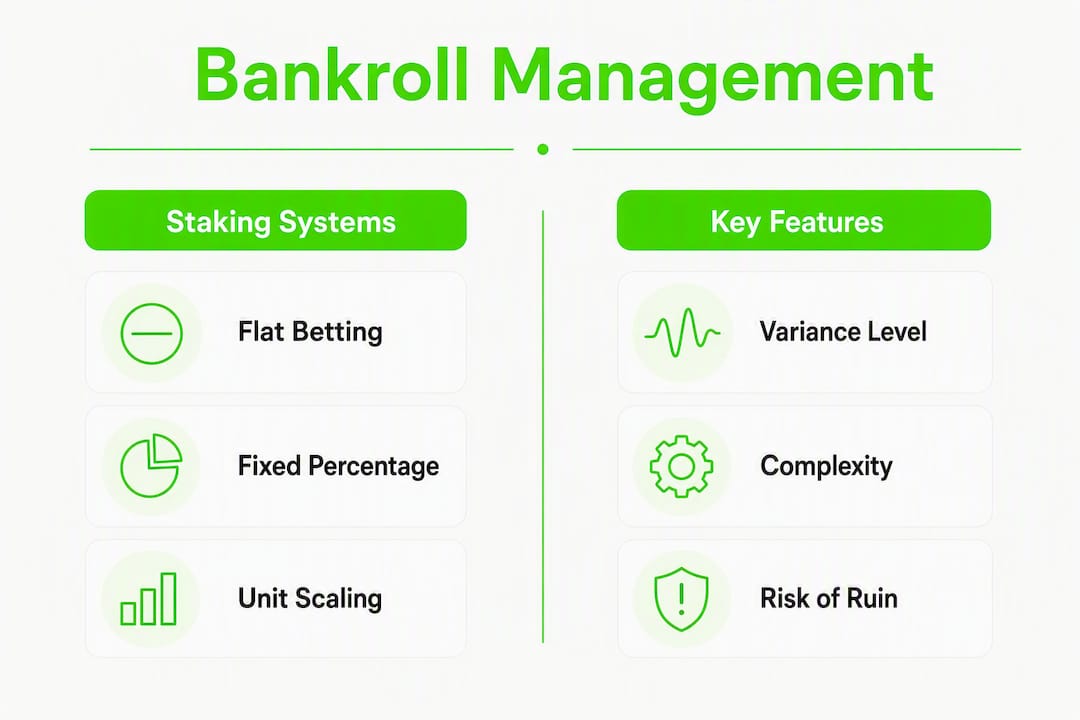
Three staking systems cover the vast majority of recreational and semi-serious bettors. Each has a different relationship with variance, complexity, and edge dependence.

Flat betting
Flat betting means wagering the same dollar amount on every bet regardless of bankroll fluctuations. It is the simplest system and works well when you cannot reliably estimate your true win probability on each bet. The downside: your unit does not shrink during a losing run, so a bad streak hits harder in percentage terms as your bankroll falls.
Fixed-percentage (unit) staking
Fixed-percentage staking is the standard recommendation for most bettors. You bet a set percentage of your current bankroll on each wager, which means your unit automatically shrinks during losing runs and grows during winning ones. The 1–3% baseline is the most commonly cited range for novice and intermediate bettors.
A 100-unit minimum bankroll is the standard practitioner guideline. MarketMath explains why: fewer than 100 units leaves you fragile to normal variance, where a 15-bet losing streak can eliminate 15–30% of your funds at a 2% unit size, but the same streak at a 10% unit size is catastrophic. The math is not subtle.
Practical calculation:
- $500 bankroll × 2% = $10 per unit
- $2,000 bankroll × 1.5% = $30 per unit
- $5,000 bankroll × 1% = $50 per unit
Unit scaling
Unit scaling adds a layer of flexibility: you divide your bankroll into a fixed number of units (typically 100) and adjust the dollar value of each unit monthly based on your current bankroll balance. This approach works well for bettors who want automatic resizing without recalculating percentages manually after every bet.
| Staking Method | Variance | Edge Dependence | Complexity | Risk of Ruin |
|---|---|---|---|---|
| Flat betting | High during drawdowns | Low | Very low | Higher at fixed $ |
| Fixed-percentage | Self-correcting | Low to moderate | Low | Lower |
| Unit scaling | Self-correcting | Moderate | Low to moderate | Lower |
| Full Kelly | Very high | Very high | High | High without calibrated inputs |
| Fractional Kelly | Moderate | High | Moderate | Lower than full Kelly |
Pro Tip: Recalculate your unit size at the start of each month, not after every bet. Constant recalculation creates noise; monthly recalculation keeps sizing accurate without becoming a distraction.
Kelly Criterion and Fractional Kelly: how the formula works
The Kelly Criterion is a mathematical formula that calculates the theoretically optimal fraction of your bankroll to wager, given your estimated edge and the odds on offer. The full formula is:
Kelly % = (bp − q) / b
Where:
- b = the decimal odds minus 1 (the net odds received on a winning bet)
- p = your estimated probability of winning
- q = your estimated probability of losing (1 − p)
Worked example
Suppose a sportsbook offers +110 moneyline odds (decimal 2.10) on a game. After de-vigging the market, you estimate the true win probability at 52%.
- b = 2.10 − 1 = 1.10
- p = 0.52
- q = 0.48
- Kelly % = (1.10 × 0.52 − 0.48) / 1.10 = (0.572 − 0.48) / 1.10 = 0.092 / 1.10 ≈ 8.4%
Full Kelly says bet 8.4% of your bankroll. On a $2,000 bankroll, that is $168 per bet. Most practitioners immediately cut that in half or to a quarter:
- 1/2 Kelly: 4.2% = $84
- 1/4 Kelly: 2.1% = $42
The 1/4 Kelly figure lands squarely in the 1–3% range recommended for most bettors, which is not a coincidence. Fractional Kelly is the bridge between theoretical optimality and practical survival.
Why full Kelly is dangerous in practice
Full Kelly maximizes long-run geometric growth, but the volatility is severe. A string of losing bets at 8–10% per wager can cut a bankroll by 50% or more before the edge reasserts itself. MarketMath’s risk-of-ruin analysis shows that bet size is the primary driver of ruin probability, even when a genuine edge exists. Practitioners widely use 1/4 Kelly or 1/2 Kelly to reduce drawdowns and the emotional pressure that leads to poor decisions.
Caution: Kelly requires calibrated probability estimates. If your win probability inputs are wrong by even a few percentage points, the formula can recommend oversized bets that accelerate losses. When you cannot estimate true probabilities with confidence, fixed-percentage staking is the safer default.
Common fractional Kelly choices and their tradeoffs:
- 1/2 Kelly: Faster growth, moderate volatility. Suitable for bettors with high-confidence probability estimates.
- 1/4 Kelly: Slower growth, significantly reduced drawdowns. The most common practitioner recommendation.
- 1/8 Kelly: Very conservative. Appropriate when probability estimates carry high uncertainty.
Pro Tip: Use de-vigged market probabilities as your starting estimate, then shade them conservatively. If the market implies 52% and you think 54%, use 52.5% in your Kelly calculation. Overconfidence in your edge is the most common Kelly mistake.
How to set stake sizes, stop-losses, and session rules
Recommended percentage ranges by experience level
- Novice bettors (fewer than 500 documented bets): 1–2% per wager. The lower end protects against the learning curve and the variance that comes with a small sample.
- Intermediate bettors (500–2,000 documented bets, positive CLV trend): a small percentage per wager. The upper end is only appropriate when CLV data confirms a genuine edge.
- Aggressive bettors (verified edge, large sample, high confidence): 3–5% per wager. ESPN’s bankroll survival guide cites 2–5% as a commonly referenced range for rookies, though the lower end of that range is the more defensible starting point for anyone without a documented track record.
The preference for the lower end is not timidity. It is arithmetic: a 2% unit requires a 50-bet losing streak to halve your bankroll; a 5% unit requires only 14 losses in a row.
Concrete dollar examples
| Bankroll | 1% Unit | 2% Unit | 3% Unit |
|---|---|---|---|
| $500 | $5 | $10 | $15 |
| $2,000 | $20 | $40 | $60 |
| $5,000 | $50 | $100 | $150 |
Stop-loss and stop-win rules
Session budgets and stop rules are among the most effective controls for recreational bettors. Set these before each session:
- Session loss cap: Stop betting when you have lost a predetermined amount in one session (a common rule is 5–10% of total bankroll per session).
- Drawdown audit trigger: If your bankroll drops 20–30% from its peak, stop and audit before placing another bet. Review your CLV data, check whether you have been chasing losses, and verify that your unit size is still appropriate for the reduced bankroll.
- No-reload rule: Do not add new funds to a session after hitting your loss cap. Reloading mid-session is the fastest path to blowing past your risk limits.
Step-by-step implementation
- Choose your starting bankroll from disposable income only.
- Select your unit percentage (start at 1–2% if new).
- Write the unit dollar amount and your session loss cap on paper or in a notes app.
- Set a monthly calendar reminder to recalculate your unit size based on your current bankroll balance.
- After any 20–30% drawdown, pause and run a CLV audit before resuming.
Pro Tip: If you feel the urge to double your unit size after a losing session, halve it instead. The instinct to recover losses quickly is the single most reliable predictor of bankroll blowups.
How to build and grow a bankroll responsibly
Start with the right foundation
The first rule is that your bankroll must come entirely from disposable income. Money you cannot afford to lose has no place in a betting account. Once that principle is settled, the 100-unit minimum is the practical floor: a $200 bankroll with $2 units is technically functional, but one bad week can eliminate it. A $1,000 bankroll with $10–20 units gives you enough runway to survive normal variance and gather meaningful data.

Conservative compounding
Compounding works in betting the same way it works in any other domain: profits reinvested increase the base, which increases future unit sizes. The discipline is in when to increase units. A single good week is not a signal. A sustained positive trend across at least one monthly recalculation cycle is.
- Open accounts — at two or more sportsbooks to access the best available lines.
Realistic timelines
Meaningful bankroll growth through betting takes hundreds of bets, not dozens. Small edge compounded through high turnover can generate returns, but only if sizing protects against ruin long enough for that turnover to accumulate. Expecting significant growth in a month is how bettors rationalize oversizing. Expecting gradual, measurable progress over a full season is the realistic frame.
Pro Tip: Treat the first 200 bets as a data-collection phase, not a profit phase. Your goal is to build a CLV record, not to maximize returns. The returns follow if the edge is real.
Handling variance, cold streaks, and the urge to chase
Variance is not failure
Every bettor, including those with verified positive edge, will experience losing streaks. A bettor winning 55% of bets at even odds will still lose 10 in a row with meaningful frequency over a large sample. The question is not whether losing streaks happen. It is whether your sizing lets you survive them.
Risk of ruin rises exponentially as bet size increases relative to edge. The difference between a 2% unit and a 10% unit is not linear: the 10% bettor faces a ruin probability orders of magnitude higher than the 2% bettor, even with identical edges. Sizing is the primary survival variable.
Practical rules for cold streaks
- Halve your unit size if you feel emotional. Anger, frustration, or the urge to “get it back” are signals to reduce exposure, not increase it.
- Stop-betting trigger: After five consecutive losses or a 20% drawdown from peak, stop for the session. No exceptions.
- Mandatory audit after a 30% drawdown: Before placing another bet, review your last 20 bets for CLV, check whether you deviated from your unit rules, and confirm your edge estimate is still valid.
- No-reload rule: If you hit your session loss cap, the session is over. Adding funds mid-session bypasses every protection you set in advance.
- Session budgets: Decide the maximum number of bets and maximum dollar loss before the session starts, not during it.
Variance management in poker tournaments follows similar principles, and the session budgeting frameworks used in tournament poker translate directly to sports betting: fixed session exposure, predetermined stop points, and no emotional reloading.
Pro Tip: Build a forced-pause checklist: before resuming after a losing streak, answer three questions in writing. Did I beat the closing line on those bets? Was my unit size within my rules? Was there a clear model or information reason to make those bets? If you cannot answer yes to at least two, do not resume yet.
Metrics to track and how to log them
Tracking is not optional for anyone who wants to know whether their edge is real. Without records, you are guessing.
Essential fields per bet
| Field | Purpose | Calculation note |
|---|---|---|
| Date | Sequence and streak tracking | Log at bet placement, not settlement |
| Sport / market | Variance profiling by market | Separate MLB from NFL; props from spreads |
| Stake (units) | Sizing compliance check | Verify against your unit rule |
| Stake ($) | Dollar P&L | Units × current unit dollar value |
| Odds (American) | Return calculation | Convert to decimal for math |
| Implied probability | Market assessment | 100 / (odds + 100) for positive odds |
| De-vigged probability | True market estimate | Remove the vig from both sides |
| Result | Win/loss/push | Record immediately |
| Closing line | CLV benchmark | The final odds before game start |
| CLV (beat/missed) | Edge verification | Your odds vs. closing line |
| Bankroll after bet | Running balance | Update after settlement |
Why each metric matters
ROI (return on investment) measures profitability in percentage terms and is the standard performance benchmark. CLV tells you whether your picks had edge at the time you placed them, independent of results. Units won or lost show whether your sizing is consistent. Streak tracking reveals whether a losing run is within normal variance or a signal to audit.
The CLV metric deserves particular attention. Consistently beating the closing line is the strongest available evidence of a genuine edge. If your CLV is positive but your bankroll is flat or declining, the problem is almost certainly sizing, discipline violations, or vig drag, not your pick quality.
Pro Tip: Run a monthly CLV check as a standalone exercise. Calculate your average CLV across all bets that month. If it is positive and your bankroll is not growing proportionally, audit your unit sizes and session records for discipline violations before changing anything else.
Account setup and market-specific tips that affect your bankroll
Multiple sportsbooks
Maintaining accounts at multiple sportsbooks is one of the highest-leverage operational decisions a bettor can make. Line shopping across books on the same game can add half a point to a full point on spreads, which translates directly to improved CLV and long-run returns. Distribute your bankroll across accounts based on where you bet most frequently, keeping enough in each to cover your standard unit without constant transfers.
Sizing for props and parlays
Player props carry higher variance than standard spreads and moneylines because they depend on individual performance rather than team outcomes. For prop markets, consider sizing at the lower end of your range (1% or below) or treating props as a separate sub-bankroll. For NFL player prop strategy, the market-specific variance profile matters as much as the unit percentage.
Parlays are a different problem. The house edge compounds with each leg, and parlay picks require a clear understanding of the correlated-risk dynamics before you size them. For bankroll survival, treat parlays as entertainment with a capped allocation (no more than 0.5–1% of bankroll per parlay ticket) rather than a core staking strategy.
Operational checklist
- Set deposit limits at each sportsbook using the platform’s built-in responsible gambling tools.
- Record which sportsbook each bet was placed at, so you can track line quality by book.
- Use timeout features during cold streaks rather than relying on willpower alone.
- Round unit sizes to the nearest dollar that your sportsbook’s minimum bet allows; never inflate a unit to meet a minimum.
Pro Tip: Keep a running note of which sportsbook offered the best line on each bet type. Over 50–100 bets, a clear pattern emerges about where your edge is best captured by market.
When bankroll management isn’t the problem: CLV diagnostics
Resizing your units will not fix a broken model. Before adjusting your staking plan, run a CLV diagnostic to determine whether the problem is sizing or edge.
What Closing Line Value tells you
CLV measures whether the odds you received were better than the odds the market settled at before game time. Consistently beating the closing line is the primary evidence of a genuine edge. The closing line aggregates sharp money and public information; if you are consistently on the right side of it, your picks are adding value. If you are consistently on the wrong side, no staking plan will save you.
Diagnostic checklist
- Calculate your average CLV over your last 100 bets. Positive CLV with a flat or declining bankroll points to a sizing or discipline problem.
- Negative CLV across 100+ bets means your edge estimate is wrong. Resizing will not help; the model or pick selection process needs revision.
- Positive CLV but high variance suggests your unit size may be too large for the variance profile of the markets you are betting.
- Inconsistent CLV by market (positive on spreads, negative on props) suggests you have edge in some markets but not others. Size down or exit the negative-CLV markets.
- Positive CLV, growing bankroll, but emotional stress means your unit size is too large for your psychological risk tolerance. Cut to 1/4 Kelly or a lower fixed percentage.
Fractional Kelly as a CLV-to-stake converter
When CLV data confirms an edge, fractional Kelly gives you a principled way to size the bet. Use your de-vigged probability estimate as the Kelly input, then apply 1/4 Kelly to convert that edge into a cautious stake. The independent chip model framework in tournament poker uses a structurally similar approach: translating an estimated equity advantage into a conservative chip commitment, which maps directly to how fractional Kelly works in sports betting.
Sample size caution
A 100-bet sample is the minimum for any CLV signal to carry weight. Fewer than 100 bets, and normal variance can produce positive or negative CLV results that mean nothing about your actual edge. At 500 bets, the signal is meaningful. At 1,000 bets, it is reliable.
Pro Tip: Do not adjust your staking plan based on fewer than 100 bets of CLV data. Reacting to small samples is how bettors make structural changes for the wrong reasons and compound their problems.
Key Takeaways
Disciplined bankroll management betting requires fixed unit sizing, CLV tracking, and strict stop-loss rules applied consistently across every session and market.
| Point | Details |
|---|---|
| Start at 1–3% per bet | Novice and intermediate bettors should use 1–3% of their current bankroll per wager to survive variance. |
| Use 100-unit minimum | A bankroll supporting at least 100 units gives enough runway to absorb normal losing streaks. |
| Track CLV monthly | Consistently beating the closing line is the primary proof of edge; flat bankroll with positive CLV signals a sizing problem. |
| Apply stop-loss rules | Stop betting after a substantial drawdown and audit CLV, unit compliance, and pick quality before resuming. |
| Mannysvariety for verified picks | Mannysvariety publishes a verified track record with AI-generated picks across MLB, NBA, and NFL, giving subscribers a data-driven baseline for CLV comparison. |
The part most bettors skip until it’s too late
The conventional framing of bankroll management treats it as a discipline problem: bettors know the rules but lack the willpower to follow them. That framing is partially right but misses the deeper issue. Most bettors who blow up their bankrolls are not undisciplined. They are operating without a diagnostic framework. They do not know whether their losses come from bad sizing, bad picks, or normal variance, so they cannot fix the right thing.
The CLV metric changes that. It separates the question of “did I have edge?” from “did I win?” Those are different questions, and conflating them is what leads bettors to chase losses after bad-luck stretches or to oversize after lucky runs. A bettor who tracks CLV consistently knows, within a few hundred bets, whether their model is working. That knowledge is what makes conservative sizing feel rational rather than timid.
The other thing worth saying plainly: fractional Kelly is not a magic formula. It is a tool that requires accurate inputs. Most recreational bettors overestimate their edge, which means their Kelly calculations recommend larger bets than the evidence supports. Starting at 1/4 Kelly or lower, and treating the first 200 bets as a calibration phase rather than a profit phase, is the approach that actually preserves bankrolls long enough for edge to compound.
Mannysvariety gives you the picks and the track record to size them confidently
Knowing your unit size is only half the equation. The other half is having picks with verified edge to size against. Mannysvariety’s AI-powered engines generate daily picks across MLB, NBA, NFL, NHL, and more, with every pick publicly graded and permanently archived. The platform’s verified track record includes a 63.5% win rate and 443.9 net units returned across over 1,600 tracked picks, giving subscribers a transparent CLV baseline that most bettors never have access to.

For bettors applying the fixed-percentage and fractional Kelly rules covered in this guide, Mannysvariety’s AI-powered picks and performance data provide the calibrated probability inputs that make those formulas work as intended. The platform’s Atlas tool and sport-specific engines handle the model side; your job is to apply the staking discipline. Start with a free trial to see the pick quality and track record before committing to a subscription tier.
Useful sources and further reading
- Responsible Bankroll Management Guide — RG: The primary responsible gambling reference for the 1–3% staking baseline and the advice to halve units when emotional. Use this for foundational staking guidance.
- Kelly Criterion — Wikipedia: The encyclopedic reference for the Kelly formula, its derivation, and practical notes on fractional Kelly adoption. Use for formula verification and academic grounding.
- Rookie Bettors Camp: Ultimate Bankroll Survival Guide — ESPN: Beginner-facing operational guidance including the 2–5% range, multiple sportsbook setup, and markets to approach cautiously (parlays, futures).
- National Council on Problem Gambling — Help by State: The primary U.S. resource for responsible gambling support. Relevant for any bettor who suspects their betting behavior has moved beyond recreational.
- How It Works — Mannysvariety: Documents Mannysvariety’s AI methodology, verified pick history, win rate, and unit returns. Use to verify the platform’s performance claims cited in this guide.
- AI Sports Betting — Mannysvariety Blog: Explains how Mannysvariety’s sport-specific predictive engines generate picks and how AI models estimate probabilities, relevant to the Kelly input discussion.
- MLB Betting Models — Mannysvariety Blog: Covers a high-frequency, lower-variance market useful for understanding how sport-specific variance profiles affect appropriate unit sizing.