

1.4 xG, 1.2 xGA, 12 Shots: BTTS Strategy for Bettors
Run a two-of-three screen on xG for, xG against, and shot volume before you touch a BTTS market, then confirm your side 60 to 90 minutes before kickoff once lineups drop.
TL;DR:
- Use a two-of-three screen based on xG, xGA, and shots per game to identify strong BTTS opportunities before lineups drop, usually 60 to 90 minutes before kickoff.
- Require both teams to independently meet the numeric thresholds of xG for at least 1.4, xG against at least 1.2, and 12 or more shots per game for a valid bet.
- Reassess confirmed lineups and match context, such as home/away splits and key defensive personnel, right before betting to ensure conditions remain favorable.
- Place bets only if your calculated probability exceeds the bookmaker’s implied probability by at least 5%, and log the odds, model number, and edge details before committing.
- In live betting, focus on short-term momentum triggers like early goals, red cards, or tactical switches, requiring a higher in-play edge of 7–10% over the current implied probability.
Table of Contents
- Building a BTTS Strategy Around xG Instead of Goals
- Key Statistical Signals and Numeric Thresholds
- Pre-Match Checklist: When to Place the Bet
- In-Play Triggers Worth Acting On
- Staking Rules Built for BTTS Variance
- When BTTS Bets Turn Into Losing Bets
- A Worked Example: Screening a Real Fixture
- The Evidence Behind These Thresholds
- A Note on Staying Disciplined
- Get AI-Backed BTTS Probabilities Before You Bet
- Sources
Building a BTTS Strategy Around xG Instead of Goals
BTTS settles on the final scoreline after 90 minutes plus stoppage time. A BTTS Yes bet wins the moment both teams have scored at least once, regardless of who wins the match itself. That simplicity is exactly why raw goal tallies mislead so many bettors. A team that scored in five straight games might have been riding a run of deflections and set pieces, not generating chances that repeat.
Expected goals (xG), expected goals against (xGA), and shots on target strip out that noise. They measure chance quality, not just outcomes, which is why any credible btts betting strategy treats them as the baseline inputs rather than an afterthought. Calculate each team’s attacking and defensive numbers separately. A team can be great at scoring and terrible at conceding, and BTTS needs both halves of that equation to hit.
Key Statistical Signals and Numeric Thresholds
A workable btts strategy starts with a fast numeric pass, not a deep tactical review of every fixture on the card. GG Bettings recommends requiring two of three conditions over a team’s recent matches before you go further: xG for at or above 1.4, xG against at or above 1.2, and shots per game at or above 12.
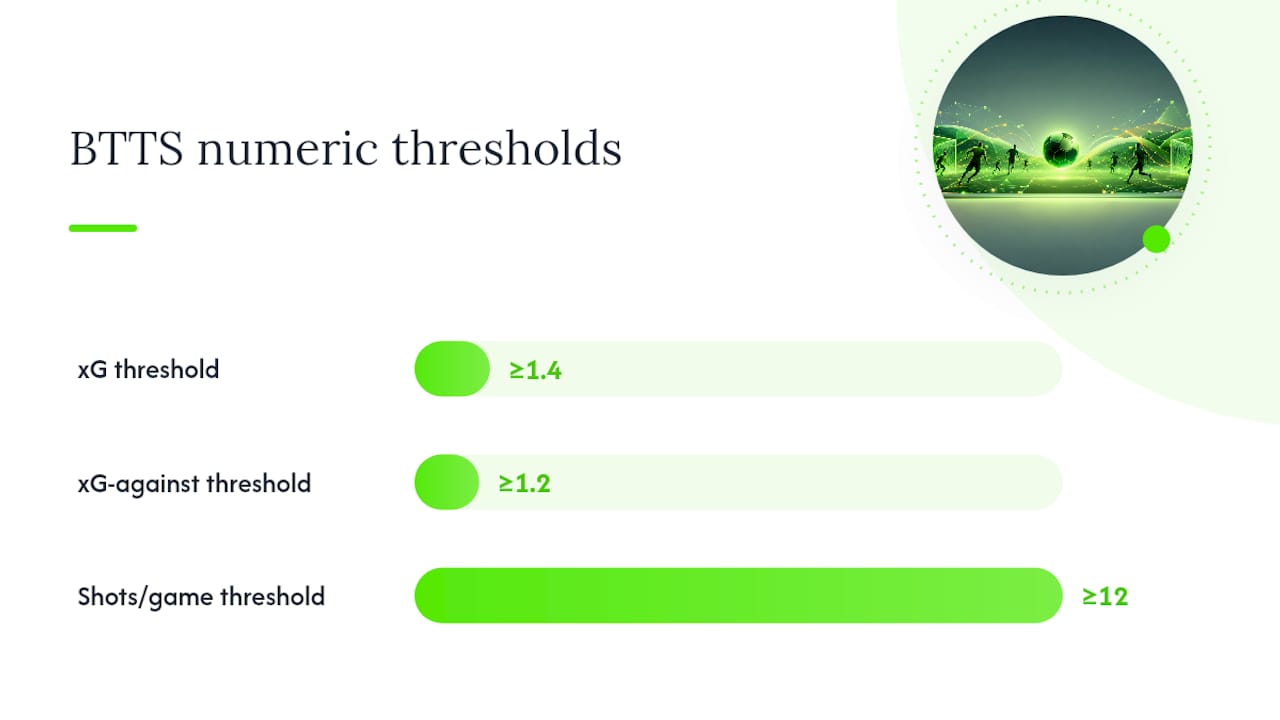
Pro Tip: Run this screen on both teams independently, then only proceed if each side individually clears the two-of-three bar. One strong attacking team paired with one weak one usually fails BTTS more often than the raw goal average suggests.
Once a fixture clears the numeric filter, layer in context:
- Home/away splits matter more for BTTS than for straight win markets, since some teams defend tightly at home but leak goals on the road.
- An elite goalkeeper (top-tier save percentage, low goals conceded relative to xGA faced) can suppress BTTS Yes even when the underlying attacking numbers look strong.
- Check for missing starting center backs or a rotated goalkeeper; either one shifts the defensive numbers more than most bettors account for.
Converting xG into an implied goal-scoring probability (a simple Poisson model works fine for a manual check) lets you compare your own number against the bookmaker’s price instead of guessing at value.
Pre-Match Checklist: When to Place the Bet
Timing separates a disciplined btts betting strategy from a guess dressed up in stats. Work through this sequence:
- Complete your numeric screen 24 to 48 hours out so you have a shortlist, not a live scramble.
- Wait for confirmed lineups, typically 60 to 90 minutes before kickoff, when team news and market liquidity are both strongest.
- Re-check the starting XI against your screen. A rotated back line, a rested striker, or a backup keeper can flip a passing grade into a fail.
- Apply the value rule: only bet if your calculated probability sits at least 5% above the bookmaker’s implied probability. Skip anything closer than that.
- Log the price, your model number, and the edge before you place anything. You will need this later to see whether your thresholds actually hold up.
In-Play Triggers Worth Acting On
Live BTTS betting works differently from pre-match screening. You are reacting to what just happened on the pitch, not projecting from historical data, so the bar for entry should be higher.
- Track rolling xG and shots on target in short windows, roughly 20-minute spans, rather than the full-match total, since momentum shifts fast.
- Watch for specific triggers: an early goal that visibly opens the game up, a red card against a center back or defensive midfielder, or a tactical switch to a more attacking front line.
- Require a bigger edge than you would pre-match, roughly 7 to 10% above the live implied probability, since in-play prices move quickly and your read has to clear a higher bar to justify the risk.
Pro Tip: *Cut your live stake relative to your pre-match unit.
Staking Rules Built for BTTS Variance
BTTS markets swing on single moments, a deflected own goal, a stoppage-time equalizer, more than most markets. Your staking has to account for that variance rather than assume steady returns.
- A flat 1% of bankroll per bet is the standard baseline for recreational bettors; half-Kelly sizing works if you are comfortable calculating edge precisely.
- Tie stake size to edge: a 5 to 6% edge might warrant 1%, a 7 to 9% edge 1.5%, and anything above 10% up to 2%, but never exceed 3% on a single BTTS bet regardless of how confident you feel.
- After three consecutive losses, cut your stake size in half until you have logged enough new results to trust your filters again.
Pro Tip: Keep a running log of every bet, the edge you calculated, and the result. Reviewing that log after 20 to 30 bets tells you far more about whether your thresholds work than any single winning or losing streak. A deeper breakdown of sizing rules lives in Mannysvariety’s guide on bankroll management.
When BTTS Bets Turn Into Losing Bets
Certain fixture types consistently produce weak BTTS value no matter how appealing the odds look:
- Big mismatches in quality, where the stronger side dominates possession and the weaker team barely threatens goal.
- Deep-block, low-block matchups where a team parks a back five and grinds out a clean sheet by design.
- Fixtures involving a genuinely elite goalkeeper, since save quality can override attacking numbers on paper.
- Squad rotation windows, cup replays, or dead rubbers where teams field understrength lineups.
Accumulators compound the problem. Stack five legs that each look like a 55% BTTS Yes and the combined hit rate on the whole slip drops well below half, because each leg needs its own individual edge, not just a plausible-sounding probability. Chasing a losing streak, leaning on last season’s goal totals, and ignoring home/away splits round out the most common ways bettors bleed value in this market.
A Worked Example: Screening a Real Fixture
Picture two mid-table sides. Team A shows xG for of 1.6 and xG against of 1.3 over its last eight matches, with 13.5 shots per game, clearing all three thresholds. Team B shows xG for of 1.5, xG against of 1.4, and 12.8 shots per game, also clearing the bar.
Log the number, the price, and the reasoning before kickoff, then revisit it after the final whistle to check whether your model called it correctly.
The Evidence Behind These Thresholds
Every pick sits in a permanent, inspectable archive rather than a private spreadsheet, and the analysis pages show the reasoning behind each call. No model replaces a human sanity check on lineup news or a red card, though. Treat the simulations as your starting probability, then adjust for whatever the numbers cannot see.
A Note on Staying Disciplined
Refine your thresholds gradually. Test small stakes while you build your log, then adjust filters based on what actually happened, not what felt right in the moment. If betting stops feeling controlled, BeGambleAware has resources worth reviewing.
— Manuel
Get AI-Backed BTTS Probabilities Before You Bet
Running xG screens by hand works, but it is slow, and Mannysvariety already does that math for every major matchup before kickoff. The platform runs sport-specific AI engines through thousands of simulations to produce a probability for markets like BTTS, then grades every pick publicly so you can check its record instead of taking anyone’s word for it.
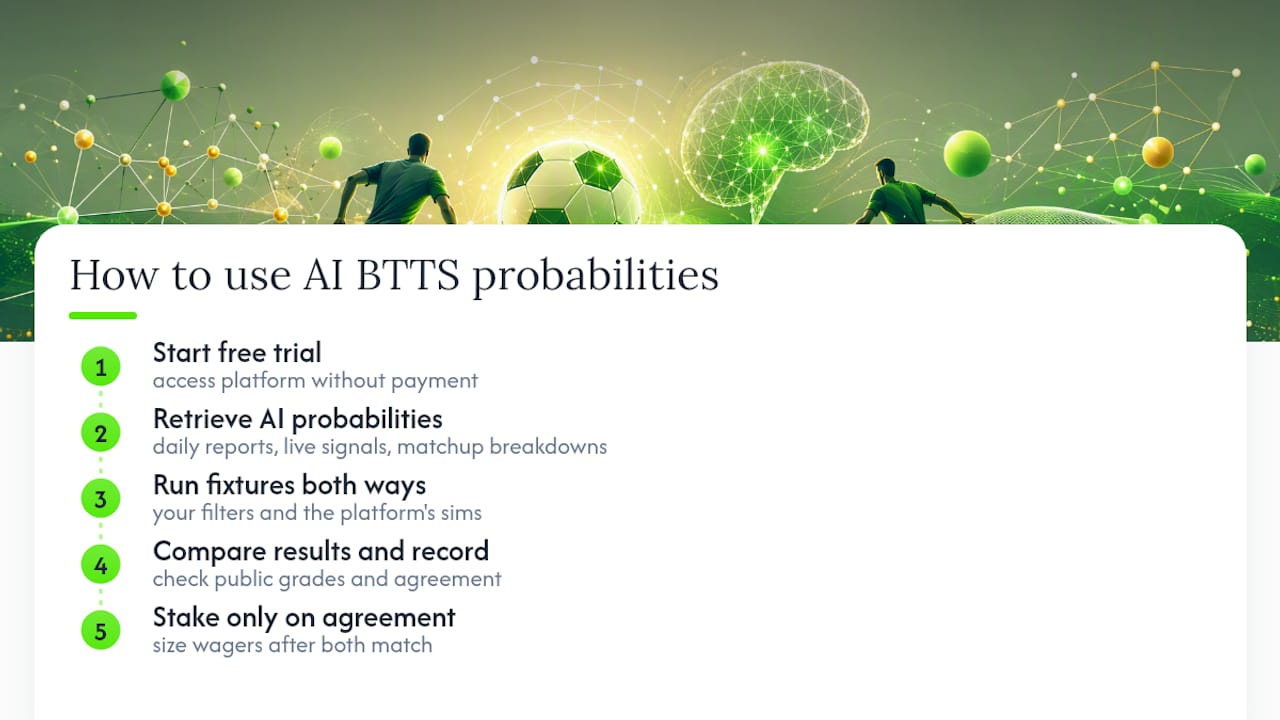
Subscribers get daily reports, live in-play signals through the live picks feed, and full matchup breakdowns that show the numbers behind each call. Compare that output against your own checklist. Start with the free trial, run a few fixtures through both your filters and the platform’s probabilities, and see where they agree before you size a single stake.
Sources
- How to find value in both teams to score markets using xG, shots and tactical context - GG Bettings
- Both Teams to Score Betting Guide: How to Bet BTTS in Soccer
- What is Both Teams to Score: BTTS Explained - August 2026
- BeGambleAware