

Top 30 Dynasty Rookie Rankings 2026 Backed by Manny’s Variety
Jeremiyah Love, Carnell Tate, and Jordyn Tyson headline the top of dynasty rookie boards this year, with Makai Lemon and Jadarian Price rounding out the first true tier. Prioritize Love and Tate in rookie drafts and startup trades. Price carries buy-low appeal given the shallow running back class behind him. In superflex leagues, adjust immediately for any rookie quarterback projected to start Week 1.
TL;DR:
- Draft capital, landing spot, and immediate opportunity make Jeremiyah Love, Carnell Tate, and Jordyn Tyson the safest rookie assets to prioritize in drafts and trades.
- Running backs with clear starting paths or significant touches, like Love and Price, hold more dynasty value than similarly talented wide receivers early in their careers.
- Players outside the top two or three receivers should be viewed as long-term projects, with tight ends and quarterbacks needing patience or situational breaks to reach their ceiling.
- Team scheme changes and coaching shifts can rapidly alter rookie opportunity, especially for running backs and quarterbacks, making camp reports vital to evaluate.
- Rebuilding teams should focus on acquiring Tier 1 and Tier 2 rookies for long-term upside, while contending teams should trade rookie picks for current veteran depth based on immediate needs.
Table of Contents
- Dynasty Rookie Rankings 2026: The Tiered Top 30 Board
- RB, WR, TE, and QB: Who Contributes Now vs. Who You Stash
- How to Apply These Rankings in Your Rookie Draft and Trades
- The Five Factors Behind Every Ranking
- Why Manny’s Variety Data Backs These Ranks
- Comparing This Class to Last Year’s Rookie Rankings
- How College Production and Scouting Reports Shape the Board
- Balancing Rookie Picks Against Your Veteran Core
- What These Rookies Are Worth Two and Three Years From Now
- Coaching Changes and Scheme Fit Still Move the Needle
- Our Read on This Class
- Turn Rookie Research Into a Daily Betting Edge
- Sources
Dynasty Rookie Rankings 2026: The Tiered Top 30 Board
A flat list of 100 names does not help you make a decision on draft night. What helps is knowing which players are worth trading real assets for and which are lottery tickets you stash and forget. The board below groups rookies into three tiers with a short rationale for each, built around draft capital, landing spot, and immediate opportunity.
Tier 1: Pay whatever it costs. These are the players you trade up for in rookie drafts and refuse to move in normal-value trades.
- Jeremiyah Love (RB) landed in a run-friendly scheme with a clear path to early touches. Positional scarcity makes him the top overall asset in most 2026 rookie classes, since the 2026 draft produced relatively few high-impact running backs taken with early capital.
- Carnell Tate (WR) projects to command a significant share of his team’s passing targets right away. Consensus boards from FantasyPros, ESPN, and Yahoo largely agree he belongs in the top tier of rookie wide receivers this cycle.
- Jordyn Tyson (WR) brings a college production profile that translates well to early NFL usage. His draft slot and offensive fit both support a Year 1 role, which is exactly the combination dynasty managers should chase.
Tier 2: High-upside starters worth a first-round rookie pick. These players carry real Year 1 roles but lack the slam-dunk profile of Tier 1.
- Makai Lemon (WR) offers route-running polish that should get him on the field early, even if his target share takes a few weeks to stabilize.
- Jadarian Price (RB) is one of the better buy-low names on this board. He landed in a backfield without a clear bell cow, and per-player situational notes suggest he could see three-down work if he wins camp.
- KC Concepcion (WR) has the athletic tools to separate from mid-tier defensive backs, and his landing spot gives him a real shot at slot snaps early.
- Jonah Coleman (RB) profiles as a between-the-tackles runner who could carve out early-down work if the incumbent starter struggles with health.
- Eli Stowers (TE) stands out in a rookie tight end class that is otherwise thin. Tight end production usually takes longer to arrive, but his athletic profile gives him TE1-in-waiting upside.
Tier 3: Stashes and lottery tickets. These players need a specific opportunity to break to hit their ceiling. Roster them in deeper leagues and be patient.
- Mike Washington Jr. (RB) enters a crowded backfield, but he has the tools to climb the depth chart if injuries open a window. He is a name to monitor rather than draft aggressively for.
The full mid-to-late board includes plenty of names worth a late rookie pick, but tiered boards that weight draft capital, landing spot, opportunity share, age, and scarcity produce clearer breaks than trying to rank 40 players in a perfectly ordered line. Treat everything past Tier 2 as depth, not core roster construction.
RB, WR, TE, and QB: Who Contributes Now vs. Who You Stash
Position matters as much as talent when you are deciding what to give up in a trade. Here is the quick version for each spot.
Running back is where the scarcity argument hits hardest this year. Positional breakdowns show WRs are deeper in overall volume while only a handful of rookie RBs project as true bell cows, which pushes Love, Price, Coleman, and Washington up dynasty boards relative to where their raw talent grades alone would place them. If a rookie RB has a path to 15+ touches per game, he is worth more than a WR with a similar talent grade.
Wide receiver depth is the opposite story. Tate, Tyson, and Lemon should see early volume, while Concepcion needs a role to open up before he becomes a weekly fantasy factor. WR development also tends to run over two or three seasons, so patience pays off more here than at running back.
Tight end and quarterback hinge heavily on your league’s scoring format. Stowers is the name to know at tight end, but rookie tight ends rarely produce before Year 2. Rookie quarterbacks barely register in one-quarterback leagues, but any rookie QB with a Week 1 starting job jumps several tiers in superflex.
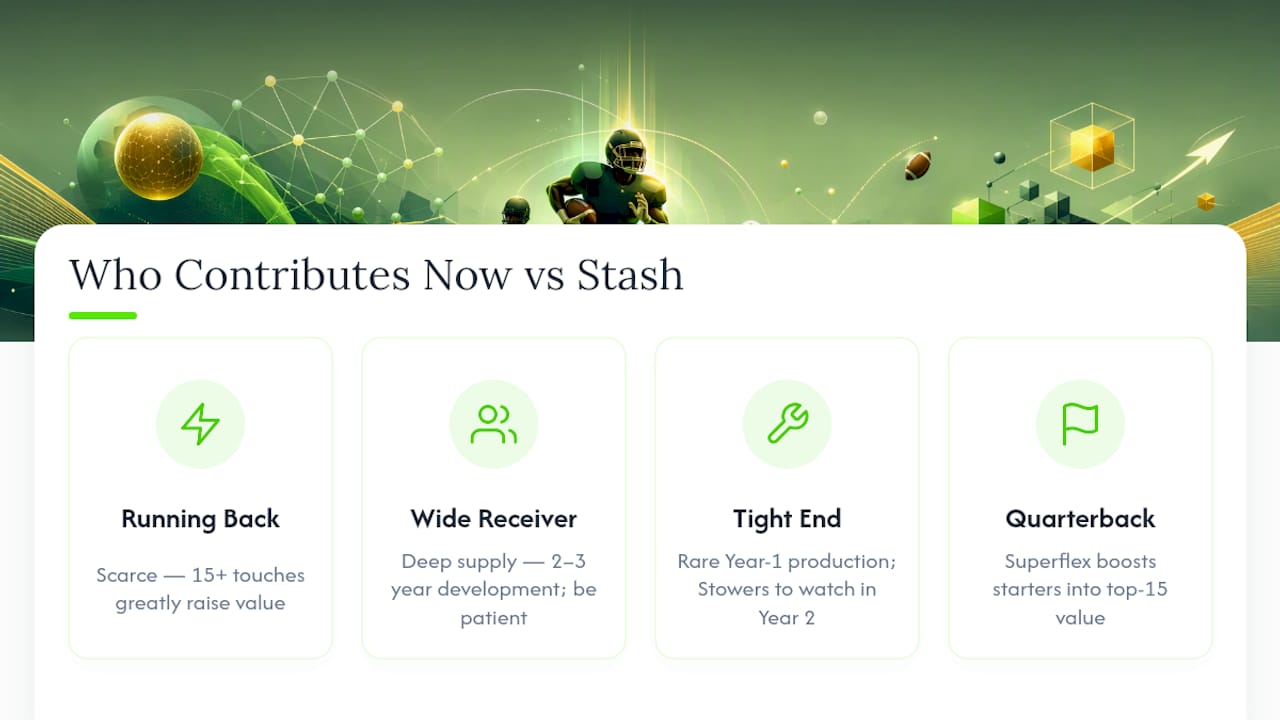
Pro Tip: In superflex, re-rank any rookie QB projected to start as a top-15 dynasty asset regardless of pure talent grade, since the position itself carries scarcity value that RB and WR do not.
How to Apply These Rankings in Your Rookie Draft and Trades
Knowing the tiers is one thing. Acting on them during a live rookie draft or a midseason trade conversation is another. Here is a simple process to follow.
- Lock in your Tier 1 picks first. If you hold a top-three rookie pick, take Love, Tate, or Tyson and do not overthink it. Trading down out of Tier 1 rarely pays off unless you are collecting multiple Tier 2 assets.
- Use Tier 2 as your trade-up target. Price, Concepcion, Coleman, and Stowers are the players worth packaging a future second-round pick to acquire if they slide.
- Watch preseason news for buy-low windows. Rookie rankings shift through camp as injuries and depth-chart battles play out, and a high-draft-capital rookie stuck behind a veteran is often a discounted asset, not a bust.
- Adjust your superflex board separately. Rookie QBs and even mid-tier RBs climb in superflex because of the two-QB requirement. Check our superflex draft strategy guide before finalizing your rookie draft order.
- Run a quick checklist before any pick or trade: age relative to draft class, current depth-chart spot, and any early snap-count reporting from camp.
The Five Factors Behind Every Ranking
Every rookie on this board is scored across five factors: draft capital, projected opportunity share, offensive environment quality, age-adjusted production curve, and positional scarcity. Tier breaks reflect meaningful gaps in that composite score, not arbitrary cutoffs, so a player near the bottom of Tier 1 is genuinely closer in value to the top of Tier 2 than to the top of the tier he sits in.
- Draft capital and landing spot carry the heaviest weight early in the season, since first-round capital still correlates strongly with early production, though opportunity can override raw draft slot.
- Positional scarcity gets extra weight at running back this year given the thin 2026 class.
- The board updates continuously through the preseason and reacts to injuries, depth-chart movement, and reported snap counts, so a Tier 2 name in July can move into Tier 1 by September.
Why Manny’s Variety Data Backs These Ranks
Manny’s Variety runs sport-specific AI engines across thousands of simulations, and that same predictive framework informs how we weigh rookie opportunity. The platform’s broader projection track record has produced a 63.5% win rate across more than 1,600 graded picks and a net return of 443.9 units, and the same target-share simulation approach can reorder wide receivers who otherwise look identical on paper.
- A target-share simulation moved one Tier 2 receiver ahead of a similarly drafted peer once camp reports showed a wider route tree than expected.
- Author credentials and full grading history remain publicly archived for verification.
Comparing This Class to Last Year’s Rookie Rankings
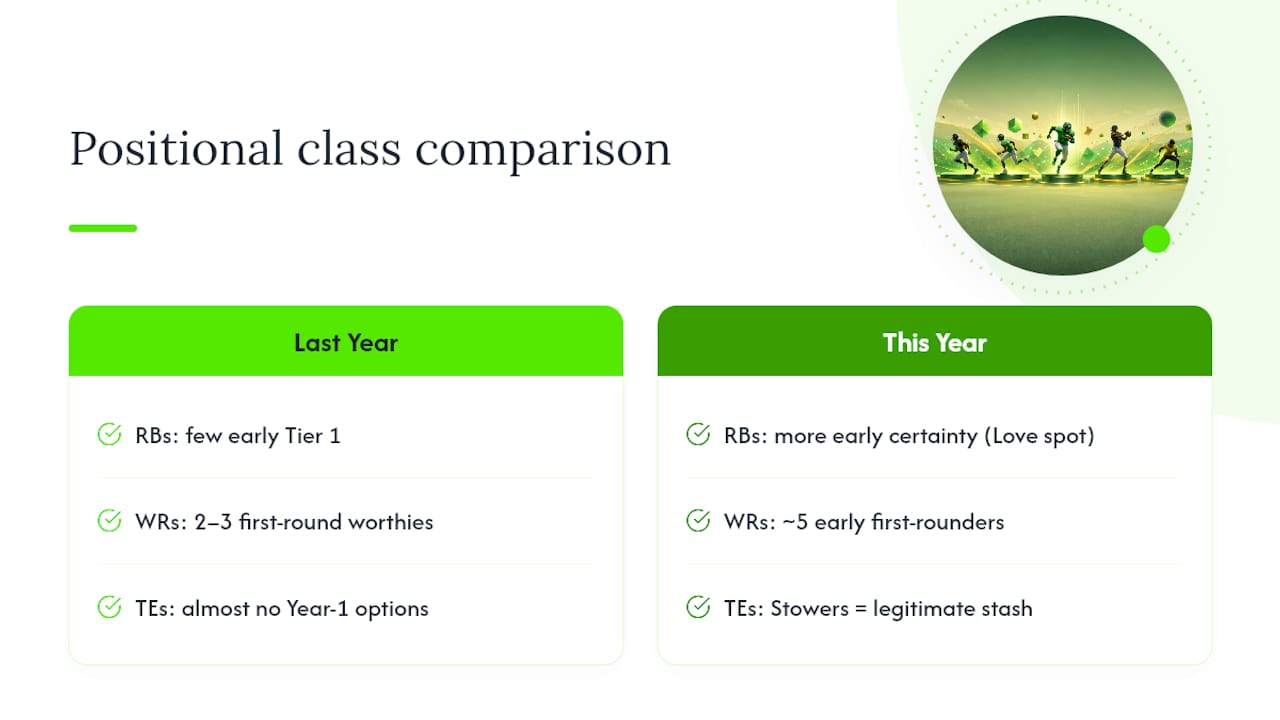
Last year’s board leaned heavily on wide receiver depth, with fewer running backs earning Tier 1 grades out of the gate. This year flips that script. Love’s landing spot and the shallow 2026 running back class give this cycle more early RB certainty than the previous class offered, where most rookie backs needed a full season to earn dynasty trust.
The receiver picture looks familiar on the surface, since Tate, Tyson, and Lemon all fit the profile of last year’s early risers: strong college target share paired with a landing spot that supports snaps immediately, making funny fantasy football names a clever way to add personality to your team while you manage these rookies. The difference is depth. Last year’s class had two or three receivers worth a true first-round rookie pick. This year has closer to five, which should soften WR premiums in trade talks compared to last season’s bidding wars.
Tight end also trends differently. Last year’s rookie tight end class produced almost no fantasy-relevant names in Year 1. Stowers gives this class a legitimate stash option at a position that usually offers none, which is worth factoring into how you allocate a rookie draft’s middle rounds.
How College Production and Scouting Reports Shape the Board
College metrics do not translate one-to-one to the NFL, but certain patterns hold up. Target share and yards after catch in a Power Four conference schedule tend to predict early NFL role better than raw touchdown totals, which is why Tate and Tyson both grade out ahead of receivers with flashier college box scores but thinner target volume.
Pre-draft scouting reports matter most when they flag traits that don’t show up in a stat line: contact balance for a running back, release quickness for a receiver, or blocking willingness for a tight end. Love’s scouting profile emphasized vision and contact balance, which lines up with the early-down role he is stepping into. Price’s reports flagged similar traits, part of why he graded as a buy-low target even before camp battles play out.
Scouting reports also help separate players with similar draft capital. Two Day 2 running backs can carry near-identical draft slots but very different long-term outlooks once you weigh receiving-down ability and pass-protection reports. That distinction is baked directly into the age-adjusted production curve factor in our scoring model, and it’s a big reason two backs taken 10 picks apart can land in different tiers here.
Balancing Rookie Picks Against Your Veteran Core
Rookie picks are lottery tickets with better odds than most people admit, but they still shouldn’t crowd out a roster built around proven production. A good rule of thumb: if you are picking in the top three of a superflex rookie draft, that pick is worth more than most veteran RB2s or WR3s, and you should treat it that way in trade talks.
Outside the top few picks, value drops fast. A late first-round rookie pick is usually worth less than a solid veteran producing WR2 numbers right now, especially if your roster is built to win in the next year or two. Contending teams should feel comfortable trading Tier 3 rookie capital for proven veteran depth at a position of need.
Rebuilding teams should do the opposite: turn expiring veteran value into as many Tier 1 and Tier 2 rookie assets as possible, even if it means taking a step back in the standings this year. The best ball approach to building for ceiling rather than floor applies directly here. A rebuilding roster benefits more from upside swings than from safe, low-ceiling veterans.
What These Rookies Are Worth Two and Three Years From Now
A rookie’s Year 1 role tells you almost nothing about his Year 3 ceiling, especially at wide receiver and tight end. Tate and Tyson’s dynasty value should climb as they enter their second and third seasons, assuming their offenses stay stable, since receiver production typically peaks in Years 2 through 4 rather than Year 1.
Running backs work differently. Love and Price carry more risk of value decay simply because RB careers run shorter, and a committee backfield today can become a timeshare or a cap casualty within two years. That’s part of why running backs who secure clear starting paths early carry outsized dynasty value relative to backs stuck in committees, even when the raw talent looks similar.
Stowers represents the classic tight end curve: modest Year 1 output, then a jump in Years 2 and 3 as he earns more complex route responsibilities. If you’re stashing him, budget for patience rather than immediate return.
Coaching Changes and Scheme Fit Still Move the Needle
A rookie’s landing spot matters as much as his talent grade, and scheme fit is the piece casual rankings often skip. A zone-blocking offense benefits a vision-and-patience runner like Love far more than it would a pure power back, while a quarterback who throws with anticipation gives a route-runner like Lemon more opportunity to win before the catch than a system built on scramble-drill improvisation.
Coaching changes during the offseason can reshuffle opportunity overnight. A new offensive coordinator installing a run-heavy scheme instantly raises the ceiling for every back on that roster, rookies included, while a pass-heavy hire can pull volume away from a run game that looked promising in May. Track beat reporter notes on scheme installs through training camp, since they often predict opportunity shifts before the box scores do.
Our Read on This Class
Take the running backs aggressively and be patient with everyone outside your top two or three receivers. Scarcity favors Love and Price more than the market currently prices them. For a deeper strategy breakdown, see our superflex draft guide.
— Manuel
Turn Rookie Research Into a Daily Betting Edge
Ranking rookies is one form of research. Beating a market number every week is another, and it takes a different kind of edge. That’s the same target-share modeling approach behind the rookie tiers above, applied daily to spreads, totals, and player props with every pick archived for verification.

If dynasty research is your offseason hobby, daily AI-graded picks are the year-round version of that same edge. Check out how the picks are generated or head straight to today’s live picks to see the current slate before lines move.