

Turn Middling Into EV for Experienced Bettors With Five Books and AI
Middling in betting means holding two opposite wagers on the same game at different lines, so a result landing between the two numbers pays out on both. The cost is limited to the juice on a rare push or split, while the payoff on a hit is two full wins. It works best for experienced bettors who already shop lines across multiple sportsbooks and can move fast when a number shifts.
TL;DR:
- Middle opportunities are more likely around key NFL numbers like 3 and 7, with wider gaps in NBA totals providing better chances for profit.
- A typical middle window requires about a 4.8% success rate to break even on a -110/-110 spread, with wider ranges increasing profitability.
- Finding middles effectively needs multiple sportsbooks, active line monitoring, and placing bets at different books to avoid limits and restrictions.
- Overtime rules, prop settlement variations, and line copying can turn a potential middle into a loss, so careful rule awareness is essential.
- Automated tools and real-time tracking can improve success by catching market shifts faster than manual line shopping.
Table of Contents
- What Is Middling in Betting? A Point-Spread Example
- Where Middles Show Up: Spreads, Totals, and Props
- The Math: What Hit Rate Do You Actually Need?
- How to Find and Place a Middle Without Losing the Window
- The Mistakes That Turn a Middle Into a Loss
- Live Middling: Bigger Windows, Faster Decisions
- Middling vs. Hedging vs. Arbitrage: Picking the Right Tool
- Where Automated Monitoring Fits Into the Process
- When Manuel Reaches for a Middle
- A Faster Way to Spot Value Than Watching Five Tabs at Once
- Sources
What Is Middling in Betting? A Point-Spread Example
Middling exploits the gap between two different lines on the same game. You bet one side early, the market moves, and you bet the other side later at a more favorable number. If the final result lands inside that gap, both bets win.
Say you bet a favorite at -7 on Monday. By Sunday, the same book (or a competitor) has the underdog at +10. You now hold two tickets covering a 3-point window: 8, 9, or 10. Line moves like this happen constantly as markets absorb new information, and that movement is exactly what creates the window.
The outcomes break down cleanly:
- Final margin lands in the window (8, 9, or 10): both bets win. You collect on both tickets.
- Favorite wins by more than 10, or underdog wins outright: one bet wins, one loses. You net roughly the vig, a small loss.
- Final margin lands exactly on one number (7 or 10): a push on one side, a win on the other. You profit on the winning leg with no offsetting loss.
This is not arbitrage. A true arbitrage locks in a guaranteed profit regardless of outcome. A middle only pays out big if the result falls in a specific range. Miss the window, and you’re paying juice on two losing tickets instead of one.
Where Middles Show Up: Spreads, Totals, and Props
Point spreads are the classic middle, and NFL spreads produce the best windows because of key numbers like 3 and 7, the margins by which NFL games end most often. A middle built around either number carries more real hit probability than one built around, say, 5 or 9.
Totals middles work the same way on over/under lines, and NBA totals often move several points during the week, creating wide, workable gaps. Player props can middle too, particularly in high-volume markets like passing yards or points scored, where different books post noticeably different numbers.
- Point spreads: best in the NFL, built around key numbers.
- Totals: best in the NBA, where lines shift with injury news and pace trends.
- Player props: inconsistent across books, which is exactly why they middle.
- Moneyline-adjacent cases: when odds swing hard enough, a moneyline position can edge into arbitrage territory rather than a true middle.
The Math: What Hit Rate Do You Actually Need?
The formula is simple: EV = (P_middle × Profit_both) − ((1 − P_middle) × Loss_split). P_middle is your estimated probability the result lands in the window. Profit_both is what you collect when both legs hit. Loss_split is what you give up in vig when only one leg cashes.
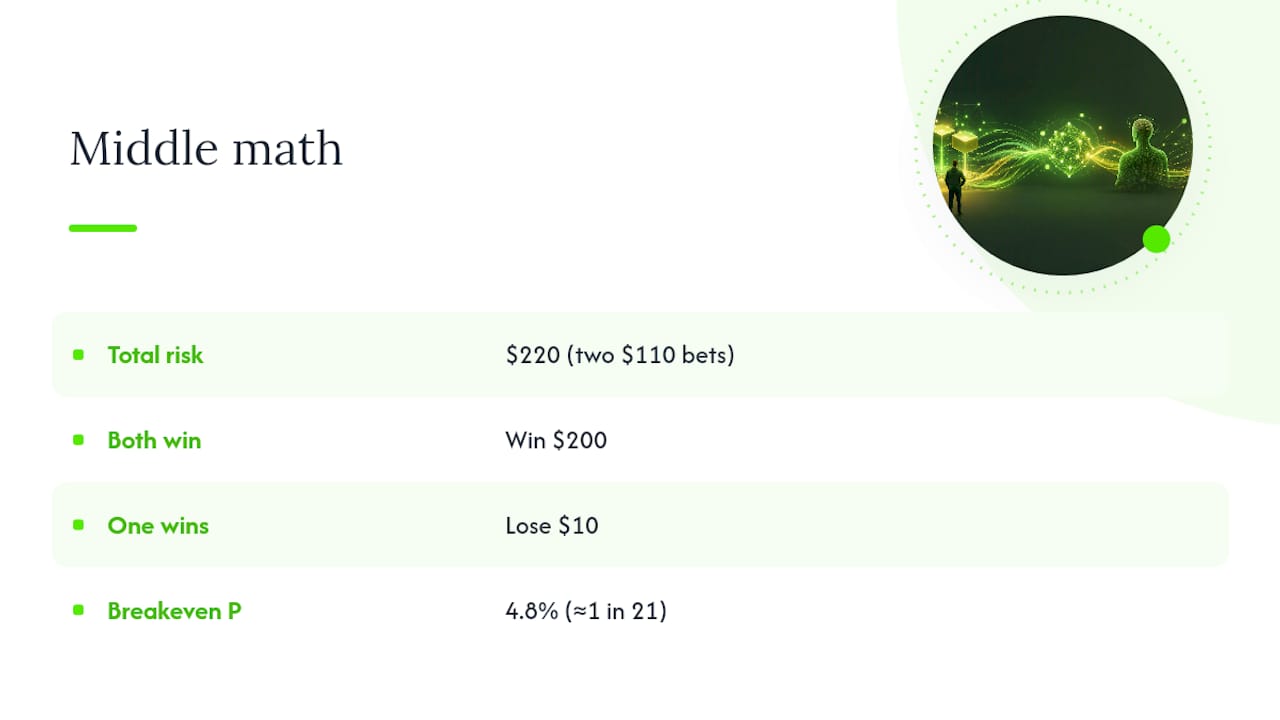
On a standard -110/-110 middle, a $110 bet on each side risks $220 to win $200 if both hit. If only one wins, you lose $10 net, the vig. Run the formula and you need to hit that window roughly 1 in 21 times, about 4.8%, just to break even on a one-point NFL window.
A wider window, say a 3-point NBA total gap, clears it far more easily because more possible final scores fall inside the range. That’s why the same math applied to a 3-point window turns marginal middles into genuinely profitable ones. Understanding American odds makes this calculation second nature once you’ve run it a few times.
How to Find and Place a Middle Without Losing the Window
- Open accounts at five or more sportsbooks. Line discrepancies only show up when you’re watching several boards at once.
- Monitor lines through the week, not just at kickoff. Middles usually appear after injury news, weather updates, or heavy public action pushes one book off the pack.
- Place the less-liquid leg first. Thin markets (props, smaller totals) move fast once one sharp bettor jumps in, so lock that side before the number disappears.
- Use separate sportsbooks for each leg. Placing both bets at the same book invites scrutiny and, on some platforms, outright limits.
- Size your stakes to equalize the split loss. When the juice differs between legs (-105 on one, -115 on the other), adjust the stake so a split costs the same either way.
Pro Tip: Keep a running list of each book’s current line on games you’re tracking. A five-minute check before bed catches more middles than any single tool, because line moves cluster overnight when soft money comes in.
Solid bankroll management matters more here than on a standard single bet, since you’re committing capital to two tickets before you know which one wins.
The Mistakes That Turn a Middle Into a Loss
The vig is the known cost of middling, but it’s not the only way to lose more than expected. A push on one leg is fine, a loss on both is not, and that only happens if you misjudge the window or the game moves the wrong direction entirely.
- Overtime rules differ by sportsbook. Some grade spreads and totals including overtime, others don’t; a mismatch can flip a “safe” middle into a straight loss.
- Prop settlement clauses vary too, especially for stat categories affected by garbage time or backup players entering late.
- Correlated lines can fool you. If both legs come from books that copy each other’s numbers within minutes, your window may close before you get the second bet in.
- Account limits are real. Books that notice consistent middling behavior sometimes restrict stake sizes on sharp-looking accounts.
Check house rules before you bet, not after the final whistle.
Live Middling: Bigger Windows, Faster Decisions
In-game markets move faster and further than pregame lines, which means bigger windows appear, but they close fast too. A missed touchdown, an injury, a scoring run, any of it can shift a live number three or four points in seconds.
The trade-off is execution risk: slower apps or clunky bet slips cost you the window entirely. Place the harder-to-fill leg first, and treat live middles as a speed game more than a research game. When timed well, they can outperform pregame middles simply because the gaps are wider.
Middling vs. Hedging vs. Arbitrage: Picking the Right Tool
Middling offers a small, frequent cost against a rare big payoff. Hedging locks in a guaranteed smaller profit or reduced loss on an existing bet. Arbitrage locks in a profit no matter what happens, but usually at thinner margins.
- Choose middling when you want variance and see a real numeric gap.
- Choose hedging when you already hold a live ticket and want to protect it.
- Choose arbitrage when the math guarantees profit and you don’t need the upside of a hit.
Where Automated Monitoring Fits Into the Process
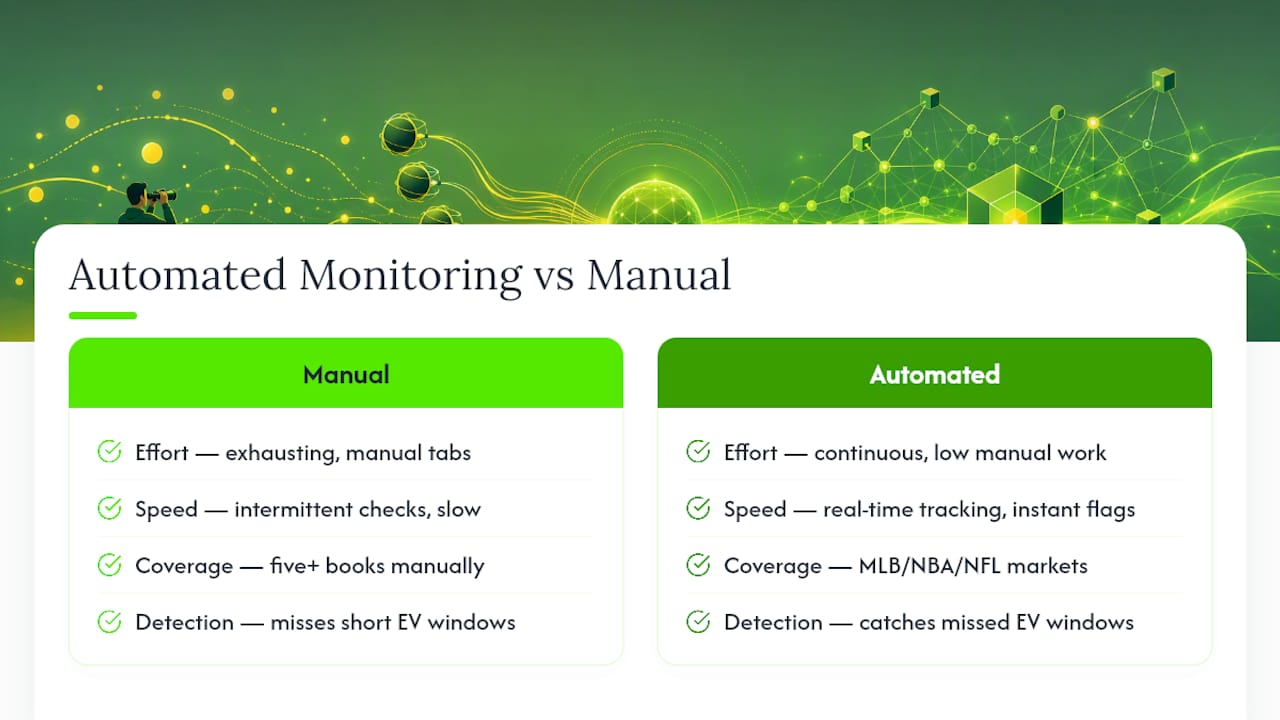
Manual line-shopping across five or more books is exhausting, and the best windows often open and close within minutes. Automated tools that track odds continuously and flag EV shifts catch middles a human scanning tabs at midnight will miss entirely.
Mannysvariety’s predictive engines run real-time simulations across MLB, NBA, and NFL markets, feeding a public track record that currently shows a 63.5% win rate across more than 1,600 graded picks. That kind of continuous monitoring doesn’t replace manual line-shopping. It catches the windows you’d otherwise miss between checks.
When Manuel Reaches for a Middle
Middling earns a spot in my process only on wide windows near key numbers, never on thin one-point gaps chasing volume. Pair it with disciplined bankroll rules, and if betting ever stops feeling optional, the National Council on Problem Gambling is worth calling.
— Manuel
A Faster Way to Spot Value Than Watching Five Tabs at Once
Middling rewards patience and constant line-checking, but not everyone wants to run five sportsbook tabs at once looking for a gap. Mannysvariety takes a different route to the same goal: catching value before it disappears.

The platform’s sport-specific AI engines run thousands of simulations daily, surfacing picks, player props, and parlays with a permanent, publicly graded archive so you can check the math yourself instead of taking a marketing claim on faith. For in-game situations, the live picks feed tracks moving numbers the way a middling bettor would, but without you needing to babysit six browser windows during the fourth quarter.
If manual middling sounds like more screen time than you want, start with a trial and see what the daily reports actually flag before your next slate of games.
Sources
- What is a sports betting middle or middling? - The New York Times (The Athletic)
- What is Middling in Sports Betting? How to Middle a Point Spread - Action Network
- What Is A Middle In Sports Betting? Middling Explained - TheLines
- Middle Bet Explained: How to Win Both Sides of a Wager | Market Math
- National Council on Problem Gambling