

Same Game Parlay Strategy: Fewer Legs, Better Correlation
The most reliable same game parlay strategy is also the simplest: build a coherent game script around a few correlated legs, size the bet as a small unit, and avoid large leg counts from which sportsbooks profit. Correlation is the entire game. When your legs support the same outcome instead of fighting each other, you’re pricing a real scenario, not stacking independent coin flips.
Three things to do before you submit a ticket:
- Build the script first. Decide how the game actually plays out, then pick legs that follow from it.
- Align every leg. Cut anything that only wins if your script is wrong.
- Size it small. Treat SGPs as smaller-than-normal bets, never full units, because variance runs high even on well-built tickets.
Pro Tip: Lower-leg SGPs with good hit rates typically out-earn longshot tickets that rarely hit. Fewer legs, better correlation, smaller stakes. That’s the whole strategy.
Key Takeaways
The most effective same game parlay strategy combines correlated legs into a single coherent game script, caps the ticket at 3 to 4 legs, and stakes it as a small fraction of bankroll.
| Point | Details |
|---|---|
| Correlation drives pricing | Sportsbooks price SGPs using correlation models, which is why naive odds multiplication always overstates the real payout. |
| Fewer legs win more often | Each added leg can cut hit probability by a third to half, so 3 to 4 legs balances payout against realistic odds. |
| One script, no exceptions | Every leg should reinforce the same game outcome; cut any leg you can’t tie to that script in one sentence. |
| Size small, track everything | Cap SGP stakes as small units and log multiple tickets before judging whether your approach is profitable. |
| Manny’s Variety offers a verified shortcut | Its AI engines simulate thousands of scenarios per game and publish a strong win rate across many archived picks for anyone to check. |
Table of Contents
- What Is a Same Game Parlay and How Does It Differ From a Regular Parlay?
- Why Doesn’t Naive Odds Multiplication Work on Correlated Legs?
- How Do Sportsbooks Price Correlated Legs and Limit SGPs?
- What Are the Highest-Impact Same Game Parlay Tips?
- How Do You Build a Coherent Game Script Into an SGP?
- How Should You Size and Manage Bankroll for SGPs?
- What Mistakes Turn a Good SGP Idea Into a Bad Ticket?
- How Do You Actually Place an SGP in a Sportsbook App?
- How Do You Track Whether Your SGP Strategy Is Actually Working?
- How Does a Predictive Engine Vet Same Game Parlay Ideas?
- When Do I Actually Use a Same Game Parlay?
- Want a Data-Driven Shortcut to Building SGPs?
- Sources
What Is a Same Game Parlay and How Does It Differ From a Regular Parlay?
A same-game parlay combines multiple bets from a single game into one ticket, and every leg has to win for the ticket to pay out. A cross-game parlay spreads that same risk across unrelated games, so each leg’s outcome is statistically independent of the others. An SGP’s legs usually aren’t independent at all. They’re pulled from the same 60 minutes of action, which means what happens on one leg often directly affects the others.
Take a simple 3-leg NFL SGP: a quarterback to throw over 1.5 touchdown passes, his team to win, and the total to go over. If that quarterback throws two touchdowns, his team is probably winning and the scoreboard is probably climbing. The legs move together. That’s correlation, and it’s the entire reason SGP odds work differently than a standard parlay calculator would suggest.
Common leg types you’ll build SGPs from include:
- Moneyline (who wins the game)
- Point spread
- Game total (over/under)
- Player props (yards, points, assists, player props)
- Team props (first team to score, team total points)
- Game props (largest lead, overtime, margin of victory)
Why Doesn’t Naive Odds Multiplication Work on Correlated Legs?
Multiply the odds of three independent bets and you get a number that overstates the true payout, because sportsbooks don’t price SGPs by simple multiplication. They run correlation models that account for how legs move together, then shave the payout down to protect their margin. Bettors call this the “parlay tax,” and it’s steeper on SGPs than on cross-game parlays because the correlation is stronger and easier for the book to detect.
Here’s the math in plain terms. If those two events were independent, you’d multiply 0.50 by 0.55 to get a combined probability of 27.5%. But they aren’t independent. The real combined probability of both things happening together is closer to 40%, not 27.5%.
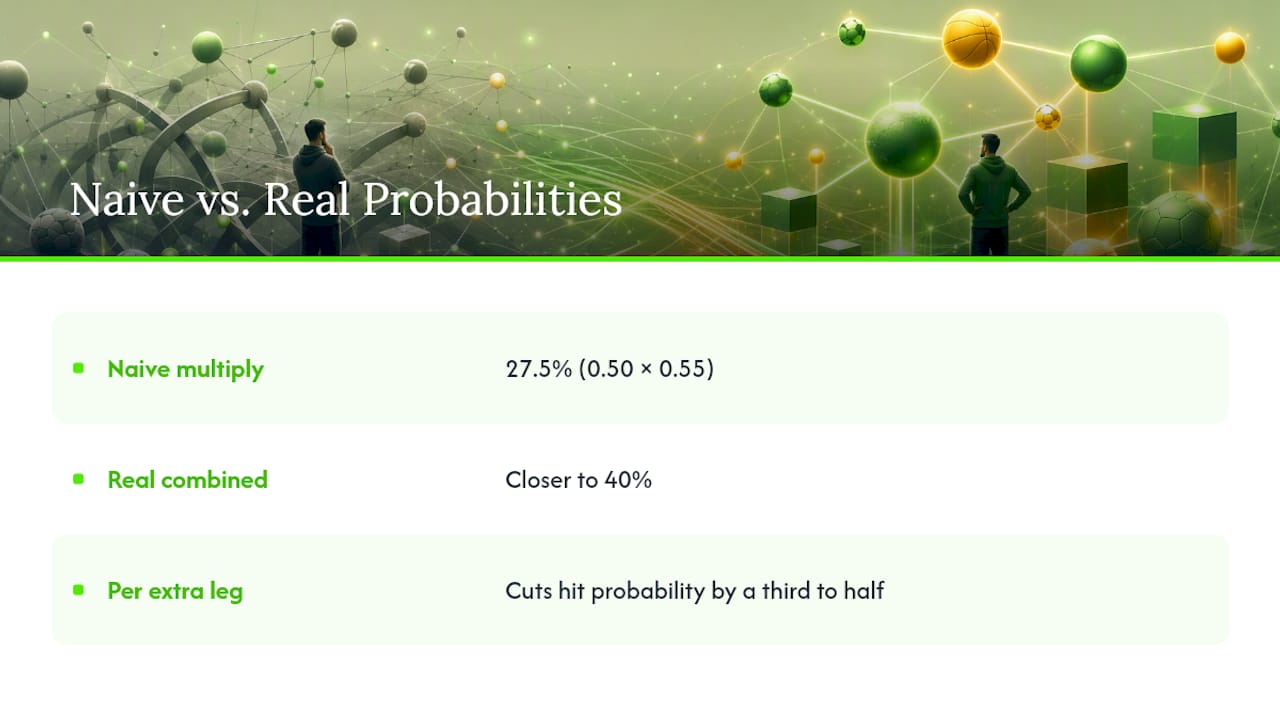
That gap between the naive math and the real math is exactly what the sportsbook prices into the payout. If a book paid you as though the two legs were independent (at odds implying 27.5%), you’d have a substantial mathematical edge. This is the correlation tax in action, and it’s why an SGP calculator that just multiplies individual leg prices will always show a number higher than what the book actually offers.
Now extend that to a 4-leg ticket. Add a third leg (team total over) and a fourth (a receiver over 60 receiving yards), and each additional leg introduces a fresh chance for the script to break. DeucesCracked’s analysis of SGP construction found that 3 to 4 legs tends to hit the sweet spot between payout size and realistic hit probability. Push past that, and even tightly correlated legs start multiplying your exposure to a single bad quarter or an early garbage-time substitution.
A useful rule of thumb: every leg you add roughly cuts your hit probability by anywhere from a third to half, depending on how tightly it’s correlated to the rest of the ticket. That’s not a reason to avoid SGPs. It’s a reason to respect what each additional leg costs you in realistic win rate, and to demand a payout that compensates for it.
How Do Sportsbooks Price Correlated Legs and Limit SGPs?
Sportsbooks build correlation directly into their SGP engines, which is why the combined price on a same-game ticket almost never matches what you’d get multiplying each leg separately. Behind that pricing sit conflict guards, automated checks that block combinations that don’t logically make sense together, like a team to win by 10-plus paired with the under on their own team total. Modern parlay-builder tools use these correlation checks to catch mathematically doomed tickets before a bettor can even submit them.
Operators also cap max payouts and restrict certain markets from combining with others, particularly in live betting once a game is underway. Legal Sports Report’s breakdown of SGP mechanics notes that these limits vary meaningfully by sportsbook, which is exactly why shopping around matters.
Promotions change the math in ways worth exploiting:
- Profit boosts work best on SGPs with legs that are already likely to hit. A boost on a longshot 7-leg ticket barely moves your real expected value.
- Parlay insurance (bet credit back if one leg misses) reduces downside on 3 to 4 leg tickets where one leg failing is the realistic outcome.
- No-sweat SGPs effectively give you a free look at a ticket, best used on your highest-conviction game script of the week.
Sporting News points out that boosts and insurance offers deliver the most value when applied to conservative legs rather than longshot multi-leg tickets, since a small probability edge matters more on a bet you were already likely to win.
Before placing any SGP, run this line-shopping checklist across two or three books: compare the combined payout on identical legs, check which conflict guards each book applies, confirm whether live-betting versions of the same market exist, and look for an active boost or insurance offer on that specific combination.
What Are the Highest-Impact Same Game Parlay Tips?
Some tactics move your win rate more than others. Here are the ones that matter most, ranked by impact.
- Correlate every leg to one script. Pick a single outcome (blowout, shootout, defensive grind) and only add legs that support it.
- Cap your ticket at 3 to 4 legs. Beyond that, even strong correlation can’t offset the compounding risk.
- Stack quarterback and receiver props together. A QB over on passing yards paired with his top target’s receiving yards tends to move in the same direction, since one is largely a function of the other.
- Target usage changes before the market catches up. An injured starter, a suspension, or a new offensive coordinator creates windows where usage-change edges exist because sportsbooks are estimating snap counts and target shares off stale data.
- Look for funnel matchups. Some defenses funnel opposing offenses toward the run or the pass by design. Identifying these defensive tendencies creates a correlation edge most casual bettors miss entirely.
- Use boosts on your safest legs, not your riskiest ones. A boost applied to a near-coin-flip ticket does far more for your expected value than one applied to a 6-leg moonshot.
A few examples make these concrete. In a game where an offense is a heavy favorite at home, stacking their moneyline with their quarterback’s over on passing touchdowns and the game total going over reflects one coherent story: this team wins comfortably by scoring through the air. In a run-funnel matchup where a defense allows a high rate of rushing yards, pairing a running back’s over on rushing yards with his team covering the spread tells the same story from a different sport’s script.
Pro Tip: Consider adding one contrarian final leg, like an alternate prop set slightly below the median projection, once your first three legs already reflect your core script. This trades a small amount of expected value for meaningfully better payout odds, since you’re no longer needing the chalk outcome on every single leg.

Cluster-based analysis of player stats, rather than raw season averages, tends to reveal better prop targets, since averages can be skewed by one or two outlier performances that don’t reflect a player’s typical role.
How Do You Build a Coherent Game Script Into an SGP?
Building a workable SGP starts before you look at a single prop line. Follow this sequence every time:
- Identify your edge. What do you know or believe that the market hasn’t fully priced? An injury, a pace mismatch, a weather factor.
- Pick one game-state scenario. Blowout, close game, shootout, defensive slog. Commit to one story.
- Select legs that reinforce that scenario. Every leg should be a natural consequence of your chosen script, not a separate bet you also happen to like.
- Check for hidden conflicts. Does any leg only cash if your script is wrong? Cut it.
- Sanity-check the payout. If the combined odds look too good relative to your actual confidence, you’ve probably missed a correlation the book already priced in.
Two examples show this in practice. In an NBA game where a star wing is questionable, betting his team’s leading scorer to go over on points, the team to cover a shortened spread, and the game total to go under (since a shorthanded team often controls pace more than usual) all point to the same story: one team’s offense funnels through fewer options and slows the game down.
In an MLB matchup with a heavy favorite starting pitcher, stacking that pitcher’s over on strikeouts with his team’s moneyline and the total going under reflects a single script: dominant pitching leads to both a win and a low-scoring game.
Adding a contrarian leg, like a backup running back to score a touchdown in a likely blowout, trades some win probability for a bigger payout. Use that move sparingly, and only after your core script legs are already locked in.
How Should You Size and Manage Bankroll for SGPs?
Size SGPs smaller than your straight bets, full stop. A same-game parlay carries more variance than a single-game moneyline or spread bet, even a tightly correlated one, so treat it accordingly.

A sample allocation for a bankroll: keep total weekly SGP exposure to a small percentage, split across a few tickets rather than one large bet. That leaves the bulk of the bankroll for straight bets and lower-variance plays, with SGPs functioning as a smaller, higher-upside slice of the portfolio.
A few habits protect the bankroll during rough stretches:
- Cap ticket frequency. Two to three well-built SGPs a week beats ten rushed ones.
- Set a max ticket size and don’t chase past it, even after a loss.
- Track line movement on your favorite legs so a late shift doesn’t blindside your script.
Pro Tip: During a cold streak, cut your SGP unit size in half rather than stopping entirely. This keeps you in the game without letting variance drain the bankroll you need for straight bets.
What Mistakes Turn a Good SGP Idea Into a Bad Ticket?
Most bad SGPs share the same handful of flaws:
- Negative correlation you didn’t notice. A leg that only wins if your other legs lose.
- Emotional add-ons. Tossing in a favorite player’s prop that has nothing to do with your script.
- Ignoring available boosts. Leaving expected value on the table because you didn’t check for a promo.
- Oversized stakes. Betting a full unit on a 4-leg ticket because the payout looked exciting.
A common version of this: a bettor builds a solid 3-leg script around a team winning big, then adds a fourth leg because a favorite player “needs” a big game, even though that stat runs counter to a blowout script (garbage-time usage often drops, not rises). The first three legs hit. The fourth kills the ticket.
Run this before every submission: does each leg support the same outcome, is any leg included for reasons other than the math, and does the stake match your actual conviction? Pro Tip: If you can’t explain why a leg is on the ticket in one sentence tied to your game script, cut it.
How Do You Actually Place an SGP in a Sportsbook App?
The workflow is nearly identical across major apps:
- Select your game from the live or upcoming slate.
- Add each leg by tapping the individual markets (moneyline, total, player props) within that same game.
- Confirm the combination is valid. The app will flag or block conflicting legs automatically.
- Enter your stake and review the combined odds before confirming.
- Double-check the payout against what you expected from your own math.
Pregame SGPs generally offer more stable pricing. In-play SGPs shift fast as scores change and some markets get pulled entirely once a game state resolves them (a first-half prop disappears at halftime, for instance). Before you tap confirm, run a final check: do the legs still support one script, is a boost or insurance offer active, and does the displayed payout match what you calculated on your own?
How Do You Track Whether Your SGP Strategy Is Actually Working?
Most bettors never find out if their SGP approach makes money because they don’t track it. A simple spreadsheet fixes that. Log the date, sport, game, stake, legs included, the game script you were betting on, the implied odds, your own estimated true probability, the result, and the return on investment for that ticket.
| Metric | What it tells you |
|---|---|
| Hit rate by leg count | Whether 3-leg tickets outperform 4-leg or 5-leg tickets over time |
| ROI vs. closing line | Whether you’re beating the market’s final price or just getting lucky |
| Variance per ticket size | How much your bankroll swings based on stake size |
| Sample size to date | Whether you have enough tickets logged to trust the trend |
Track at least 30-50 SGP tickets before drawing conclusions about hit rate or ROI. Fewer than that, and normal variance can make a bad strategy look good, or a good one look bad. Compare your closing-line value across different leg counts to see whether 3-leg scripts are actually beating 5-leg ones, or whether you just remember the big wins more vividly than the losses.
How Does a Predictive Engine Vet Same Game Parlay Ideas?
Building a defensible SGP by hand means manually tracking usage rates, matchup tendencies, and correlation across every leg. AI-driven sports betting models approach this differently, running thousands of game simulations to estimate how legs actually move together rather than guessing from memory or a handful of box scores.
A useful mini-checklist, whether you’re using software or doing it manually, includes:
- Check for recent usage changes (injuries, role shifts, coaching changes) that the market hasn’t fully adjusted to.
- Cluster a player’s recent stat line rather than relying on season-long averages.
- Compare alternate props against the main line to see where the market’s pricing looks inconsistent.
- Confirm every leg supports a single, coherent game outcome.
Manny’s Variety runs sport-specific predictive engines across NBA, MLB, and NFL, and publishes every pick in a permanent archive so bettors can verify results rather than take a win rate on faith. That transparency, a full track record open to inspection, is the standard a data-driven SGP approach should be held to.
When Do I Actually Use a Same Game Parlay?
I skip SGPs on games where I don’t have a clear read on pace or usage. No script, no ticket. But when a defensive funnel matchup lines up with a player prop the market hasn’t adjusted for, a 3-leg SGP built around that read is one of the better ways to express real conviction.
Do: build around one script, keep it to 3-4 legs, size it small. Don’t: add a leg because you like the player, chase a loss with a bigger ticket, or ignore a live boost on a safe combination.
Want a Data-Driven Shortcut to Building SGPs?
Manny’s Variety gives you what hand-building a game script can’t: thousands of simulations run before you ever open the app, catching usage-change edges and correlation patterns across NBA, MLB, and NFL games faster than manual research allows.

Every pick lives in a permanent, gradeable archive, so you’re never relying on a screenshot or a cherry-picked highlight reel. If you want to see the methodology behind the picks and props feeding into smarter SGP construction, visit the Manny’s Variety how-it-works page and start a trial to see today’s picks before your next slate locks.
Sources
- Same-Game Parlay Strategy: Smarter SGPs 2026 | DC