

Best NFL Betting Newsletters: How to Pick One in 2026
The best NFL betting newsletter is the one that shows a complete, publicly graded record, explains how each pick is built, and delivers it before the line moves. Most newsletters fail the first test. Before you pay for any of them, check the record, the pricing and the process using the criteria below.
This guide covers the main types of NFL newsletters, the six checks that separate a useful one from noise, the math behind a win rate, and how Manny’s Variety Picks fits the criteria.
TL;DR
- Judge a newsletter on its record, not its tone: look for every pick archived, graded in public and measured in units.
- Know the break-even point. At -110 odds you need to win about 52.38% of bets just to break even.
- Prefer newsletters that publish the reasoning (injuries, weather, short weeks, simulations) and the timing of each pick.
- Match the format to your style: a daily report for spreads and totals, a props feed for player markets, or a fantasy tool for season-long leagues.
- Manny’s Variety Picks offers a free tier, Core at $39.99 per month and Elite at $79.99 per month, with a permanent archive of every pick.
Table of Contents
- What an NFL betting newsletter should do
- The main types of NFL betting newsletters
- Six checks before you subscribe
- The math every subscriber should know
- What a good NFL newsletter covers each week
- How to compare two newsletters in 15 minutes
- Our perspective
- What you get with Manny’s Variety Picks
- Pricing and how to choose a plan
- Try the free tier first
- Using a newsletter responsibly
- FAQ
- Sources
What an NFL betting newsletter should do
An NFL betting newsletter has one job: save you time and sharpen your decisions on a slate of games. It does that by turning injury reports, weather, matchups and line movement into a short list of plays, each with a reason attached.
The format varies. Some arrive by email each morning. Others live on a website or app with a daily report. The delivery method matters less than three things:
- Verification. Can you see every pick it has ever made, with the result?
- Method. Does it explain why a side, total or prop was chosen?
- Usability. Does it reach you early enough to act, and in a form you can scan in five minutes?
A newsletter that fails the first point cannot be rescued by the other two. A strong sales page and a few screenshots of winning tickets prove nothing about the picks you did not see.
The main types of NFL betting newsletters
Search results for this topic show a mix of formats, from sportsbook news hubs and forum threads to handicapper sheets and podcasts. Grouped by what they actually offer, they fall into five types.
| Type | What you get | Strength | Watch for |
|---|---|---|---|
| Free news and picks hubs | Daily headlines, odds, expert picks | Cheap, broad coverage | Picks often unlinked to a graded record |
| Forum-style threads | Crowd opinions and shared links | Variety of viewpoints | No accountability for any single pick |
| Handicapper sheets | Power ratings, trends, matchup notes | Deep numbers for each game | Ratings alone are not a pick or a price |
| Podcast and video picks | Weekly best bets, props, parlays | Easy to follow, entertaining | Hard to audit later |
| AI and model-driven platforms | Simulation-based picks and projections | Consistent method, scalable across sports | Quality depends on the published record |
None of these is automatically best. The right pick for you depends on how much verification you need and how much time you have on Sunday morning. If you are new to betting, a model-driven platform with a public record gives you a clear baseline. If you already have your own power ratings, a trends sheet may be enough.
Six checks before you subscribe
Use these in order. If a newsletter fails check one, you can stop there.
1. A permanent, public record
Every pick should be archived with the date, the side, the odds taken and the result. Look for picks that stay on the page after they lose. A record that only shows the last two weeks, or only winners, is marketing and not a track record.
We cover this in more detail in our guide to verifying consensus and AI picks with records.
2. Results in units, not just win percentage
Win rate alone misleads. A service can win 60% of its bets and still lose money if it keeps taking heavy favorites at long prices. Units account for the odds. One unit is your standard bet size, so a record reported as net units tells you how much a flat bettor would have gained or lost.
3. Sample size
One strong month proves little in a sport with a 17-game regular season. Look for a record built over hundreds or thousands of picks, across more than one sport if the service covers several. A larger sample is harder to fake and easier to trust.
4. A stated method
The newsletter should say how it arrives at a pick. That might be a simulation model, a power rating system or a defined set of situational rules. You do not need the source code. You do need to know whether the pick comes from a process or from a hunch.
5. Timing and line awareness
A pick posted after the line has moved a point and a half is a different pick. The best newsletters tell you the number they recommend and the price at which the edge disappears. Our piece on NFL weather betting and line timing shows why the timing of a wind-based total can matter as much as the read itself.
6. Price relative to your bankroll
A subscription is a cost against your expected return. If you bet $25 a game, a $79.99 monthly fee takes a real share of your profit. Match the plan to your stake size, and use the free or short-term options first.
The math every subscriber should know

Most sportsbook spreads and totals are priced at -110. That means you risk $110 to win $100. The implied probability is 110 divided by 210, or about 52.38%. In other words, you need to win roughly 52.38% of comparable -110 wagers to break even.
This single number changes how you read any record:
- A 50% win rate at standard prices loses money over time.
- A 55% win rate is a profitable clip on spreads, but only if the sample is large.
- A rate far above 60% on a big sample is rare and should come with a full, auditable archive.
Always read win rate and units together. A high win rate with low or negative units means the picks were priced too short. A moderate win rate with strong units means the service found value at fair prices.
A worked example
Suppose a newsletter posts 100 picks at -110, winning 55 and losing 45. Wins return $100 each, so $5,500. Losses cost $110 each, so $4,950. The net is $550 on $11,000 risked, or 5 units if you bet $110 per unit. That is a good result, but notice how thin the margin is: if it had won 52 instead of 55, the profit would shrink to almost nothing. This is why the sample size and the full archive matter more than a headline percentage.
What a good NFL newsletter covers each week
The NFL is a weekly sport, so the best products follow a weekly rhythm. A useful package includes:
- Sides and totals. Spreads, moneylines and over/unders for the full slate.
- Player props. Passing yards, receptions, rushing attempts and touchdowns, which are often where the biggest pricing gaps appear. See our approach to NFL player props strategy and how to find +EV props by pairing five tool types each day.
- Situational angles. Short weeks, travel, weather and preseason signals. Our short-week betting rules and preseason coach signals show how these angles are built.
- Parlays and ladders. Structured multi-leg plays with clear sizing, such as the 50/30/20 ladder approach.
- Live picks. In-game numbers for bettors who act after kickoff.
- Fantasy tools. Useful if you play season-long leagues and want projections that follow your league settings.
If a newsletter offers none of the situational reasoning and only lists teams with a unit count, you are paying for a list. A list is easy to copy and hard to learn from.
How to compare two newsletters in 15 minutes
Pick two candidates and run the same test on each.
- Open the archive. Find the oldest pick and the most recent one. Confirm the dates are continuous.
- Scan for losses. A real record has losing streaks. If you cannot find any, ask why.
- Check the odds listed with each pick. They should match typical market prices from that day.
- Add up units over a stretch of 50 picks. Compare with the headline claim.
- Read two full reports. Do they explain injuries, weather or matchup factors in specific terms?
- Check how the plan is priced and whether a free or short-term option exists.
If you want a wider view of the category, our overview of betting analysis sites for data-driven bettors lays out how to sort them by method.
Our perspective
We built Manny’s Variety Picks on one idea: a pick is only worth following if you can see how it did. Every pick we publish goes into a permanent archive and is graded in public, whether it wins or loses.
Our sport-specific AI engines run real-time analytics and thousands of simulations for each slate. For the NFL, that means the engine reads injuries, weather, rest and market pricing, then reports the result in a daily report with the reasoning attached. Our tracked record stands at more than 1,600 picks, a 63.5% win rate and a net return of 443.9 units.
We think that is the standard a bettor should demand from any newsletter, ours included: a full record, a stated method and prices you can verify. For first-time bettors, it gives a trusted starting point. For experienced bettors, it adds a layer of professional-level analysis to their own work.
Manuel
What you get with Manny’s Variety Picks
Manny’s Variety Picks is an AI-powered platform covering the NFL along with the NBA, MLB, NHL, PGA, MMA, soccer and international tournaments. For NFL bettors, the offering includes:
- Daily picks, reports and market analysis from sport-specific predictive engines
- Player props and parlays
- A permanent archive of every pick with public grading
- Versioned, evidence-based reporting
- Fantasy football tools with custom league settings
- Live in-game picks
The free fantasy football hub is a good place to start if you play in season-long leagues.
Pricing and how to choose a plan
The published plans are:
| Plan | Price | Who it suits |
|---|---|---|
| Free | $0 one-off | Bettors who want to read the reports and see the archive first |
| Core | $39.99 per month | Bettors who follow daily picks and want consistent weekly coverage |
| Elite | $79.99 per month | Bettors who want the fullest access, including props and deeper analysis |
Short-term day and week passes are also offered, which suits bettors who only want to follow a single NFL Sunday or a playoff week. The pricing page has the current details on what each tier includes.
A simple rule: match the plan to your typical stake. The more you bet per game, the easier it is for a monthly fee to be absorbed by a small edge. If you are just starting, begin on the free tier and read the archive before you move up.
Try the free tier first
If you are comparing NFL newsletters, put Manny’s Variety Picks in the comparison. See the archive, read a daily report and check the grading against the six checks above. You can view all tiers on the pricing page, where the Free plan costs nothing and Core and Elite are billed monthly.
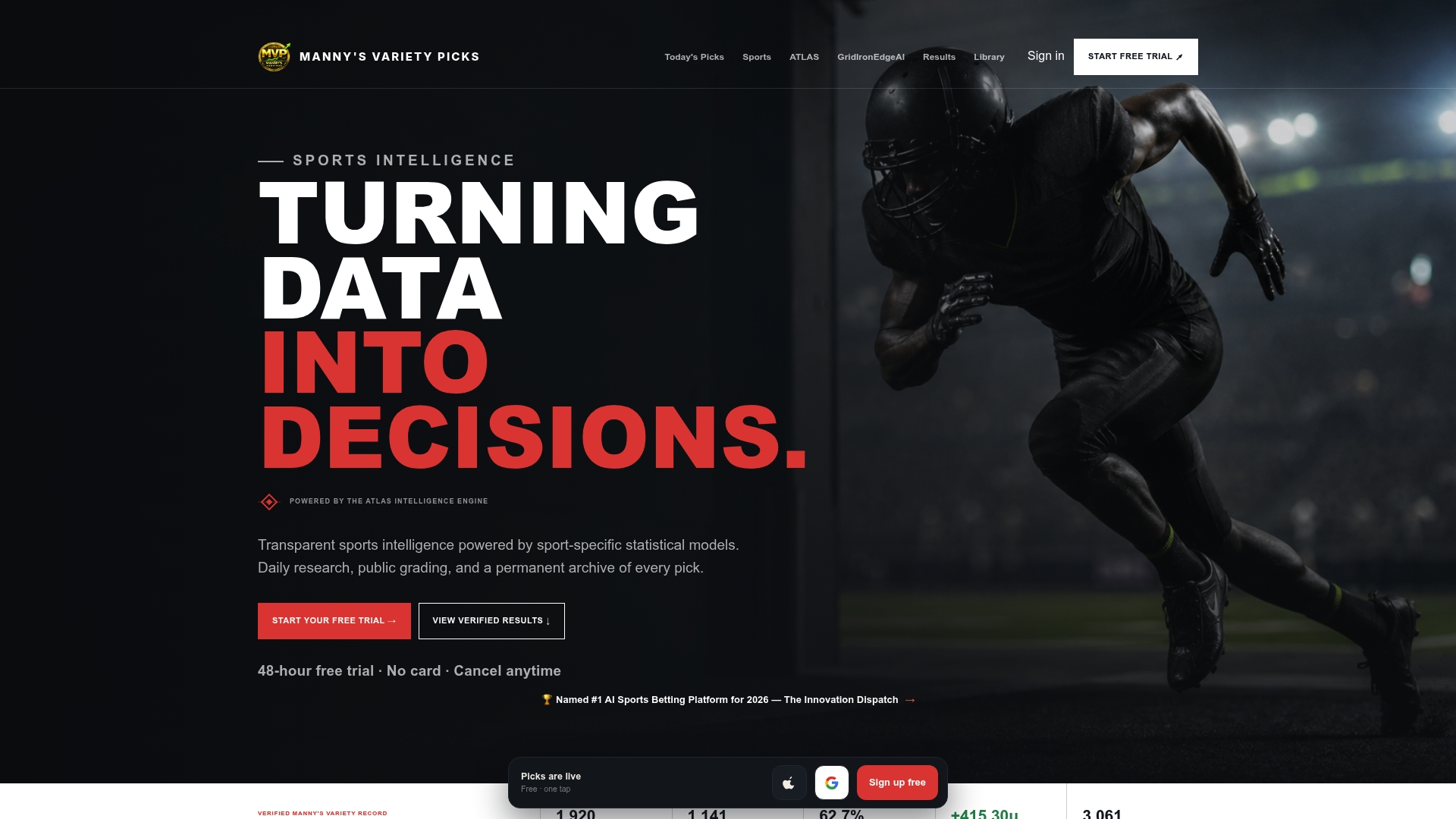
If you want a fuller view of the platform first, the Manny’s Variety homepage shows the sports covered and the daily reports.
Using a newsletter responsibly
A newsletter gives you information, not a guaranteed result. Set a bankroll you can afford to lose, bet a consistent unit size, and never chase losses with larger stakes. Sports betting is legal only in certain US states and only for adults of legal age, so confirm the rules where you live before you place a wager.
If betting stops being fun or starts causing stress, call or text 1-800-GAMBLER. The helpline runs 24 hours a day, every day, and it routes you to support in your state.

FAQ
What is the best NFL betting newsletter for beginners?
The best choice is one with a public archive, plain-language reports and a free way to start. A beginner learns the most from a newsletter that explains each pick in terms of injuries, weather and pricing. Start free, read several weeks of reports, then decide if a paid plan fits your stakes.
Are free NFL betting newsletters worth reading?
Free newsletters are useful for headlines, odds and injury news. Their picks are often hard to check against a graded record. Use them for information, and look for a published archive when you want picks you can follow with confidence.
How do I know if a betting newsletter’s record is real?
Look for a permanent archive that lists every pick with its date, odds and result, including losses. Compare the units over a sample of 50 picks to the headline number. A real record has losing streaks and does not disappear after a bad week.
What win rate should a good NFL newsletter have?
At standard -110 pricing, a bettor needs about 52.38% to break even, so anything meaningfully above that on a large sample is strong. Read the win rate alongside net units, since units reflect the odds taken. Manny’s Variety Picks reports a 63.5% win rate and 443.9 net units across more than 1,600 tracked picks.
How much do NFL betting newsletters cost?
Prices range from free to well over a hundred dollars a month, depending on the format. Manny’s Variety Picks has a Free plan, Core at $39.99 per month and Elite at $79.99 per month, plus short-term day and week passes. Match the cost to your typical bet size.
Sources
- Expected Value in Sports Betting, Core Sports Betting
- 1-800-GAMBLER: Nationwide Helpline For Gambling Addiction, GamblingHarm.org