

Verify Picks in 10 Minutes: Bet Grading Explained for Bettors
Public bet grading is the process of recording every pick a service makes, locking it before the event starts, settling it as a win, loss, push, or void, and publishing the full result. A record is only credible when picks are time-stamped ahead of the game and graded by consistent, disclosed rules, not curated after the fact. Everything else, win rates, unit totals, ROI, only means something once that foundation is in place.
TL;DR:
- Verified bet grading requires at least 200 to 500 graded picks to reliably distinguish skill from noise.
- The record must include time-stamped picks settled by an independent platform, with all results permanently archived and visible.
- A trustworthy record shows both winning and losing weeks, including cold streaks and worst drawdowns, to give an accurate performance picture.
- Market-based metrics like closing line value provide stronger evidence of skill than win rates alone, especially over large samples.
- Avoid services that delete or alter picks after outcomes, and prioritize transparent, auditable records with clear odds, stakes, and settlement rules.
Table of Contents
- Why Public Bet Grading Matters for Bettors
- Core Components of a Real Grading System
- How to Verify a Picks Service in Under 10 Minutes
- Reading Win Rate, Units, ROI, Drawdown, and CLV
- Grading Rules and Edge Cases That Cause Disputes
- What Verifiable Reporting Looks Like in Practice
- Why Variance Makes Small Samples Misleading
- How Bet Grading Shapes Smarter Betting Decisions
- Real Examples of Grading in Action
- The Checklist That Actually Matters
- How Manny’s Variety Applies This Standard
- Sources
- FAQ
Why Public Bet Grading Matters for Bettors
Marketing highlight reels show winners. A real grading record shows everything, including the picks that lost. That distinction is the whole reason bet grading exists as a concept: without a full log, a service can quietly delete its worst weeks and let the winners speak for themselves.
Sample size matters just as much as honesty. Betting outcomes carry enough variance that 50 to 100 picks tell you almost nothing about skill — you need somewhere in the range of 200 to 500 graded picks before a win rate starts separating real edge from noise.
A trustworthy record will show:
- Losing weeks and cold streaks, not just hot runs
- A chronological log you can scroll through pick by pick
- Enough volume (hundreds of picks) to make the win rate statistically meaningful
- No gaps where inconvenient stretches seem to disappear
Core Components of a Real Grading System
A grading system either has structural integrity or it doesn’t. Four elements separate a verifiable record from a marketing page.
- Locked, time-stamped picks. Every selection gets a timestamp before the event starts, which prevents anyone from adjusting or adding picks after the outcome is known.
- Independent settlement. An autograder or third-party platform settles the outcome rather than the service grading its own homework, closing the door on self-reported wins.
- Clear odds and stake rules. The service states what price it advised, how a unit is defined, and how pushes and voids get counted.
- A permanent, public ledger. Every graded pick stays visible, including the ones that lost, and that’s what makes a record auditable rather than curated. Graded picks become the actual unit of truth behind every win rate and ROI figure a service publishes.
Pro Tip: If a service can edit or remove a graded pick after the event has finished, the record isn’t a record. It’s a highlight reel with extra steps.
How to Verify a Picks Service in Under 10 Minutes
You don’t need a statistics degree to run a real audit. You need about ten minutes and a short checklist.
Start with the full public bet log. Confirm each pick carries a timestamp before kickoff and a clearly stated unit size, not a vague dollar figure. Next, check whether the grading comes from an independent autograder or platform rather than the service marking its own picks. Self-reported records aren’t automatically fraudulent, but they carry zero built-in protection against quiet edits.
Then look at volume and distribution. Ask specifically about the worst month on record, not the best one. A service unwilling to show a losing stretch is telling you something, even if it never says it out loud.
From there, check for closing line value (CLV) reporting and ROI expressed in units rather than dollars. And finally, run a random spot check: pick five or six graded selections from a month ago, and compare the advised odds against what the market closed at for that game. If the numbers line up with what was posted, that’s a good sign. If they don’t, that’s a red flag worth taking seriously.
A quick audit checklist:
- Full chronological log with timestamps
- Independent or platform-based grading, not self-reported
- Sample size in the hundreds, not dozens
- CLV and unit-based ROI reporting
- Spot-checked odds that match historical market data
Roughly 200 to 500 graded picks is the volume threshold most auditors use before trusting a win rate at all — anything short of that range is closer to a sample than a track record.
Reading Win Rate, Units, ROI, Drawdown, and CLV
Each metric answers a different question, and none of them means much in isolation.
- Win rate tells you how often picks hit, but it says nothing about the odds attached to those wins. A 55% win rate on heavy favorites can still lose money.
- Units normalize results so a bettor risking $10 a play and one risking $500 a play can compare the same record fairly.
- ROI divides net units returned by units risked, and it only means anything when the unit definition behind it is stated clearly.
- Drawdown shows the worst losing stretch in the record. A service that hides this number is hiding the exact information a subscriber needs before committing real money.
- Closing line value measures whether a pick beat the market’s final number before the game started. Consistent positive CLV is one of the strongest available signals that a service has genuine predictive value, since it’s a market-based test rather than a lucky-outcome test.
Win rate gets the attention. CLV is the metric that separates skill from streaks.
Grading Rules and Edge Cases That Cause Disputes
Most complaints about a picks service trace back to grading rules nobody explained upfront. Pushes and voids should be recorded plainly, not folded quietly into the win or loss column where they flatter the record.
Odds conventions matter too. Some services grade against the price they advised at posting time; others grade against the closing line. Grading to the advised price is defensible as long as it’s documented clearly, since it reflects what a subscriber could have actually gotten at the time.
Ungradeable picks, games that got postponed, players who never suited up, markets that closed early, need their own honest category rather than a silent deletion. A sound methodology marks these as ungradeable instead of guessing at an outcome.
Watch for these red flags:
- Losing picks that quietly vanish from the log
- Settling rules that seem to change month to month
- Monthly breakdowns that are visible for good months only
- Odds conventions that switch depending on which result flatters the record
What Verifiable Reporting Looks Like in Practice
A credible picks service publishes a graded pick count, a verified win rate, and a net unit return as an open, permanent archive rather than a rotating highlight list. The platform’s Report Archive keeps every past pick visible, sport-specific breakdowns included, so a subscriber can trace a result back to the original call instead of taking a summary number on faith.
The proofs worth checking on any platform, Manny’s Variety included, are the same ones covered above: a stated win rate tied to a real graded pick count, a net return expressed in units, and archived matchup breakdowns that let you confirm a result independently. Transparency at that level doesn’t guarantee profit. It does mean a bettor can verify the record instead of trusting a marketing claim, which is the entire point of grading picks publicly in the first place.
Why Variance Makes Small Samples Misleading
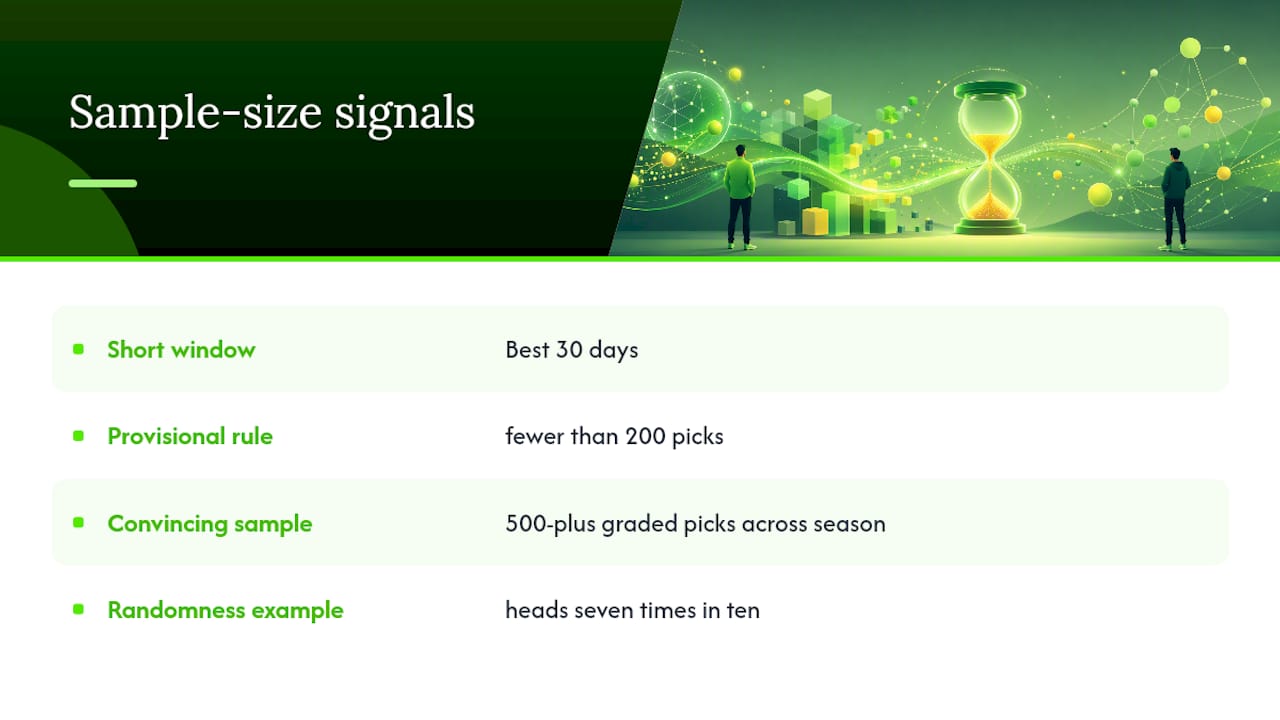
A hot week feels like proof. It usually isn’t. Sports betting carries enough game-to-game randomness that a service can go 8-2 purely on variance, with no skill involved at all, and a bettor watching only that stretch would draw the wrong conclusion entirely.
Statistical significance in bet grading is really about one question: how much of this result is signal, and how much is noise? A coin flip can land heads seven times in ten without being rigged.
This is exactly why sample size and month-by-month visibility matter more than any single hot streak. A service posting 500-plus graded picks across a full season gives variance room to average out. A service showing only its best 30 days gives variance nowhere to hide the losses, because there aren’t enough of them on display to reveal a pattern either way.
The practical takeaway: treat any win rate built on fewer than 200 picks as provisional. Treat a single winning month, no matter how good it looks, as a data point rather than a trend. And treat consistent CLV across a large sample as far more convincing than a short hot streak, because CLV is measured against a market price that adjusts on its own, not against a small set of outcomes that variance can distort.
How Bet Grading Shapes Smarter Betting Decisions
Once you can actually verify a record, the picks themselves start mattering less than the pattern behind them. A bettor who understands grading stops asking “did this pick win?” and starts asking “does this service beat the closing line often enough, across enough volume, to trust with real money?”
That shift changes staking behavior directly. A verified record with disclosed unit sizing lets a subscriber size their own bets proportionally instead of guessing at how much to risk per play. It also changes how a bettor reacts to a losing week. If the drawdown sits inside a range the historical record has already shown, a cold stretch is expected variance. If it exceeds anything on record, that’s a signal to reassess, not to panic and abandon the strategy on one bad weekend.
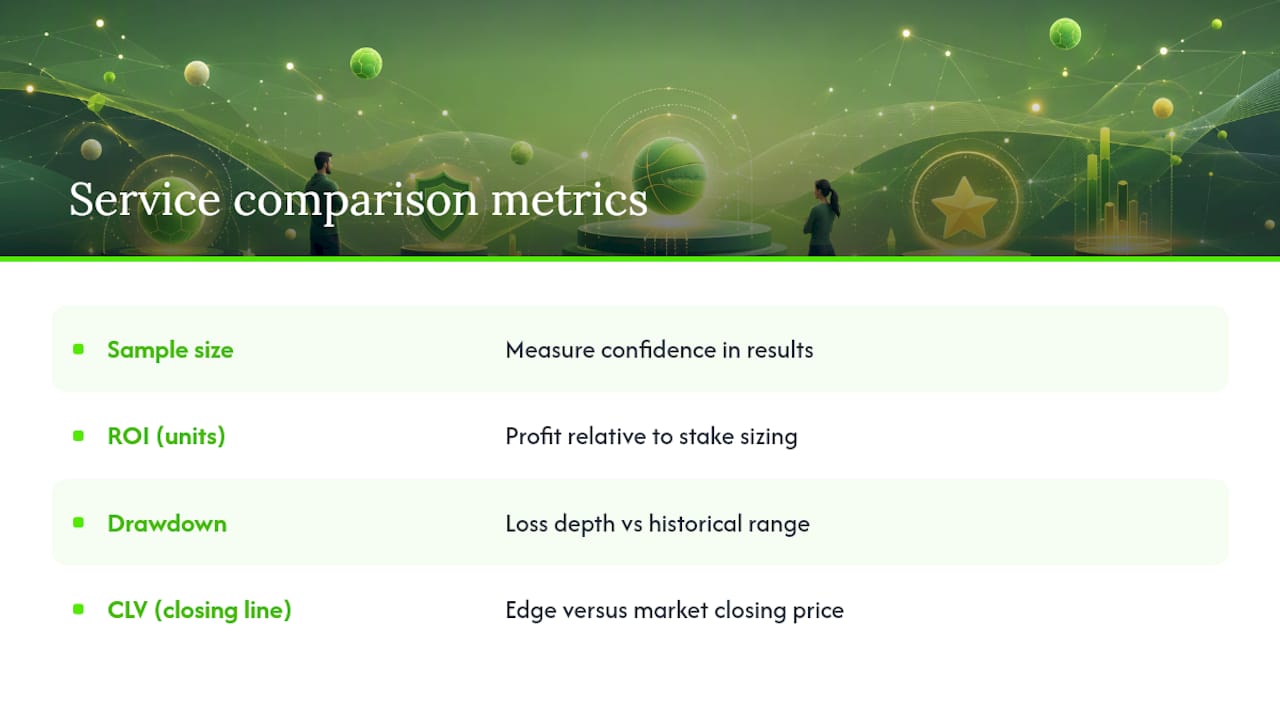
Bet grading also reframes how bettors compare services against each other. Instead of comparing marketing claims, a bettor comparing two platforms can put sample size, ROI in units, drawdown, and CLV side by side and make an actual apples-to-apples decision. That’s a fundamentally different process than picking a service because last week’s results looked good on a screenshot.
Real Examples of Grading in Action
Consider a service claiming a win rate close to 60% on NFL player props over a small sample of picks in a month sounds impressive until you check the sample size against the 200 to 500 pick threshold that gives a win rate real weight. A hot month on 30 picks tells you almost nothing on its own.
Now consider a service with several hundred graded picks across a full season and a notable drawdown at its worst point, and a positive CLV averaging a couple points across the sample. That’s a record with enough volume to trust, a visible worst case a subscriber can prepare for, and a market-based signal, CLV, that raw win rate can’t provide on its own.
The difference between those two examples isn’t the win percentage. It’s whether the record gives a bettor enough information to judge the claim independently, rather than asking them to trust a summary number pulled from a short, cherry-picked window.
The Checklist That Actually Matters
If you take one thing from this, take the order of priority. Locked timestamps and independent grading come first, because nothing else means anything if the record can be edited after the fact. A complete public ledger comes second, since it’s the only way to confirm the timestamps and grading claims are real. CLV reporting comes third, because it’s the metric hardest to fake and most predictive of actual skill.
Everything else, win rate, unit totals, ROI headlines, is secondary to those three. Walk away from any service that only shows curated winners or leans on dollar-figure promises instead of unit-based, verified numbers. Make verification a habit you repeat every few months, not a box you check once before subscribing and never revisit.
— Manuel
How Manny’s Variety Applies This Standard
Manny’s Variety builds its entire public record around the standards covered above: timestamped picks, an archived and audited ledger, and sport-specific AI engines generating the calls in the first place. Every graded pick stays in the Report Archive permanently, win or loss, so nothing gets quietly removed once the results are in.
You don’t have to take a stated win rate at face value. The archive is public, and the methodology page walks through exactly how each sport-specific engine generates its picks before they’re locked. That’s the same verification standard this article just walked you through, applied to a real, ongoing record rather than a hypothetical checklist.
If you want to see how the grading holds up before committing money, start with the how-it-works breakdown and then compare plans on the pricing page, where the Free tier lets you check the archive yourself before ever upgrading to Core or Elite.
Sources
For deeper reading on CLV and grading methodology, see the auditor’s framework for vetting tips sites and the complete guide to verifying handicapper records.
- How to Verify a Sports Handicapper’s Track Record in 2026: The Bettor’s Complete Guide - XCLSV
- What ‘Verified’ Tipster Records Really Mean - Tipster Reviews
FAQ
What Is Bet Grading, Exactly?
Bet grading is the public process of recording a picks service’s selections, locking them before the event, and settling each one as a win, loss, push, or void. A credible version of it requires an uneditable public ledger with disclosed settling rules, not a summary page of past winners.
How Many Graded Picks Do I Need to See Before Trusting a Service?
Most auditors look for somewhere between 200 and 500 graded picks before treating a win rate as meaningful. Anything smaller is too vulnerable to short-term variance to draw real conclusions from.
What’s the Difference Between Manual and Automated Grading?
Manual grading relies on a person or the service itself marking outcomes, which leaves room for editing after the fact. Automated grading uses an independent autograder that settles picks against final results without the service touching the record.
Why Does Closing Line Value Matter More Than Win Rate?
Win rate can look good purely from short-term variance, while CLV measures whether picks consistently beat the market’s final price. Consistent positive CLV is a stronger, market-tested signal of real predictive skill.
How Much Does Manny’s Variety Cost?
Manny’s Variety offers a Free tier, a Core plan at $39.99 per month, and an Elite plan at $79.99 per month, all listed on the pricing page. Each tier gives access to a different level of daily picks, reports, and archived data.