

Verify a Public Betting Record in 2 Minutes: 3 Checks for Bettors
Before you subscribe to any picks service, demand proof: a timestamped, graded ledger that shows every pick, win or loss, with stakes and odds attached. This is what a legitimate public betting record looks like, and anything less is a marketing page dressed up as a track record. Three things to check right now: locked timestamps before kickoff, complete history including losing months, and visible units or ROI math you can recalculate yourself.
TL;DR:
- Verified betting records should include timestamps before game start, full history with losses, and clear ROI calculations for credibility.
- Records with fewer than 200 picks are statistically unreliable, while those with over 300 span multiple seasons for stronger validation.
- Red flags include editable timestamps, highlights-only pages, missing months, and vague staking language that hinder trust.
- Proper verification involves checking third-party proof links, recalculating results on a sample, and requesting raw data or API access.
- Manny’s Variety publicly shares a comprehensive, AI-generated record across major leagues, emphasizing transparency and regular audits.
Table of Contents
- What a Verified Public Betting Record Actually Contains
- How Do You Verify a Betting Record Is Real?
- How Many Tracked Picks Make a Record Statistically Meaningful?
- What Red Flags Mean You Should Not Subscribe
- How Manny’s Variety Publishes a Verifiable Record
- Is It Legal to Publish and Follow a Public Betting Record?
- Why Accurate Public Betting Records Are Hard to Maintain
- Does a Public Record Actually Build Trust in a Tipster?
- Quick Vetting Routine to Use Before You Pay
- Start a Verification First Trial With Manny’s Variety
- Sources
- FAQ
What a Verified Public Betting Record Actually Contains
A real public betting record is a data set, not a highlight reel. Each entry needs enough detail that a stranger could reconstruct the bet and check the math without asking the tipster a single question.
At minimum, a complete entry includes:
- Timestamp — the exact date and time the pick was published, ideally before the game or match started
- Sport and event — the specific matchup, league, or tournament
- Market and selection — spread, moneyline, total, or player prop, and which side was advised
- Advised odds — the price at the time of publication, not the closing line
- Stake or units — how much was risked relative to the service’s standard unit
- Sportsbook or exchange type — where that price was reasonably available
- Result and profit/loss — win, loss, push, and the unit gain or loss
- Running cumulative units — a tally that lets you see the trend over time
Records typically live in one of a few formats: a public ledger page hosted on the service’s own site, a profile on a third-party tracker, a downloadable CSV, or in more sophisticated setups, a sealed hash ledger or API endpoint that proves entries weren’t rewritten after the fact. A marketing highlight, by contrast, usually shows only a handful of big winners with no odds, no losses, and no way to check the date it was actually posted.
How Do You Verify a Betting Record Is Real?
Verification does not require a forensic accounting degree. It requires patience and a willingness to check a sample instead of trusting the summary number on the homepage.
- Find the third-party proofing link. Legitimate services usually point to an independent tracker profile rather than asking you to trust a page they control entirely. Timestamped public ledgers from a third party show every graded pick with a time stamp that precedes the event, which is the single strongest signal you can check in under two minutes.
- Confirm the timestamp beats the clock. Pull up three or four picks and compare the posted time against the actual game start. If a pick for a 1:00 PM kickoff shows a timestamp of 1:15 PM, that is not a live record. That is a rewrite.
- Recalculate the math on a small sample. Pick 10 to 15 entries at random, not the ones featured on the landing page, and recompute the unit result using the listed odds and stake. If your numbers do not match the published ROI, that is a hard stop.
- Check for full monthly coverage. Losing months should be visible and dated, not skipped. A record that hides losing picks while keeping every winner is not a public betting record. It is a curated advertisement.
- Look for immutable proof where it exists. Some services use sealed-hash ledgers or public APIs specifically to prove nothing was edited after publication. This is not standard across the industry, but where it exists, it is the strongest guarantee available.
- Ask for raw exports. A CSV file or API access lets you audit the full history yourself instead of relying on a summary dashboard. Refusal to provide one is worth noting.
Pro Tip: Do your unit recalculation on a Tuesday, not a Sunday. Off-peak days give you time to actually cross-reference odds history on a site like Odds Portal instead of rushing through the check before kickoff.
How Many Tracked Picks Make a Record Statistically Meaningful?
A record with fewer than 200 to 300 tracked picks is often not statistically reliable, no matter how good the win rate looks. Industry vetting guidance consistently recommends 200 to 300 or more documented picks before you treat a tipster’s numbers as meaningful rather than a lucky streak.
- Under 200 picks: treat any win rate or ROI figure as a small sample and expect it to move sharply with the next 20 results
- 200 to 300 picks: you’re starting to see a real signal, though variance in markets like player props or parlays still swings results more than it does in straight sides and totals
- 300+ picks: confidence improves, especially when the sample spans multiple seasons rather than one hot stretch
Sample-size needs also shift by bet type. Moneylines and spreads settle into patterns faster than props or live in-game bets, where variance runs higher. Ask for rolling monthly breakdowns and the worst individual month on record, not just the lifetime total. A service that will not show you its worst month is telling you something.
What Red Flags Mean You Should Not Subscribe
Certain patterns should end the conversation before you ever enter a card number.
- No timestamps, or timestamps that can be edited after the fact. If picks can be silently altered post-game, the record proves nothing.
- A highlights-only page. Ten screenshots of winning slips is not a record. It’s a sales page.
- Missing months. Gaps in the calendar almost always mean a losing stretch got deleted.
- Vague staking language. “We bet based on confidence level” without a defined unit system makes ROI impossible to verify.
Ask these questions directly, and treat hesitation as an answer:
- How many total picks are tracked, and over what time span?
- Where exactly are picks timestamped, and can I see that page myself?
- What staking plan do you use, and is it consistent across the whole record?
- Can I get a raw export or API access to the full history?
- What did your worst month look like, in units?
A proof-first vetting checklist built around exactly these questions is a useful reference if you want to standardize how you evaluate every service you consider. If a service dodges two or more of these, walk away. That is the fail-fast rule.
How Manny’s Variety Publishes a Verifiable Record
Manny’s Variety is built around the idea that a betting service should have to show its work, not just its highlights. The platform runs sport-specific AI engines across NBA, MLB, and NFL, generating picks from real-time analytics and thousands of simulations rather than a single analyst’s gut call.
What that looks like in practice:
- A public track record covering a large number of tracked picks, with wins and losses graded openly rather than curated after the fact
- A reported win rate and net return figures, stated to be drawn from published history
- Sport-specific engines for each league rather than one generic model stretched across every sport
- Educational resources, including a blog post on what a verified betting record actually shows and a companion piece on choosing the right tracking method depending on whether you have under 50, 50 to 300, or 300+ bets to evaluate
- A stated goal of standing apart from services that lack any verifiable record at all
The details of how picks are generated, including the simulation approach behind each sport-specific engine, are laid out on the how-it-works page for readers who want the mechanics before they check the ledger.
Is It Legal to Publish and Follow a Public Betting Record?
Publishing a record of past picks is generally legal in the United States, since it’s a form of commentary or historical reporting rather than a wager itself. The legal line that actually matters sits elsewhere: sports betting itself is regulated at the state level, and where you can legally place a bet depends entirely on your jurisdiction, not on the record you’re reading.
The ethical line is narrower but just as important. A tipster who publishes a “public” record but quietly edits entries after the game ends is not committing a crime in most cases, but the practice is deceptive in the plain sense of the word. Advertising standards in several jurisdictions already treat unsubstantiated performance claims as a consumer protection issue, which is part of why transparency around advised odds and full history has become a standard bettors expect rather than a bonus feature.
There’s also a duty of accuracy that has nothing to do with regulation and everything to do with trust. If a service advertises a win rate calculated from a curated subset of picks, it is misrepresenting performance to people making a purchasing decision based on that number. That’s not a technicality. It’s the entire reason verification checklists exist in the first place.
For the reader, the practical takeaway is simple: you are not doing anything legally risky by reviewing a tipster’s public record before subscribing. You are doing exactly what a careful buyer should do before paying for any service that claims measurable results.
Why Accurate Public Betting Records Are Hard to Maintain
Keeping a public betting record accurate over hundreds or thousands of picks is harder than it sounds, and most of the failures aren’t intentional fraud. They’re sloppy process.
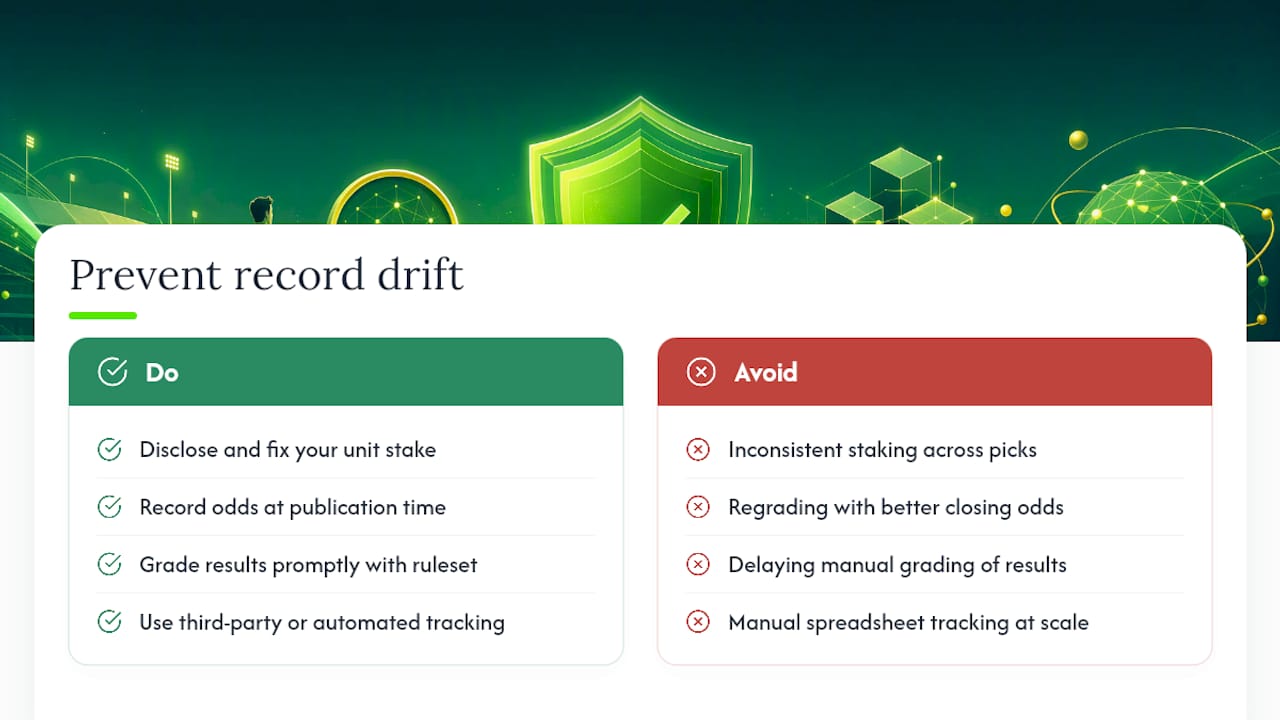
The most common pitfall is inconsistent staking. A service that bets 1 unit on one pick and 3 units on another, without a documented reason, makes ROI calculations meaningless even if every single result is graded honestly. The math only works if the unit system stays fixed and disclosed.
Odds drift is another quiet problem. A pick advised at plus 150 that gets graded using the closing line at plus 130 inflates the apparent edge. The record should lock in the odds available at the moment of publication, not adjust it retroactively to look better.
Grading delays cause their own mess. A service that waits days to log results risks memory errors, especially around pushes, half wins on split tickets, or postponed games that need to be voided rather than counted as losses. Manual grading without a clear ruleset for these edge cases is where a lot of otherwise honest records quietly drift from accurate.
The last pitfall is simpler: growth outpacing infrastructure. A tipster who starts by logging picks in a spreadsheet and later scales to hundreds of picks per month often lacks the systems to keep that spreadsheet airtight, which is exactly why third-party tracking profiles and automated ledgers exist. Manual record keeping does not scale cleanly, and readers should treat a sudden switch in tracking method, or a record that resets without explanation, as worth a direct question rather than a shrug.
Does a Public Record Actually Build Trust in a Tipster?
Yes, and the mechanism is straightforward: a record you can audit removes the need to take anyone’s word for anything. Trust in this industry has historically been cheap to fake and expensive to verify, which is exactly why so many services rely on curated screenshots instead of full ledgers.
A tipster willing to publish losses alongside wins is making a specific claim: the numbers are real enough that hiding the bad stretches isn’t worth the risk of getting caught. That’s a meaningfully different posture than a service that only shows you its best month. Full history, including losing picks, is the baseline signal that separates a credible operation from a marketing funnel.
The credibility gap widens further once a reader understands ROI in context, rather than as an isolated headline number. A payout structure with lower expected return can quietly erode a bettor’s edge over hundreds of wagers, the same way a lower RTP costs money over volume in casino games. A service that publishes odds and stakes lets you judge whether its ROI reflects skill or a favorable sample of easy prices. One that hides that data is asking you to trust a number you cannot actually check.
There is a compounding effect, too. Once a bettor learns to check timestamps, sample size, and staking consistency for one service, that same checklist gets applied to the next one. Transparent records don’t just build trust in a single tipster. They raise the baseline expectation for the entire category, which is uncomfortable for services that were never built to survive that kind of scrutiny.
Quick Vetting Routine to Use Before You Pay
If you take nothing else from this, take the order of operations: timestamping first, full history second, sample size third, staking transparency fourth. Skip any one of those and the rest of your due diligence is built on sand.
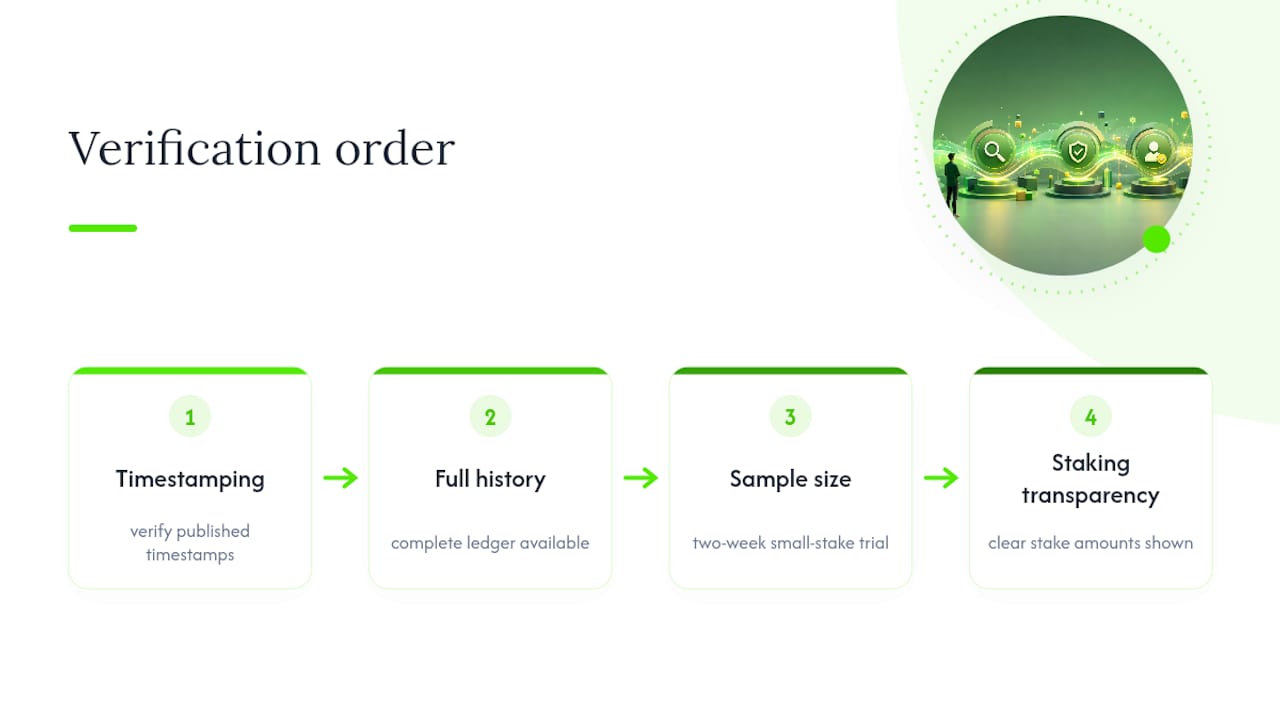
A practical way to test a service without real financial exposure is a two-week small-stake trial. Track every pick against the published ledger yourself, in a separate spreadsheet, and compare your numbers to theirs at the end of the period. Discrepancies, even small ones, tell you more about a service’s honesty than any win rate on the homepage.
Statistical rigor matters, but so does usability. A record that is technically verifiable but buried in a hard-to-navigate export defeats the purpose. The best services make both true at once: the numbers hold up, and a normal bettor can actually find them.
— Manuel
Start a Verification First Trial With Manny’s Variety
Manny’s Variety is built around a simple trade: you don’t have to take a win rate on faith, because the ledger behind it is public.

If you’ve read this far, you already know what to check first: pull up the record, confirm the timestamps, and see if the losses are still on the page. From there, you can start on the Free plan with limited features, move to Core at $39.99 per month, or go Elite at $79.99 per month once you’ve verified the numbers hold up to your own audit. The pricing page lays out exactly what each tier includes, and the verification blog post walks through the same checklist covered here applied directly to Manny’s own record.
Sources
- How to Verify a Sports Handicapper’s Track Record in 2026: The Bettor’s Complete Guide - XCLSV
- Verified Handicapper Records, Public Results | TrustMyRecord
- Proof-First Tipsters: A 10-Point Vetting Checklist - Tipster Reviews
FAQ
What Is a Public Betting Record?
A public betting record is a timestamped, graded ledger showing every pick a service has published, including wins, losses, stakes, and odds, open for anyone to review.
How Many Picks Should a Service Have Before I Trust the Record?
Aim for at least 200 to 300 documented picks, with 300 or more giving stronger confidence, since smaller samples are prone to statistical noise.
What’s the Biggest Red Flag in a Betting Record?
Missing or editable timestamps combined with a highlights-only page that shows no losing picks is the clearest sign the record isn’t a real one.
Does Manny’s Variety Publish a Verifiable Record?
Yes. The service tracks picks publicly across some major leagues, reporting a win rate and net units across a number of graded picks.
How Much Does Manny’s Variety Cost?
Manny’s Variety offers a free tier with limited features, a Core plan at $39.99 per month, and an Elite plan at $79.99 per month, all listed on its pricing page.