

Beginners: Judge Cash-Out Offers With Hedge Math and Live Simulations
Cash out lets you settle a bet before the event ends, locking in a payout below the ticket’s full potential value. The offer always includes a hidden cut for the sportsbook, so the one rule that matters is this: take it only when a real bankroll risk, a game-changing event, or a large accumulator close to landing makes the guaranteed money worth more to you than the expected value you’re giving up.
TL;DR:
- Most cash out offers include a built-in bookmaker margin of about 5% to 10%, which is typically reflected in the payout calculation.
- Cash out should be used only when the guaranteed amount outweighs the potential upside after accounting for the bookmaker’s cut, especially in material bankroll risks.
- Partial cash outs are preferable for big accumulators to lock in profits on part of the stake while the remaining part continues to risk the event.
- Habitual cash outs tend to erode long-term expected value by consistently accepting discounts below the fair hedge price.
- Always compare the sportsbook’s cash out offer to a self-calculated hedge to determine if the haircut is acceptable based on your pre-set thresholds.
Table of Contents
- How Does Cash Out Betting Work?
- What Are the Types of Cash Out?
- When Should You Actually Use Cash Out?
- How Do You Calculate What a Cash Out Is Worth?
- Real Scenarios: Accumulator, Moneyline, and Totals
- What’s the Long-Term Cost of Cashing Out?
- How Do You Cash Out and What Restrictions Apply?
- Responsible Gambling and Safer Alternatives
- Why Manny’s Variety Treats Cash Out as a Math Problem, Not a Feeling
- Get Live, Data-Backed Guidance Before You Decide
- Sources
How Does Cash Out Betting Work?
A cash out offer is a live recalculation of your ticket’s value based on current market odds and however much of the event is left to play. The sportsbook takes the probability of your bet winning, multiplies it by the payout, and subtracts its own margin before showing you a number. That process is functionally identical to a sportsbook placing a hedge on your behalf and folding its cut into a single figure you either accept or decline.
The margin isn’t small. Bookmaker overrounds on standard markets typically run several percentage points above a true 100% probability book, and that margin shows up again inside the cash out price. You’re not just paying the vig once at bet placement. You’re paying a version of it again every time you cash out early.
Three operational quirks matter in practice:
- Prices update on a short lag, so the number on your screen can shift by the time you confirm.
- Sportsbooks suspend cash out entirely during goals, penalties, VAR reviews, or other live action.
- Requests get rejected outright when the market moves faster than the app can process your tap.
Statistic Callout: Bookmaker margins on mainstream markets commonly sit in the mid-single digits as a percentage of the total implied probability, and that same structural cut is embedded in every cash out offer you see.
What Are the Types of Cash Out?
Sportsbooks generally offer three versions of the feature, and knowing which one you’re using changes how you should think about the offer.
- Full cash out settles the entire ticket at once. You take the guaranteed number, and any remaining upside on the bet disappears immediately.
- Partial cash out splits your stake, so you bank a portion of the guaranteed payout while leaving the rest of the ticket live to keep chasing the full result.
- Auto cash out lets you set a target payout or loss threshold in advance; the system settles automatically when that number hits, which removes emotional decision-making but can also lock in a price worse than you’d have accepted with a second look.
Availability varies a lot by market and bet type. Same-game parlays, certain player props, and some in-play markets restrict or disable cash out entirely, even when the feature works fine on a simple single.
When Should You Actually Use Cash Out?
Run through a short checklist before you tap “confirm,” because the pressure of a live game pushes most people toward decisions they wouldn’t make with a clear head.
- Bankroll exposure first. Ask whether the guaranteed amount is material to your total roll. If losing the bet wouldn’t meaningfully hurt you, there’s less reason to take a discounted payout now.
- Compare the haircut to a threshold. Decide in advance how much of a discount you’ll tolerate, say 5% to 10% below fair value, and hold yourself to it instead of reacting in the moment.
- React to real information, not noise. An injury, a red card, or a sudden weather shift can genuinely change the true probability of your bet winning. A missed shot on goal usually doesn’t.
- Lean on partial cash out for big accumulators. Locking in some guaranteed profit while letting the rest ride protects you from a single late leg wiping out the whole ticket.
Industry explainers consistently frame this as a price decision rather than an emotional one: compare, don’t just react.
Pro Tip: Before accepting any cash out, mentally price out what you’d need to bet on the opposite outcome to lock in the same guaranteed profit yourself. If the sportsbook’s offer is noticeably worse than that manual hedge, you’re paying extra for convenience.
How Do You Calculate What a Cash Out Is Worth?
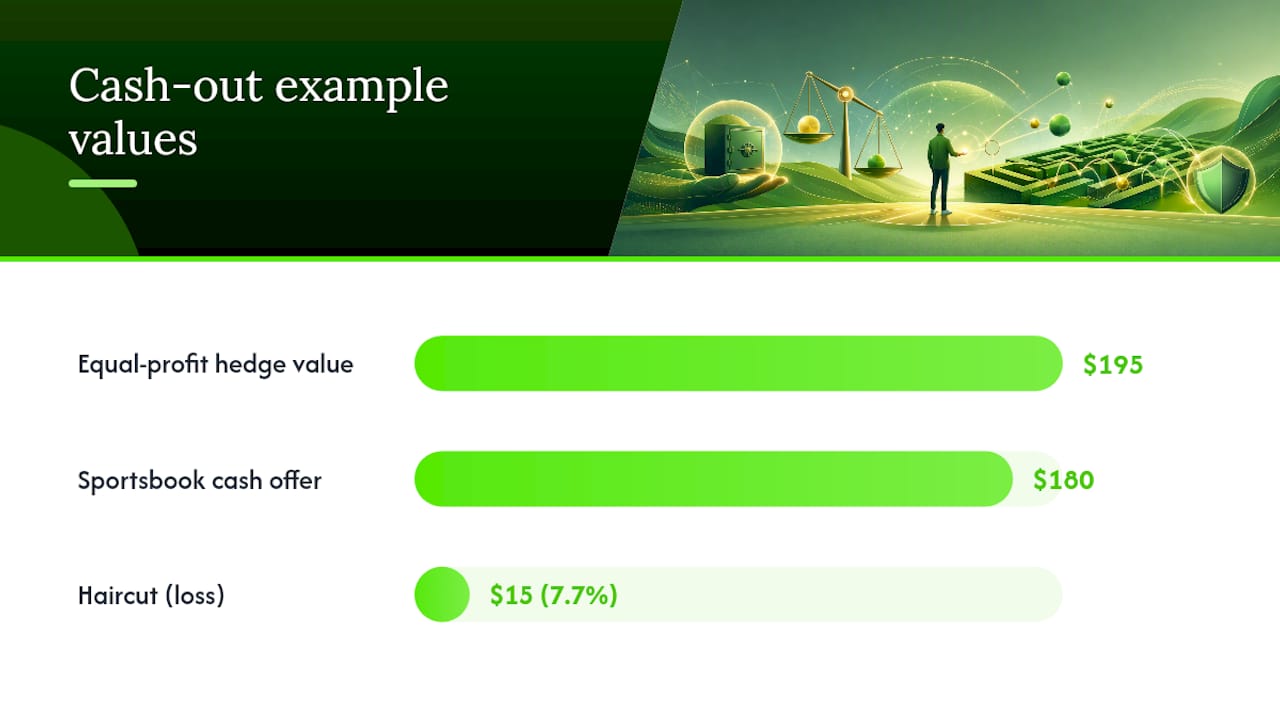
Here’s a simple worked example. Say you bet $100 on a moneyline at odds that would pay $250 if it wins. Late in the game, your team is protecting a lead, and the sportsbook offers a $180 cash out.
To check that number, calculate the equal-profit hedge yourself: find the current opposite-side price and figure out how much you’d need to stake on it to guarantee the same profit regardless of outcome, using the same math a manual hedge relies on.
- If the live opposite-side odds suggest a hedge stake that leaves you with $195 guaranteed either way, the sportsbook’s $180 offer is a $15 haircut, about 7.7% below the fair hedge value.
- That gap is the sportsbook’s built-in cut for handling the transaction and eliminating your risk instantly.
Statistic Callout: A haircut in the range of 5% to 10% below the equal-profit hedge is common on standard markets; anything sharply beyond that deserves a second look before you accept.
Only take the offer if that gap sits inside a tolerance you set beforehand, or if you have an urgent, real bankroll reason to lock in cash right now.
Real Scenarios: Accumulator, Moneyline, and Totals
- Accumulator with one leg left. If the guaranteed cash out would be life-changing money for your bankroll, partial cash out makes sense even at a meaningful discount. Protecting a chunk of that win matters more than squeezing out full value.
- In-play moneyline with a late lead. Accept the offer only if the haircut is small or if losing the bet outright would put your bankroll under real strain. Otherwise, let a well-priced favorite play out.
- Totals and goals markets. These swing hard on a single score, so cash out can be genuinely useful the moment you judge that momentum has decisively shifted, not before.
What’s the Long-Term Cost of Cashing Out?
Cashing out habitually is a slow bleed on your bankroll, not a single bad decision.
- A bettor with a genuine long-term edge who cashes out routinely hands back a meaningful slice of that edge to the sportsbook on every ticket where the outcome was trending their way.
- Frequent cash out use erodes returns over time precisely because each instance applies a discount versus letting a positive-expected-value bet play to its natural conclusion.
- Better alternatives exist for managing the same anxiety: sizing your stakes so no single bet threatens your bankroll, hedging manually at a price you’ve checked yourself, or setting a hard stop-loss rule before the game starts.
Understanding expected value is what separates a bettor who occasionally cashes out for good reason from one who quietly gives away their edge every week.
How Do You Cash Out and What Restrictions Apply?
- Open your “My Bets” or “Open Bets” tab, where any eligible ticket shows a live cash out value next to it.
- Tap the offer and confirm quickly. Prices refresh constantly, and a few seconds of hesitation can change the number.
- Watch for common blockers: markets suspend after goals or VAR reviews, free bet conversions often exclude cash out entirely, and multi-event parlays sometimes restrict the feature until certain legs settle.
- If a cash out fails or gets reversed, check your bet history immediately and contact support if the ticket status looks wrong.
Responsible Gambling and Safer Alternatives
Set a firm rule before you ever place a bet: decide your maximum acceptable haircut and your staking limits in advance, then stick to them regardless of what’s happening on screen. Prefer manual hedging at prices you can verify over habitual auto cash out, which can quietly lock in worse numbers than you’d accept with a clear head.
- If cashing out (or not cashing out) starts to feel compulsive, BeGambleAware offers free tools and guidance.
- Gamblers Anonymous provides peer support for bettors who need more structured help.
- Self-exclusion and device-lock tools, similar to those used for gaming-related gambling problems, can add a physical barrier when willpower alone isn’t enough.
Why Manny’s Variety Treats Cash Out as a Math Problem, Not a Feeling
Most bettors decide to cash out based on nerves, not numbers. That’s the gap I keep coming back to: the sportsbook’s offer is a calculated haircut, and the only honest way to judge it is against your own hedge math or a simulation of how the game is likely to finish. Advanced sports betting platforms run thousands of live simulations per matchup precisely so subscribers aren’t guessing under pressure. If you want that kind of evidence-based read on an in-play situation, our live picks are built for exactly that decision.
— Manuel
Get Live, Data-Backed Guidance Before You Decide
A reliable betting platform gives you a second opinion the sportsbook’s cash out screen never will.

That track record matters most in the moment a cash out button is flashing at you. Rather than relying on gut instinct about whether your lead is safe or your parlay leg is shaky, you can check what the simulations say about the actual probability shift happening in the game. Our live in-game picks update as the action unfolds, giving you a data point the sportsbook’s own offer conveniently leaves out. If you’re deciding whether cash out or holding is the smarter move tonight, see how Manny’s Variety works and start your trial before your next live bet.
Sources
- Cash outs during in-play sports betting: Who, why, and …
- BeGambleAware
- Cash Out vs Hedge: The Math Books Do Not Show