
4-Step Injury Report Betting Workflow to Beat Public Money
Injury reports create a real betting edge, but only for bettors who track the practice-participation trend, not the headline designation, and act before the number stabilizes. The clearest example: a starting NFL quarterback going from probable to out can swing a spread 3 to 7 points depending on the backup. Real-time analytics resources exist specifically to help bettors catch that window before the public does.
TL;DR:
- Injury impact varies significantly by position, with starting quarterbacks, primary scorers, and top pitchers moving betting lines much more than role players or secondary positions.
- The best betting opportunities emerge when injury reports are tracked from practice sessions Wednesday through Saturday, especially as practice trends converge or diverge from initial reports.
- Most sportsbooks settle bets based on actual participation and recorded game statistics, with some offering protections like bet refunds if a player is ruled out before kickoff.
- Sharp bettors should monitor injury practice trajectories daily, compare line movements to model expectations, and size bets according to the level of remaining uncertainty.
- Patience and discipline yield better results, since acting too quickly on headlines without confirming actual practice trends often leads to overreaction and losses.
Table of Contents
- Which Injuries and Positions Move Betting Lines Most?
- When Is the Best Time to Bet Around an Injury?
- How Do Sportsbooks Settle Bets When a Player Gets Hurt?
- A Workflow for Betting on Injury Reports
- Why Discipline Beats Reaction on Injury News
- How Manny’s Variety Puts This Workflow to Work
- Sources
- FAQ
Which Injuries and Positions Move Betting Lines Most?
Not every injury matters equally, and the market prices that difference. Position-weighted impact drives the size of a line move far more than injury severity alone.
An NFL starting quarterback going down typically shifts the spread 3 to 7 points, depending on how far the backup’s talent drops off. A number two receiver or a backup linebacker rarely moves a spread more than half a point. In the NBA, a primary scorer or lead ball handler sitting out can shift a total by 4 to 6 points and swing the spread 3 to 5 points, since usage rate concentrates so heavily on one or two players. In MLB, a starting pitcher scratch is the single biggest line mover in the sport, often shifting the moneyline by 20 to 40 cents once a bullpen game is confirmed.
- NFL: starting QB > starting offensive tackle > primary receiver > everyone else
- NBA: primary scorer/point guard > starting big man > role players
- MLB: starting pitcher > everyone else, by a wide margin
Chronic versus first-time injuries price differently. A player with a known recurring issue (a bad hamstring, a history of back spasms) gets discounted by the market gradually, since sharp bettors have seen the pattern before. A first-time, unexpected injury, like the MRI scare that briefly clouded a Phillies starter’s availability, creates more uncertainty and often overreaction in the initial minutes after news breaks, which is exactly where value tends to show up before the number corrects.
When Is the Best Time to Bet Around an Injury?
Thursday through Saturday practice reports carry outsized weight because that window is when trajectories either confirm or reverse. A player who logs limited on Wednesday, limited on Thursday, and full on Friday is trending toward playing. The reverse pattern, limited fading to DNP, often precedes a Saturday or Sunday out ruling that the public won’t see coming until the official announcement.
The sequence almost always runs the same way:
- Information surfaces (a beat reporter, a practice report, a manager’s comment)
- Sharp bettors and models act on it within minutes to hours
- The line moves, sometimes before mainstream coverage picks up the story
- Public money follows once the news is widely reported, often pushing the line further
Compare the opening line to the current line before you bet. A gap between the two, especially one that opened before news became public, tells you sharp money already priced something you may be seeing late.
A practical 72-hour checklist: check the injury report Wednesday and Thursday, watch practice trajectory Friday, confirm inactive lists the morning of game day, and place your bet as close to your intended line as your model allows once you’ve confirmed the trend rather than guessed at it.
How Do Sportsbooks Settle Bets When a Player Gets Hurt?
The general rule across most operators: once a player takes part in the game, the bet stands and settles on recorded statistics, regardless of how limited that participation turns out to be. A player who exits after one series still has a live prop bet graded on whatever stats he produced, even a single snap.
If a player is ruled out or inactive before the game starts, most books void player prop bets on that individual and refund the stake. But this isn’t universal, and some operators offer specific protections, like Bet Protect features that refund certain bets under defined conditions.
- Parlays containing a voided prop leg typically reduce to the remaining legs rather than canceling the whole ticket, though this varies by operator
- Full prop bet terms are worth reading before you build a same-game parlay around a questionable player
- Always check your specific operator’s help page before placing a prop on anyone with an injury designation, since policies differ enough to matter
Verify settlement policy before you bet, not after a surprising grade shows up on your account.
A Workflow for Betting on Injury Reports
A repeatable process beats reacting to headlines. Here’s the sequence worth running before every bet involving a player with any injury designation:
- Build a pre-event expectation for the line assuming full health, so you have a baseline to measure against
- Monitor practice participation daily rather than waiting for the final tag, since the trajectory reveals more than the label
- Compare the opening line to the current line to spot whether sharp money has already moved
- Act when your model’s expected line diverges meaningfully from the current market number, not before
Before locking in a bet, ask three questions: How big is the drop off to the backup or next man up? Does this position carry outsized weight in this sport’s scoring or usage model? And how much uncertainty remains, given the practice trend so far?
Size your stake to that uncertainty. A confirmed out on a backup lineman deserves a normal-sized bet if the number moved in your favor. A “questionable” tag on a star with conflicting reports deserves a smaller stake, or none at all, and bankroll discipline matters more here than anywhere else in your process.
Pro Tip: Track your own record on injury-driven bets separately from your overall record. Bettors often overestimate their edge on headline news because a few big wins stick in memory while the quieter losses don’t.
Manny’s Variety builds this exact monitoring into its sport-specific engines, running real-time simulations that update as practice reports and inactive lists change, and it has tracked over 1,600 picks with a 63.5% win rate as part of its public record.
Why Discipline Beats Reaction on Injury News
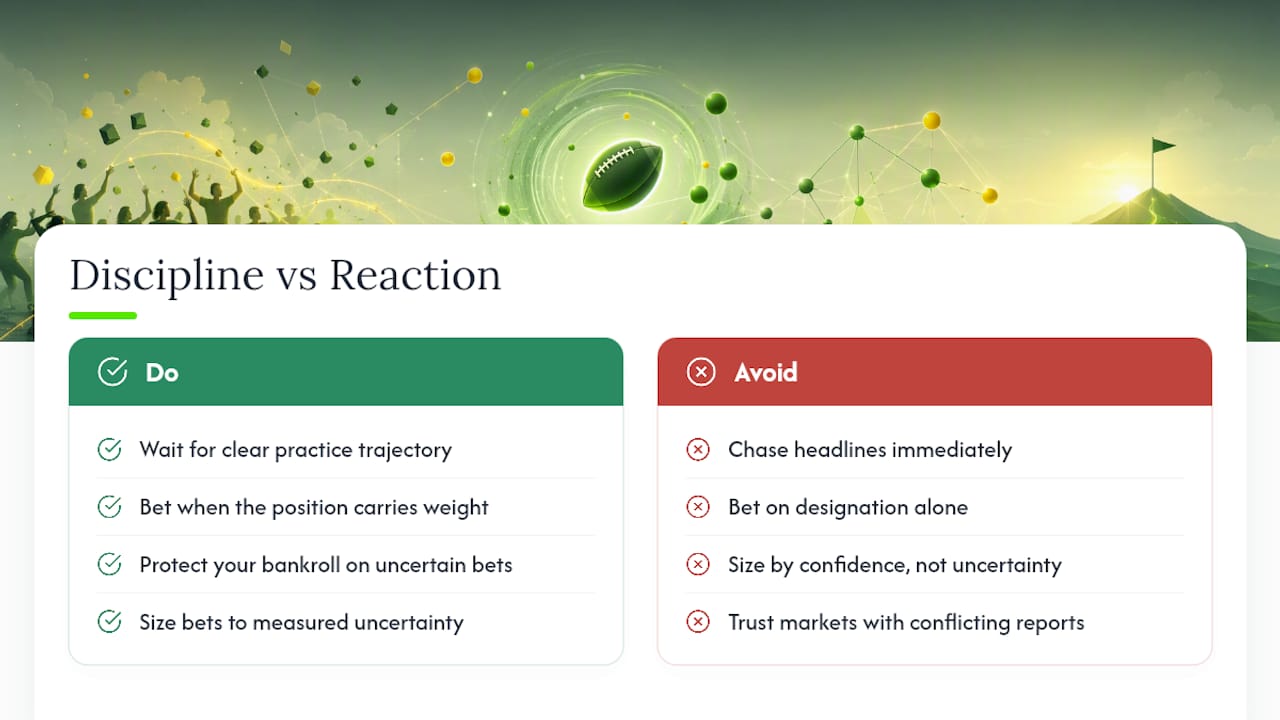
Injury news rewards patience more than speed. The bettors who lose money chasing headlines usually act on the designation itself instead of the practice trend behind it, and they size bets on confidence rather than on how much uncertainty actually remains.
I use injury signals when the practice trajectory is clear and the position carries real weight, a starting quarterback, a top scorer, a starting pitcher. I skip markets where the news is murky or where three conflicting reports exist, because a guess dressed up as a signal is still a guess. Protecting your bankroll on the uncertain bets matters more than winning the clear ones.
— Manuel
How Manny’s Variety Puts This Workflow to Work
A platform is built for the exact gap this article describes: the window between when injury news breaks and when the line finishes adjusting, using sport-specific AI engines running thousands of simulations against real-time data across various sports markets.
The platform’s live in-game picks apply the same monitor-then-model approach to injuries and lineup changes that surface after a game starts, which is often when the sharpest value on late scratches and in-game role changes appears. Every pick is archived publicly, so you can check the 63.5% win rate and 443.9 net units against real history rather than a marketing claim. If you want to see the model in action before committing, see how it works and start pulling real-time picks into your own injury-report workflow today.
Sources
Official league and team injury report hubs update on a fixed schedule. The NFL requires teams to publish practice participation and game status by mid-afternoon on Wednesday, Thursday, and Friday, with a final designation issued Friday. The NFL injury report hub on CBS Sports aggregates these updates by team, which beats refreshing 32 individual team pages.
The designation itself, questionable, doubtful, or out, tells you less than the practice log behind it. A player listed as “limited” three days running behaves differently than one who was full Wednesday and DNP Friday, even if both carry the same tag.
For faster signals, watch these sources in order of speed:
- How injuries actually move betting lines — SportsCommand blog
- What happens to my prop bet if a player is inactive or injured — FanDuel Support
Set up alerts on two or three beat reporters per team you bet regularly, plus a league injury feed, and you will see most moves before the line fully reflects them.
FAQ
Will I lose my bet if a player gets injured?
Not automatically. For bettors, understanding skin betting risks is essential for managing safe practices and avoiding pitfalls related to wagers on player performance and injury outcomes. If the player takes part in the game at all, your bet settles on the statistics recorded, even if he leaves early.
What happens to my sports bet if a player gets injured before the game?
If the player is ruled out or inactive before kickoff, most operators void player-specific prop bets and refund the stake, though policies vary by book.
What’s worse, questionable or doubtful?
Doubtful signals a lower chance of playing than questionable, but the practice-participation trend leading up to either tag is a more reliable indicator than the label itself.
Does FanDuel offer injury protection for bets?
FanDuel and several other operators offer specific protections, such as Bet Protect features, for certain bet types when a player is ruled out, and the exact terms are listed on the operator’s own support pages.