

1–2% Units and CLV: Data First Long Term Betting Strategy for Bettors
A long term betting strategy is a repeatable process for finding positive expected value (+EV) and protecting your bankroll through the losing stretches that follow every winning one. The core rule: chase EV, not outcomes, and size stakes so no single bad week ends the project. Only around 3 to 5 percent of sports bettors turn a profit over the long run, and that group shares the same habits: bankroll discipline, closing line value tracking, and patience measured in seasons, not weekends.
TL;DR:
- Consistently beating the closing line value by 55-60% on a large sample size is a key indicator of genuine long-term betting edge.
- Bankroll management should use flat units or fractional Kelly staking to survive typical losing streaks and protect your capital from variance.
- Relying on high win rates alone is misleading; focus on CLV and volume to accurately gauge betting performance over hundreds of wagers.
- Line shopping across multiple sportsbooks can improve long-term ROI by 1-3% through better odds and reduced vig.
- Avoid parlay bets, revenge betting, and chasing losses, as these practices significantly increase risk and diminish playing edge.
Table of Contents
- What a Long Term Betting Strategy Actually Requires
- How to Build and Run Your Betting Plan
- Staking, Variance, and Protecting Your Bankroll
- The Metrics That Actually Predict Long-Term Success
- Tools That Save Time and Cut Down on Leaks
- Mistakes That Quietly Destroy Long-Term Profitability
- What Manny’s Variety Publishes and What It Doesn’t Replace
- A Working Bettor’s Short, Candid Checklist
- Turning These Rules Into a Working Habit
- Sources
What a Long Term Betting Strategy Actually Requires
Betting theory has a blunt starting point. For independent random trials, no staking pattern changes your expected value; only finding genuine mispriced odds, a process called handicapping, moves the needle over time, according to the academic definition of betting strategy. That single fact separates a real system from a superstition dressed up as one. Everything below builds on it.
A working strategy rests on five components:
- Bankroll management. Flat units (1 to 2% of your roll per bet) work for most recreational bettors; fractional Kelly, typically 0.25 to 0.5 Kelly, suits bettors running their own probability models and wanting growth without the wild swings of full Kelly staking.
- Expected value. A bet has positive EV when your estimated win probability, multiplied by the payout, exceeds the cost of losing. A simple gut check: if a book prices a coin-flip game at plus-105 both sides, one side is +EV the moment your model disagrees with a 50/50 split.
- Closing line value. Beating the closing number, even on losing bets, is the strongest signal that your process finds real edges rather than random noise.
- Record keeping. Every wager needs a row: date, sport, market, odds taken, closing odds, stake, CLV, and result. Skip any field and you lose the ability to diagnose what is actually working.
- Emotional discipline. Separate entertainment bets, the ones you place because you want your team to win, from analytic bets, the ones your model or your handicapping generated. Mixing the two accounts is how disciplined bettors quietly become undisciplined ones.
The OddsShopper framework compresses this into a six-move loop: strip the vig to find true odds, shop lines, size stakes mathematically, and judge your process over a full season rather than a single Sunday. A detailed breakdown of expected value calculations walks through the math step by step if you want to build your own spreadsheet formula.
How to Build and Run Your Betting Plan
Turning theory into a Tuesday-night routine takes five steps.
- Lock your staking rule first. Decide between a flat 1 to 2% unit or a fractional Kelly formula before you place a single bet this season. Write the number down somewhere you cannot quietly revise it after a loss.
- Specialize in 1 to 3 markets. Focusing on a narrow slice, say, NFL player props and MLB run totals, sharpens your model calibration far faster than spreading thin across every sport with a scoreboard.
- Build a line-shopping habit. Open accounts at three or four books minimum and compare the number before every bet. Consistent line shopping can add 1 to 3% to long-term ROI without changing a single pick, purely from taking better prices.
- Set a routine, not just a rule. Log bets daily, review CLV weekly, and run a full performance audit monthly. Sample spreadsheet columns: date, sport, bet type, odds taken, closing odds, CLV%, stake, result, running ROI.
- Adjust the plan when metrics lag, not when results do. A losing week with strong CLV means stay the course. A winning week with poor CLV means you got lucky, and luck runs out.
Pro Tip: Review performance in betting cycles, meaning sets of 50 or 100 wagers, instead of calendar weeks. Calendar-based reviews make you react to variance; cycle-based reviews make you react to signal.
Staking, Variance, and Protecting Your Bankroll
Numbers make variance concrete in a way that warnings never do. A $5,000 bankroll staking a flat 1% unit risks $50 per bet; a bettor running fractional Kelly at 0.5 might risk anywhere from $20 to $80 depending on the edge estimated for that specific game. Both approaches can lose ten bets in a row, even at a genuine 55% win rate, without anything being wrong with the system.
- A bettor hitting 55% winners at standard minus-110 pricing can still expect losing streaks of 6 to 8 bets somewhere across a 200-bet sample, purely from binomial variance.
- Reasonable drawdown rule: cut stakes in half after a 15% bankroll decline; pause new analytic bets entirely after 25%.
- Martingale-style chasing, doubling your stake after every loss, guarantees that a long enough losing streak (and one is always coming) wipes out the bankroll before it can recover.
Variance is not a flaw in the system. It is the cost of admission for playing a game where the edges are real but small, and the only defense is stake sizing that survives the streaks your win rate guarantees will eventually show up.
The Metrics That Actually Predict Long-Term Success
Win rate lies to you in small samples. Closing line value does not, which is why professional bettors treat CLV as the leading indicator of true edge rather than a vanity number. Calculate it by comparing the odds you took against the closing number on the same market; consistently beating the close by any margin, even while losing individual bets, means your process is finding real mispricing.
- ROI and yield need volume before they mean anything. Analysts generally want 500 to 1,000+ bets before trusting a return figure over the noise of variance; a simple 500-bet spreadsheet tracker makes this manageable without specialized software.
- CLV percentage in the 55 to 60%+ range, meaning you beat the closing line on that share of your bets, is a rough benchmark professionals cite for a genuine edge, though it varies by sport and market liquidity.
- Alert thresholds worth setting: flag any week where CLV drops below 50% for two consecutive cycles, even if your win rate that week looks fine.
Spreadsheet columns worth tracking alongside the basics: model probability vs. book implied probability, so you can measure your own calibration error over time, not just whether a pick hit.
Tools That Save Time and Cut Down on Leaks
Odds aggregators and line shoppers exist to solve one problem: books price the same game differently, and the gap between the best and worst number on a market is often the entire vig you are paying. A checklist for evaluating any betting platform should include exportable bet history, transparent grading, and an audit trail you can check against your own spreadsheet.
- Odds aggregators cut the vig by surfacing the best price across books before you place a bet.
- Bet trackers need, at minimum, odds taken, closing odds, stake, and result fields to calculate CLV automatically.
- Independent, third-party verification of trading platform statistics matters; a guide to checking gaming statistics covers the general principle of confirming numbers rather than taking a dashboard at face value.
- Model outputs deserve trust when they are calibrated and transparent; human judgment still matters for context a model cannot see, like a late scratch or a coaching change.
An evidence-based approach to combining models and judgment explains where each one earns its place in the process.
Mistakes That Quietly Destroy Long-Term Profitability
Parlays and teasers feel like a reasonable shortcut to a bigger payout; mathematically, each added leg compounds the vig, turning a stack of small edges into a large expected loss. Longshot chasing does the same thing with a single leg instead of five.
- Keep entertainment bets and analytic bets in physically separate accounts, or at minimum separate tracking sheets, so one never inflates the stake on the other.
- Revenge betting after a loss is the single fastest way to erase a month of disciplined gains; the immediate countermeasure is a hard rule to stop wagering for the day after two consecutive losses above your normal stake.
- Skipping line shopping and eating the worse number at your default book is a slow, invisible leak that adds up to real money over a season.
Pro Tip: Set a same-day betting cap the way you would set a spending limit before walking into a casino floor. Decide the number sober, before kickoff, not during a fourth-quarter loss.
What Manny’s Variety Publishes and What It Doesn’t Replace
The platform runs sport-specific AI engines across multiple leagues, generating picks from real-time analytics and simulations per matchup.
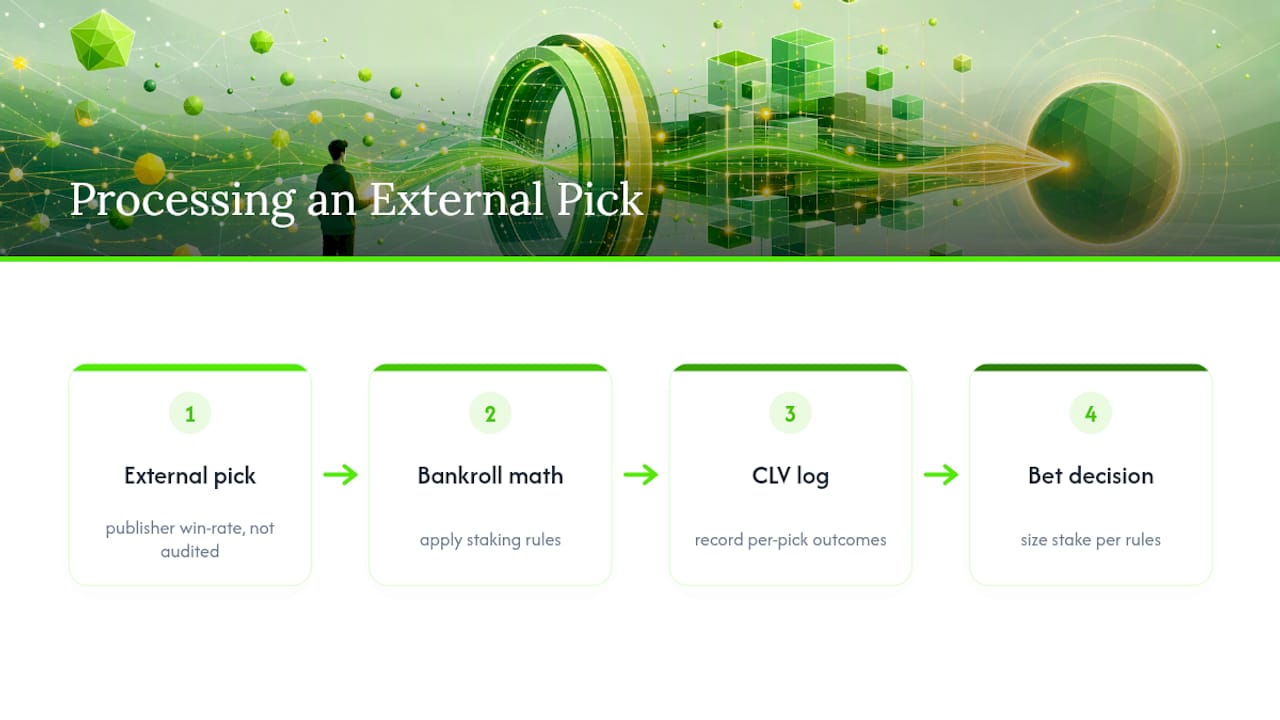
These numbers are publisher-reported track record data, not an independently audited certification, and readers should treat them the way they would treat any single input: valuable, but not a replacement for their own staking rules. Feed each pick into your own bankroll math and CLV log rather than betting blind on the win rate alone. A guide to bankroll management fundamentals covers how to size a stake around any external pick source.
A Working Bettor’s Short, Candid Checklist
Three rules I keep close: never bet a number without checking at least two books first, never raise a stake to chase a loss, and never let a hot streak convince me my process changed. I once doubled a stake after three straight losses on a “sure thing” and lost four in a row before stopping myself. Betting well is a skill you build over hundreds of decisions, not a shortcut you find once.
— Manuel
Turning These Rules Into a Working Habit
Manny’s Variety gives disciplined bettors a daily input built the way this guide describes: sport-specific AI engines, real-time simulations, and a public archive you can check against your own tracking sheet instead of taking on faith. That transparency is the practical difference between a pick source you can audit and one you just have to trust.

Treat the platform’s daily picks and live in-game picks as one input in the process outlined above, not a replacement for it. Run every pick through your own staking rule, log the closing line, and track your CLV the same way you would for a pick you generated yourself. If you want to see how the subscription tiers and daily reports fit into that workflow, the how-it-works page breaks down what subscribers receive and how to start tracking results from day one.
Sources
For deeper study, start with the Wikipedia overview of betting strategy for the math fundamentals, then the OddsShopper six-move framework for a practical workflow. If betting ever stops feeling fun or controlled, Gambling Therapy and the National Council on Problem Gambling both offer free, confidential support.
This article is general information, not a substitute for advice from a qualified financial advisor. Consult a qualified financial professional about your own circumstances before acting on anything here.
- Betting strategy — Wikipedia
- Sports Betting Strategy: The Definitive Guide to Finding Edge
- Best Sports Betting Strategy 2026: How to Win