

Stop Overpaying Half Points: Post 2015 NFL Key Numbers for Bettors
Protect 3 on spreads, respect 7, and prioritize line shopping over paying juice. Totals cluster around 41, 43, and 44, but those numbers carry far less statistical weight than 3 and 7 do on the spread side, so treat them differently when you’re deciding whether a half-point is worth the extra cost.
TL;DR:
- Buying a half-point on spreads crossing 3 or 7 offers significant value due to these margins occurring in roughly 15% and 9% of games, respectively.
- Totals cluster around 41, 43, 44, and 37, but half-point moves are less beneficial because these numbers are less predictive and occur less frequently.
- The 2015 rule change increasing missed extra points has shifted typical final margins, making margins like 2, 6, and 13 more common.
- Line shopping across multiple sportsbooks and avoiding half-points on totals generally yields better value than paying extra juice for small adjustments.
- Respect key numbers but maintain discipline by focusing on fair prices and avoiding unnecessary half-point purchases on less impactful scores.
Table of Contents
- What Are NFL Key Numbers and Why Do They Matter?
- Why Totals Cluster Differently Than Spreads
- How the 2015 PAT Rule Change Reshaped Scoring Patterns
- How to Use Key Numbers When Betting Spreads and Totals
- Worked Examples: The Real Math Behind Buying Points
- Why Manny’s Variety Trusts the Numbers Behind Every Pick
- A Blunt Take on Key-Number Discipline
- Get Model-Backed Picks Built Around These Same Key Numbers
- Where to Dig Deeper on Key Numbers
- Sources
What Are NFL Key Numbers and Why Do They Matter?
NFL key numbers are the final-margin values that show up more often than random chance would predict, and the entire buying-points and teaser market exists because of them. Football scoring runs on 3-point field goals and 7-point touchdown-plus-extra-point sequences, so final margins naturally bunch up around multiples and combinations of those two numbers.
Across 7,276 games played between 1999 and 2025, roughly 15.1% ended with a 3-point margin and about 9.0% ended with a 7-point margin. Add those together and nearly a quarter of all NFL games land on one of two numbers out of a possible range that stretches into the 40s and beyond.
Statistic Callout: 3 and 7 combine for close to 24% of all final margins since 1999. No other single-point value comes close to that concentration.
Behind those two giants sit the secondary keys: 6, 10, 4, and 14. Each reflects a common scoring combination (two field goals, a touchdown plus a field goal, a missed extra point, two touchdowns), and each still spikes above its neighbors, just less dramatically.
- 6: Two field goals or a touchdown with a missed conversion
- 10: A touchdown plus a field goal
- 4: A field goal plus a safety, or a botched two-point situation
- 14: Two unanswered touchdowns
Betting a spread that sits right on 3 or 7 means a single missed extra point, blocked kick, or garbage-time field goal can flip your ticket from a loss to a push, or a push to a win. That’s the entire reason the half-point market exists.
Why Totals Cluster Differently Than Spreads
Totals behave nothing like spreads, and treating them the same way is one of the more common mistakes bettors make.
That said, totals still cluster. Analysts consistently identify 41, 43, 44, and 37 as the most common combined-score outcomes in the modern scoring environment, with 51 showing up often enough in high-scoring stretches to matter too.
Statistic Callout: Totals key numbers are real, but they’re “weaker keys.” A push at 41 or 44 happens far less often than a push at 3 or 7 on the spread side.
- 41, 43, 44: The most frequently landed combined scores in recent seasons
- 37: A common outcome in lower-scoring, run-heavy matchups
- 51: Shows up when two offenses trade scores in shootouts
Because the probability mass at any single total number is thinner, buying a half-point on a total rarely pays for itself the way it can on a spread. You’re usually better off shopping for the best number across multiple sportsbooks than paying extra juice to move from 44 to 43.5.
How the 2015 PAT Rule Change Reshaped Scoring Patterns
The NFL moved the extra-point attempt back to the 15-yard line in 2015, and that single rule change increased miss rates on what used to be an automatic kick. More missed PATs means more games landing on margins like 2, 6, and 13 instead of the “clean” numbers of 3, 7, and 14.
Two-point conversion attempts have also crept upward as coaches chase the math on fourth-quarter decisions, nudging up the frequency of margins like 8 and 9 that used to be rare. Analysts recommend leaning on post-2015 samples specifically because pre-2015 data overstates how automatic those extra points really are in the current game.
- Post-2015 samples reflect the current PAT distance and miss rate
- Rising two-point attempts slightly inflate 8s and 9s as final margins
- A decade-plus window (roughly 2015 to present) balances sample size with relevance
How to Use Key Numbers When Betting Spreads and Totals
Buying a half-point only makes sense when the math backs it up, and that math starts with implied probability. When you buy a point that crosses 3, you’re not just nudging a number. You’re buying protection against the single most common outcome in football.
Here’s the practical workflow:
- Identify whether the number crosses 3 or 7. Moving a favorite from −3 to −2.5 turns every push at exactly 3 into a win. Moving an underdog from +3 to +3.5 turns every loss by exactly 3 into a push. That’s real, measurable value.
- Check the price you’re paying. If the book charges you an extra 20 cents of juice to move off 3, run the numbers. Given that roughly 15% of games land exactly on 3, that protection is often worth the cost. Crossing 7 is worth less because its frequency (about 9%) is lower, though still meaningful.
- Skip half-points on totals more often than not. Because totals key numbers carry less protective weight than spread keys, the same juice that’s a good deal on a spread is frequently a bad deal on a total. Line shop instead.
- Consider a Wong teaser when a game lets you cross both 3 and 7 on the same leg. This classic strategy, named for the strategy’s early advocate, buys points on favorites of around 7.5 to 8.5 down to 1.5 to 2.5, or underdogs of similar range up to 8.5 or 9.5, so the bet crosses both key numbers at once. Teasers only work when the payout math justifies it, since every leg must win.
- Build a shopping routine. Keep accounts at several books so you can compare the exact same game before deciding whether to pay for the half-point at all.
Pro Tip: Before you pay for any half-point, ask yourself whether the number you’re crossing is 3 or 7. If it’s neither, you’re probably better off pocketing the juice and shopping for a better base number instead.
Worked Examples: The Real Math Behind Buying Points
Numbers convince more than theory does, so here’s what actually happens when you move off a key number.
- Spread example, favorite at −3 vs. −2.5. If a favorite is favored by exactly 3 points about 15% of the time historically, then every one of those pushes becomes a win when you buy down to −2.5. On a $100 bet at standard juice, converting even a fraction of those pushes into wins meaningfully improves your long-run return, which is exactly why books charge extra for that half-point instead of giving it away.
- Totals example, 41 vs. 41.5. Because combined scores spread more thinly across the scoreboard, landing on exactly 41 happens far less often than landing on exactly 3 as a margin. Paying the same juice to move from 41 to 41.5 buys you protection against a thinner slice of outcomes, which is why that same half-point is a weaker buy on a total than on a spread.
- Teaser example, two-leg six-point teaser. Take a favorite at −7.5 teased down to −1.5 and an underdog at +1.5 teased up to +7.5. Both legs now cross 3 and 7. A standard two-team, six-point teaser typically pays around −120 to −130, meaning you need both legs to hit. Crossing both key numbers on each leg is what makes that structure statistically sound instead of just a coin-flip parlay.
Why Manny’s Variety Trusts the Numbers Behind Every Pick
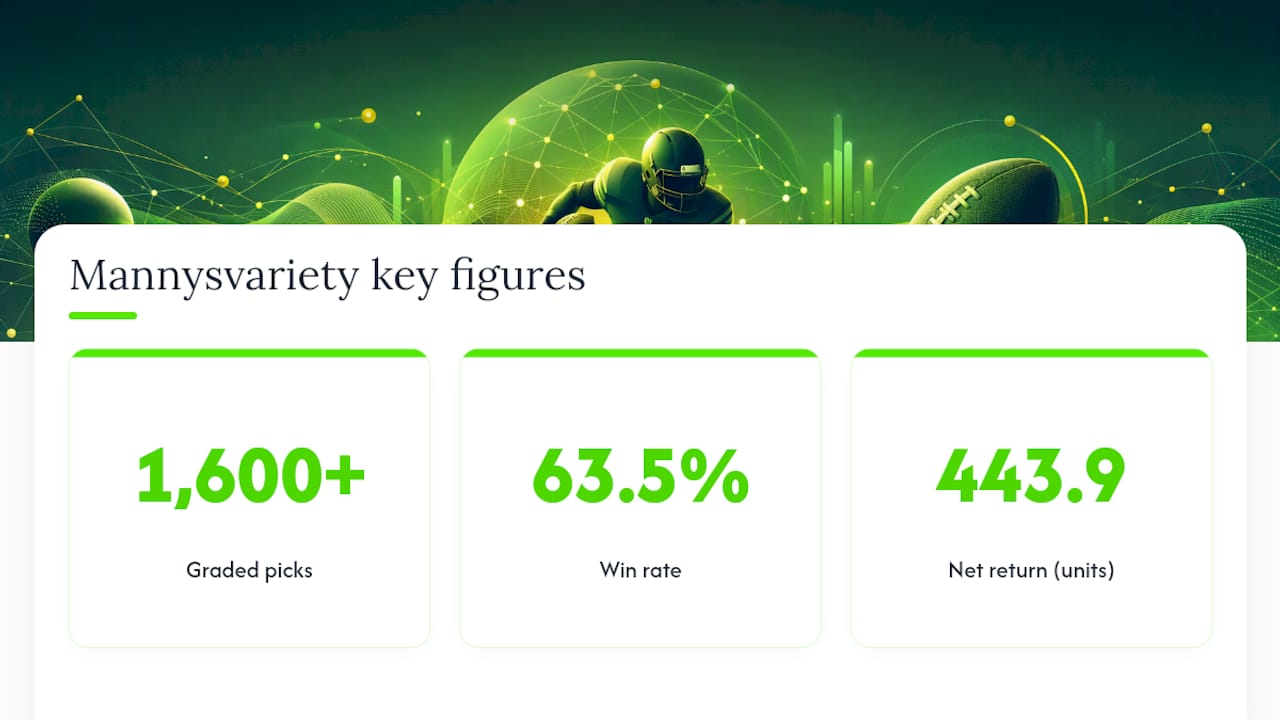
Mannysvariety has tracked more than 1,600 graded picks with a 63.5% win rate and a net return of 443.9 units. Our NFL models run thousands of simulations that account for key-number distributions directly, not just win probability. No model guarantees outcomes; every edge here is probabilistic, and responsible bankroll management still matters more than any single number.
A Blunt Take on Key-Number Discipline
Most bettors either ignore key numbers entirely or buy every half-point out of habit. Both are mistakes. Protect 3 when the price is fair, respect 7 a little less aggressively, and pass on totals half-points more often than you’d think. Pair that discipline with sane bankroll rules, and the numbers do the heavy lifting for you.
— Manuel
Get Model-Backed Picks Built Around These Same Key Numbers
Reading margin charts is one thing. Acting on them in real time, while lines are still moving, is another. Mannysvariety runs live in-game picks that react to score changes, injuries, and weather shifts as they happen, factoring key-number math into every recommendation instead of leaving it to guesswork after the fact.

Beyond live picks, daily AI-powered reports cover spreads, totals, props, and parlays with a fully public, graded track record. If you want to see how the models translate this kind of key-number analysis into actual picks, check out how the daily picks work and start your first week with real numbers in front of you instead of hunches.
Where to Dig Deeper on Key Numbers
For readers who want to keep researching before their next bet, these sources cover the frequency data, rule-change context, and teaser math referenced throughout this guide, plus player props strategy for related scoring-based markets.
- Why 3 and 7 Are the NFL’s Key Numbers
- Key Numbers in NFL Betting Explained
- NFL Over/Under Strategy: Totals Betting Guide
- Teaser Betting Strategy Guide (NFL)
Sources
- Why 3 and 7 Are the NFL’s Key Numbers | NFL Analytics
- Key numbers in NFL betting explained | Action Network
- NFL key numbers and buying points | DeucesCracked